Pillar: Land, rights and services
Can a rural home in Spain get electricity, water and drainage?

On this page
A power pole beside a rural property in Spain does not tell you what connection will cost. Before paying a deposit, establish the electricity works, lawful drinking-water source and approved route for wastewater.
Have a specific plot in mind? The report gathers the public data and official maps for it, with source and date, for €29 VAT included. Pin it on the map →
A pole by the boundary does not guarantee a cheap connection. Get written answers for the plot and the residential use you intend: the distributor’s conditions and quote, the availability of drinking water and a sewage system that can be permitted. The seller’s bills prove a supply, not that the home is lawful. On rustic land you may have to pay for the new grid extension yourself, and a septic tank that drains into the ground may need a discharge permit. If a high-voltage line crosses the plot, also check the easement strip where you cannot build.
For the outlet and records of an existing installation, see the guide to septic systems and discharge consent.
What to check before asking for a connection
Start with the town hall: can the building be used as a home, and what occupancy document applies? Planning permission and connection are separate checks (TRLSRU, article 11). A house with a meter may have unpermitted extensions, and a barn with power and water is not thereby fit to live in.
| What you see | What it means | What it does not prove | First step |
|---|---|---|---|
| A pole by the boundary | There is a network nearby. | Where the connection point is, the spare capacity or who pays. | Ask the area distributor for written conditions for your plot. |
| A meter in the house | Power was connected at some point. | Whether the supply is permanent, for works or temporary, or that the house is lawful. | Ask for the contract, the power, the CUPS and the electrical certificate. |
| A pipe along the track | Some water runs past. | Whether it is drinking water, irrigation or private. | Ask the municipal service or operator about connection, flow and cost. |
| A well on the plot | There is a catchment. | Its title, its use, its flow in the dry season or drinkable water. | Check the title and get a recent water analysis. |
The distributor runs the network; the retailer only sells the electricity (Law 24/2013, article 6). Source: BOE, Law 24/2013, article 6. Accessed 30 October 2026.
If there is no house yet, first settle what you can build on rustic land. For a house with incomplete papers, see the guide to unlicensed houses on rustic land. On the visit, have the seller point out meters, water tank and sewage on the plan: a contract for the parent property or a shared installation may not serve the piece you are buying.
Who do you ask for a power connection?
The area distributor, which runs the network. The retailer sells the electricity and sends the bill; signing up for a tariff does not deal with the connection works (Law 24/2013, article 6). Send an enquiry with the exact location, a plan and the intended use, and ask for the connection point and technical and financial conditions in writing. An installer should size the power, counting water and treatment pumps.
If there is already a supply, ask for a recent bill, the contract, the power and the CUPS (the supply point code), and ask the distributor whether it is permanent, for works or temporary. Ask too for the electrical installation certificate (boletín): low-voltage rules require technical documents, checks and an installer’s certificate before an installation is put into service (RD 842/2002, article 18). The boletín covers the wiring, not the house’s permits.
Sources: BOE, Law 24/2013, article 6; BOE, RD 842/2002, article 18. Accessed 30 October 2026.
Who pays to extend the grid?
For new supplies of up to 100 kW at low voltage or 250 kW at high voltage, the distributor builds the extension and charges extension fees only if the land was already developed and had the required services before the supply was requested (RD 1048/2013, article 25.1). Asking for little power is not enough, nor is a listing saying “developable” or the Catastro saying “urban”.
In every other case the applicant pays for the new extension, with no extension fees charged on top for it (article 25.2). On a rural plot, the line can be the deciding cost of the purchase. The distributor must provide the technical specification and the quote separately. It carries out work on its existing network; you may hire a qualified installer that meets the specification for the new extension (article 25.3). The final tie-in to the network is the distributor’s job and cost, while materials may be charged to the applicant, shown separately (article 24.4).
If the extension you pay for will serve others, it is handed over to the distributor, which runs and maintains it, and whoever paid may require a reimbursement agreement with later users lasting at least ten years (article 25.5). It does not mean getting everything back. Disputes go to the energy authority (article 25.6).
How long can a connection take?
Separate the answer from the works. The distributor has five working days to give conditions for low-voltage supplies up to 15 kW with no extension, and ten working days for other low-voltage supplies with no transformer station (RD 1955/2000, article 103.2.A). The document setting the connection fees must state how long it is valid, at least three months.
When you pay for the extension, you have six months to say who will build it; otherwise the request lapses (RD 1048/2013, article 25.4). The distributor’s build times exclude the time needed for permits, authorisations and consents (RD 1955/2000, article 103.2.B). A line across someone else’s land needs its route and rights settled; permission to drive across is not enough. See the guide to rights of way.
Sources: BOE, RD 1955/2000, article 103; BOE, RD 1048/2013, article 25.4. Accessed 30 October 2026.
Can solar panels solve the power?
Yes, if it works technically and in planning terms. Separate grid-connected self-supply from an off-grid installation. RD 244/2019 governs the first and excludes off-grid systems, which must have no physical capacity to connect to the grid, directly or indirectly; an open switch is not enough (articles 2 and 3). Self-supply without export is exempt from access and connection permits, but not from other requirements. With export, the exemption up to 15 kW depends on being on developed land with services: do not carry it over to rustic land (articles 4 and 7).
To live off-grid, have someone size the system for winter, simultaneous loads and pump start-up, with usable battery capacity, autonomy, backup and maintenance. In Andalusia, for a new isolated home not tied to an activity, the LISTA Regulations require autonomous services, preferably renewable self-supply; networks are an exception, needing sectoral authorisation and only where connection works alone are needed (Decree 550/2022, article 31.1.g). Do not apply that rule to every existing house. What permits an off-grid system needs, and why it does not legalise the house, is covered in the guide to living off-grid on a rural plot.
Sources: BOE, RD 244/2019, articles 2–4 and 7; BOJA, Decree 550/2022, article 31. Accessed 30 October 2026.
How do you prove there will be drinking water?
If there is a mains supply, ask the municipal service or operator to confirm the plot and domestic use: connection point, flow, pressure, works and cost. With a well or spring, check the title: holder, property served, use and annual volume. A right to irrigate does not cover domestic use (TRLA, article 61.2), and a concession does not guarantee the flow granted is there (article 59.2). Have a surveyor compare dry-season flow with the house’s needs.
The State regime of up to 7,000 m³ a year for use on your own land requires notice to the river basin authority and does not allow any borehole you like; in over-exploited or at-risk aquifers new works need authorisation (TRLA, article 54.2; RDPH, article 85). The Canaries have their own law. More in the guide to wells and water rights.
Lawful and drinkable are different things: get a recent analysis and ask the health authority. With tanker water, supplying drinking water by tanker for more than four months a year is exceptional and needs prior notice to the health authority for a favourable report, and the operator must be authorised (RD 3/2023, article 34). Get the favourable report: proof that notice was given is not enough.
Sources: BOE, Water Act (TRLA), articles 54, 59 and 61; BOE, Public Water Domain Regulation, article 85; BOE, RD 3/2023, article 34. Accessed 30 October 2026.
Is a septic tank enough without mains sewerage?
First ask whether there is a public sewer and whether you must connect: that discharge is authorised by the regional or local body (TRLA, article 101.2). With no sewer, find out where the effluent ends up. A tank that treats and soaks into the ground makes an indirect discharge, banned without prior permission where it may pollute (TRLA, article 100; RDPH, article 245). Happening inside your own land does not exempt it.
For domestic discharges of up to 50 population equivalent that cannot join an urban agglomeration there is a simplified declaration, decided without public consultation (RDPH, article 253 bis). It is still a permit: a form filed is not a permit granted. Population equivalent measures organic load, not residents (RDL 11/1995, article 2.f). If you propose soakaway, the authority may require a hydrogeological study (RDPH, article 246 bis.3), and if the discharge could pollute groundwater, the permit depends on that study showing it is harmless (TRLA, article 102).
Discharge permits last at most five years, renewable, and set the control charge (TRLA, article 101.1 and 101.3). Check validity, change of holder and maintenance records. With a truly sealed holding tank, ask for the emptying contract and receipts and check the truck can get in. The tank’s invoice or the equipment’s marking does not permit discharge at that spot.
Sources: BOE, Water Act (TRLA), articles 100–102; BOE, Public Water Domain Regulation, articles 245, 246 bis and 253 bis; BOE, RDL 11/1995, article 2.f. Accessed 30 October 2026.
Which water authority must answer
The water authority depends on the river basin, which may cross regional borders.
| Region | Water authority to ask | What to confirm |
|---|---|---|
| Andalusia | The regional government in internal basins; the relevant confederation in shared ones, such as the Guadalquivir. | A new isolated home not tied to an activity: autonomous services, networks only by exception. |
| Valencia | The confederation for the plot, such as the Júcar or the Segura. | Drinking water and treatment for an allowed isolated home are paid by the owner (TRLOTUP, article 211.1.b.4º). |
| Murcia | Check the basin district for the plot; the Segura is the usual one. | Ask for its discharge procedure, or for a sealed tank, how to prove there is no discharge. |
| Catalonia | The Catalan Water Agency in internal basins; the relevant confederation in shared ones, such as the Ebro. | Confirm which body handles your plot before filing. |
| Balearics | The regional water administration. | Confirm the permit for an autonomous treatment system with no sewer, even if the seller has an older declaration. |
| Canaries | The island water council (Law 12/1990, article 10). | Check title and plan under island law; do not apply the State 7,000 m³ rule directly. |
The town hall still decides planning use and the public sewer. Sources: BOE, Valencian TRLOTUP, article 211; BOE, Canary Water Law, article 10; BOJA, Decree 550/2022, article 31. Accessed 30 October 2026.
Four hypothetical scenarios
These are invented teaching examples, not real plots or any company’s quotes.
1. A line 400 metres away
Imagine a rustic plot with no power and a low-voltage line 400 m away. As the land is not developed, the buyer pays for the extension. Before the deposit: the distributor’s written conditions, the route across other land and an agreed cost ceiling.
2. A house on a builder’s meter
Imagine a house on a temporary power contract for building works. Ask the distributor what it takes to make it permanent: it may require the occupancy document the house does not have.
3. A well registered for irrigation
Imagine a well with a title to irrigate a vegetable plot. It does not cover domestic use. Have it sorted before completion or make the purchase depend on it, with a water analysis.
4. A septic tank with no papers
Imagine a tank nobody can say drains where, with no permit. If it soaks away, it is an unpermitted discharge. Have a surveyor locate it and price a system that can be permitted, and take it off the price.
When the deposit should wait
The list does not replace your lawyer or surveyor. It tells you whether you can pay now or which document is still missing.
What to write into the arras contract
Have your lawyer make the purchase depend on specific documents and a total cost ceiling you accept. If a needed discharge permit is missing, make its grant the condition: knowing how to apply is not enough. The parties may agree such terms within the law (Civil Code, article 1255); with arras penitenciales, a buyer who withdraws loses the deposit and a seller who withdraws returns it doubled (article 1454).
More in the guide to the arras contract.
The buyer’s sequence before the deposit
- Ask the town hall about residential use, the occupancy document and which works it allows for the utilities.
- Ask the distributor for the connection point and written technical and financial conditions.
- Settle the route across tracks or other land with a surveyor and a lawyer.
- Confirm the water: mains connection or well title, domestic use, flow and analysis.
- Find where the sewage goes and the permit in force, or the emptying contract.
- Agree the condition, the cost ceiling and the refund of the reservation fee or deposit.
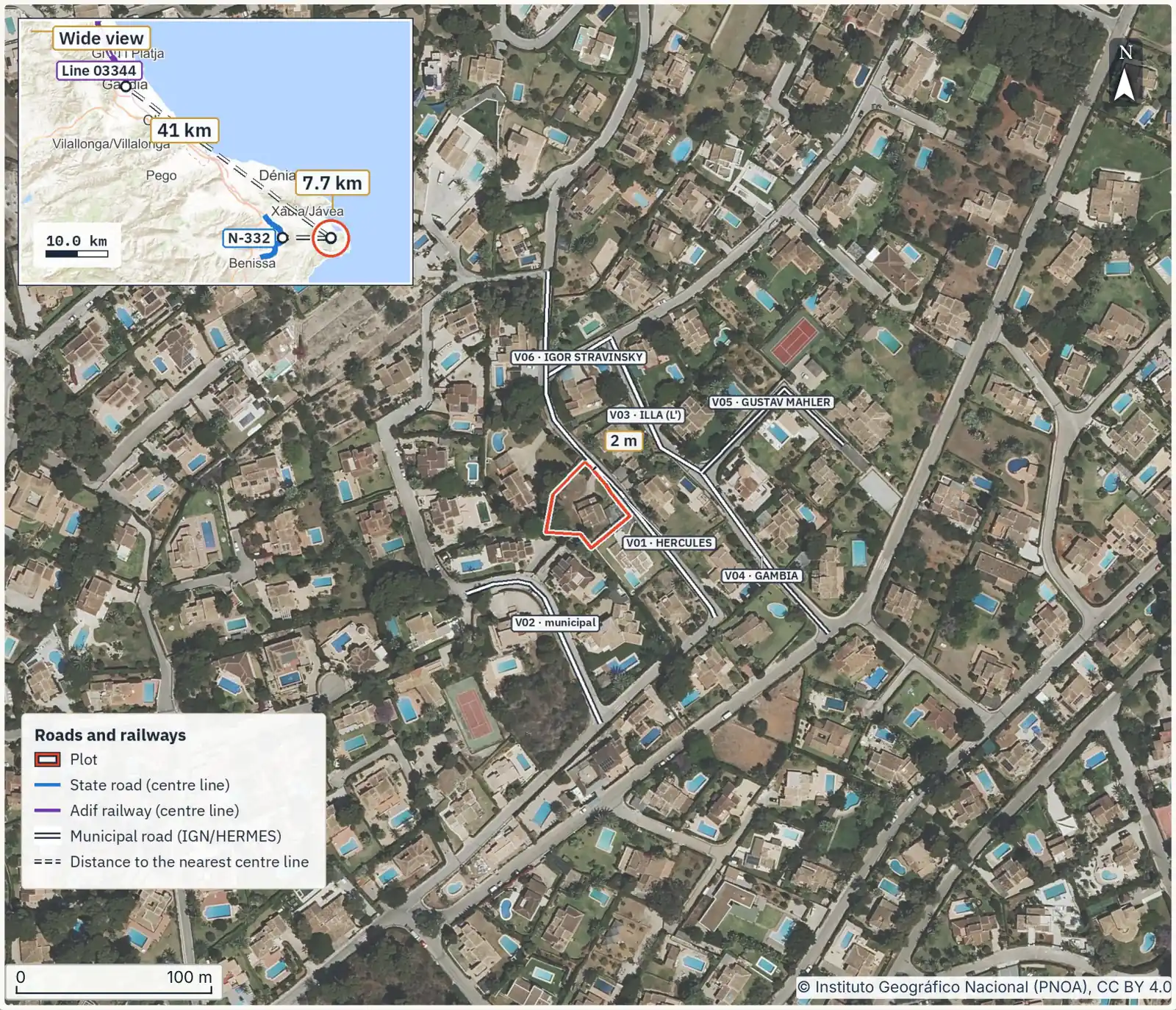
- A TerrenoCheck report shows roads, power lines and coverage around the plot, but it does not replace these documents.
Questions to send before money moves
- What power and water contracts exist, in whose name, and are they permanent?
- Is there a registered electrical certificate? What power does it cover?
- Where is the connection point the distributor proposes, and what does the extension cost?
- Does the line or pipe cross other land? Under what right?
- Where does the water come from, and under what title? Does it cover domestic use?
- Is there a recent water analysis?
- Where does the waste water go? Is there a discharge permit in force?
- What happens to each payment if the connection or permit does not arrive by the agreed date?
A cheap rustic plot with no services can stop being cheap with the first power line. Get the conditions and permits in writing and put a cost ceiling in the deposit contract.
Common questions
Must the distributor bring power because there is a pole nearby?
Proximity decides neither the connection point nor who pays. Ask for conditions for your plot. Article 25 of RD 1048/2013 requires both limited power and land already developed for the extension-fee regime to apply.
Can I choose who builds the grid extension?
When you pay for it, you can hire a qualified firm that meets the specification for the new extension. Work on the existing network is done by the distributor. Make sure the two are priced separately.
With panels and batteries, can I do without the house’s permits?
No. An off-grid system must comply with the rules, but it grants no residential use. If there is physical capacity to connect to the grid, it is not off-grid under RD 244/2019, batteries or an open switch notwithstanding.
Does a small septic tank need a discharge permit?
If it discharges directly or indirectly and may pollute, yes. The simplified route for domestic discharges of up to 50 population equivalent is still a permit. A sealed tank with no discharge must be shown to be one.
Can I live all year on tanker water with a cistern?
Do not assume so because there is a tank. Going beyond four months a year by tanker is exceptional and needs prior notice for a favourable health report (RD 3/2023, article 34). Get the report: the receipt is not enough.
Keep reading
Check this on your own plot
Pin the plot on the map and confirm the cadastral reference: the report gathers the public data and official maps for it, each with its source and date. It does not replace the land registry extract, the notary or a tax adviser. €29 VAT included.