Pillar: Land, rights and services
Does this Spanish property have legal access or need a right of way?

On this page
A drive to the front door proves that a track exists. Before buying, establish whether the property has the right to use the whole route, including the stretches across neighbouring land.
Have a specific plot in mind? The report gathers the public data and official maps for it, with source and date, for €29 VAT included. Pin it on the map →
Driving in on the viewing does not prove you will be able to after you buy. The plot needs an outlet to a public road, or a sufficient right of way over every property the access crosses, and a visible track, a key or a neighbour’s permission does not prove that. This page explains how to tell a public track from a private one, what to look for in the Land Registry, what you can claim if the land is landlocked and what to settle before you pay a reservation fee or a deposit (arras).
Permission at the public road connection is a separate check: see road access authorisation.
Reaching the plot is not a right to pass
On a viewing you see a usable track. To buy, you need to know who may use it and within what limits. It may be a public road, a strip you buy with the plot, a way over someone else’s land, or a neighbourly favour nobody ever wrote down.
A servidumbre de paso, a right of way, burdens one property for the benefit of another owner’s property. The one that benefits is the dominant plot and the one that carries the way is the servient plot (Civil Code, article 530). Check which is which: a burden that lets the neighbour cross the plot you are buying does not show that you can get out across theirs. A power line crossing a plot is a different, statutory easement with its own rules: see power line easements.
Walk the whole access to the public road. If the track leaves the plot, crosses one property and then another before reaching the municipal road, each stretch must be settled. The lawyer identifies the registered properties crossed and a surveyor places them on the ground. The cadastral reference helps locate them; it does not replace that check.
This guide explains the common Spanish Civil Code where it applies. Catalonia has its own rules, summarised below. In other regions with their own civil law, ask the lawyer to identify the applicable rules first; rights over land are governed by the law of the place where it lies (Civil Code, article 10.1).
Is the track public or private?
Being called a “camino”, being tarred or showing on a map viewer does not decide its legal nature. The Catastro, Spain’s property survey, describes properties, and its data are presumed correct unless shown otherwise, but the Land Registry’s legal findings prevail (Cadastre Law, article 3.3). A drawn line does not prove a right of way.
If the seller says the track is municipal, write to the town hall. Paths for general use whose upkeep and policing fall to the local authority are local public property; the town hall must keep an inventory of its property, and the entry for a public way must identify its limits, length and width (Local Authority Property Regulations, articles 3, 17 and 20.g). Ask for a written reply with the entry and plan, and the title or deslinde file if there is doubt. Your lawyer weighs whether the track is listed: the inventory is not a court ruling on ownership.
If it turns out to be a drove road (vía pecuaria), the question goes to the region. Drove roads are regional public domain, and their public status does not by itself allow non-farm motor traffic (Law 3/1995, articles 2 and 16). See the guide on drove roads and public paths.
If the plot is landlocked: forced passage
Article 564 of the Civil Code lets the owner of a plot enclosed by others and with no outlet to a public road require passage over the neighbouring land, after paying compensation. Being able to claim it is not the same as having a usable route. Before buying, settle who grants the right, where it runs and how it is formalised. If there is no agreement, ask the lawyer to assess a court claim before you commit money.
| Rule | What the Civil Code says | What it does not give you |
|---|---|---|
| Right to claim | A landlocked plot with no outlet to a public road can require passage over its neighbours, after paying compensation (article 564). | It does not give you a usable route today or let you open a track yourself. |
| Where the way runs | At the point least harmful to the burdened plot and, as far as that allows, the shortest route to the public road (article 565). | The shortest line next to the neighbour’s house has no automatic priority. |
| Width | Whatever the dominant plot needs (article 566). | There is no national figure; a farm-access title may not cover a home. |
| Compensation | Permanent way for all needs: land value plus damage. Farming and harvest only, no permanent way: damage only (article 564). | There is no rate per metre or share of the price in the law. |
| Landlocked by a sale or split | The seller, exchanging party or co-owner gives passage without compensation unless agreed otherwise (article 567). | It does not turn every old split into a free access already created. |
| Passage no longer needed | The burdened owner may ask to end it, returning the compensation (article 568). | It applies to forced passage, not automatically to a voluntary one. |
Being able to claim a way in is not the same as having one. Sources: BOE, Civil Code, article 564; BOE, Civil Code, article 566; BOE, Civil Code, article 568. Accessed 30 October 2026.
If there is already an outlet but it is not enough, the common Civil Code does not by itself give a right to widen it: have the lawyer assess the title. You can also negotiate a voluntary easement, which any owner may create on their land without the other plot having to be landlocked (article 594). Agree its scope and cost before you buy.
Is years of use by the neighbours enough?
Under the common Civil Code, a way that depends on people using it is a discontinuous easement (article 532). Discontinuous easements, visible or not, are acquired only by title; the twenty years of article 537 apply to continuous and visible ones (articles 537 and 539). A track used for decades does not become a right that way.
Ask what “we have always gone through” means. There may be an old title, an acknowledgement or only tolerance. If the title is missing, article 540 allows it to be replaced by a deed of acknowledgement from the servient owner or by a final court judgment. Have the seller sort it out before taking an unconditional deposit.
There is a different case: a visible sign of an easement set up by someone who owned both plots counts as title when one of them is sold, unless the sale deed says otherwise or the sign is removed before the deed (article 541). That means checking where the plots came from and the transfer document; a photo of the track does not prove every requirement.
What to look for in the Registry and the deed
Ask for the nota simple, the Land Registry extract, of the plot you are buying and of those crossed, giving your reason, and read the full deed creating the easement with its plan. For the burden to bind third parties it must appear on the entry of the plot that carries it (Mortgage Law, article 13), so searching only your future plot is not enough.
| What you find | What it means | What it does not prove | First step |
|---|---|---|---|
| Easement on the burdened plot’s entry | It binds later buyers of that plot (Mortgage Law, article 13). | That the route on the ground or the use you need matches the title. | Read the full deed and its plan. |
| Easement noted only on your plot | It may appear as a quality of the dominant plot (article 13). | That the burdened plot’s entry carries it. | Ask for the nota simple of every plot crossed. |
| Older mortgage on the burdened plot | Enforcing it cancels later charges, the easement included (article 134). | That the easement will survive a repossession. | Have the lawyer check the ranking and how to protect it. |
| Nothing in the Registry | Unregistered titles do not harm third parties (article 32). | That no easement ever existed. | Study the title, visible signs and what the buyer knew. |
| Registered but unused for years | Under the common Civil Code, 20 years’ non-use can end an easement (article 546.2). | That the way can still be used today. | Check current use on the ground. |
The nota simple is for information; against third parties, a Registry certificate counts (Mortgage Law, articles 222.5 and 225). Sources: BOE, Mortgage Law, article 13; BOE, Mortgage Law, article 32; BOE, Mortgage Law, article 134; BOE, Civil Code, article 546. Accessed 30 October 2026.
Check that the document identifies the dominant plot, the route and the burdened plots, and compare the permitted use with the one you need: on foot, by vehicle, farming or residential. Check gates, keys and upkeep. If you plan to lay pipes or cables, get a right that covers that work: the title governs (article 598), and the word “passage” does not include it on its own. A general mention of a “track to the north” does not describe a right of access either.
Cars, works and upkeep
Give the surveyor the title and the location. Have them check narrow points, slope, drainage, the entrance and turning room for the vehicles you expect. A right that is enough on paper can cross ground that needs work, and the neighbour’s agreement does not replace permits the town hall or other authorities require.
Read the title’s obligations first: it may put the works on the servient owner, who can then free themselves by handing their plot to the dominant owner (article 599). Unless the title says otherwise, the dominant owner may carry out at their own cost the works needed to use and keep the way, without changing it or making it more burdensome, choosing the time and manner that cause least nuisance (article 543). If several plots benefit, they share costs in proportion to their benefit, and the servient owner also pays if they use the way, unless agreed otherwise (article 544).
The servient owner may not impair the way. If it becomes very inconvenient or blocks important works or improvements, they can move it at their own cost to another place that is just as convenient and harms nobody entitled to use it (article 545). If you find a chain across it, record what happened and talk to the lawyer; do not remove it yourself. If you are the one planning a fence, the guide to fencing rustic land explains which permit it needs.
Carrying materials or putting up scaffolding to build or repair must be allowed, against compensation for the harm (article 569), but that is not permanent access. Check the junction with the road separately: on State roads the Ministry can limit access points, adjoining properties on ordinary roads reach them only through service roads save exceptions, and an access whose use changes can have its authorisation changed or suspended (Law 37/2015, article 36). And having a way in does not let you build: every building act needs its administrative approval (Land Law, article 11.3); see the guide on rustic and urban land.
Sources: BOE, Roads Law 37/2015, article 36; BOE, Land and Urban Renewal Law, article 11. Accessed 30 October 2026.
What changes in Catalonia
The Catalan Civil Code allows a claim for passage when there is no outlet to a public road or the outlet is insufficient, and puts first the point least harmful or inconvenient to the burdened land and, where compatible, the most useful to the dominant plot (article 566-7). The other differences matter when you read old titles.
| Question | Common Civil Code | Catalan Civil Code |
|---|---|---|
| When you can claim passage | No outlet to a public road (article 564). | No outlet or an insufficient one, with width and features for normal use of the plot (article 566-7). |
| Compensation | Land value plus damage, or damage only (article 564). | Loss in value of the burdened plot plus damage, reduced if the neighbour also benefits (article 566-10). |
| Acquired by long use | Passage is discontinuous: title needed, never 20 years’ use (articles 537 and 539). | No easement is acquired by long use (article 566-2.4). |
| Visible sign set by one owner | Counts as title when one plot is sold, unless excluded (article 541). | Survives the sale only if stated expressly in it (article 566-3.2). |
| Non-use | 20 years (article 546.2). | 10 years, except an easement over one’s own plot (article 566-11.1.a). |
Read old titles with these differences in mind. Sources: BOE, Catalan Civil Code, book five; BOE, Civil Code, article 564. Accessed 30 October 2026.
Article 566-10.4 removes compensation when the plot lost its outlet through a sale or division of the original property made by whoever would be entitled to claim it. Have the requirements checked rather than applying the common Civil Code formula.
Four hypothetical scenarios
These are invented examples to show the method, not real plots or readings from any map viewer.
1. A country house reached across two plots
Imagine a house reached by a track over two neighbouring plots. The seller’s deed mentions an easement, but only over the first. The owner of the second never granted one. The access is only half there: before the deposit, the second owner must create the way by deed, or the purchase must depend on it.
2. A registered way under an older mortgage
Imagine a properly registered easement over the neighbour’s plot, which carries an older mortgage. If the bank enforces, the sale cancels later charges, and the way with them. The lawyer must work out how to protect it before you pay.
3. A farm-access title for a renovated home
Imagine a 1960 title granting passage “for farm work” along a three-metre path. You want to renovate the house and bring in lorries. An easement’s width is whatever the dominant plot needs, but the title sets what it covers. Negotiate a written extension with the neighbour before you count on that access.
4. Landlocked after an inheritance split
Imagine a plot left without an outlet when an estate was divided among siblings. Article 567 requires the co-heir to give passage without compensation, unless agreed otherwise. The way still has to be defined and formalised: get it into a deed before you buy.
When to hold the deposit
The list does not replace a lawyer. It tells you whether you can pay now or whether a specific document is still missing.
What to write into the arras contract
Ask your lawyer for an express condition. Identify the plots and the route on an attached plan, the use you need, the deed and registration agreed and a deadline. If access depends on works or on sorting out the ranking against earlier mortgages, include those outcomes. Agree full repayment if the condition fails, within [number] days, and how an extension is agreed: these are negotiated terms, not legal deadlines. Parties may agree any terms that do not break the law, morals or public order (article 1255), but they only bind those who sign: the repayment agreement must also bind whoever takes the reservation fee or commission.
Do not confuse that agreed repayment with withdrawing under arras penitenciales: a buyer who withdraws loses the payment and a seller who withdraws pays back double (article 1454). More in the guide on the arras contract.
Steps before the deposit
- Mark the whole route from the house to the public road on a plan.
- Identify each plot crossed by its cadastral reference and Registry details.
- Ask for the nota simple of your plot and of each plot crossed.
- Read the deed creating the easement, with its plan, its use and its upkeep obligations.
- If the track is said to be municipal, ask the town hall for the inventory entry.
- Have the lawyer check earlier mortgages on the servient plots.
- Have the surveyor check the real route, width, vehicles and the works needed.
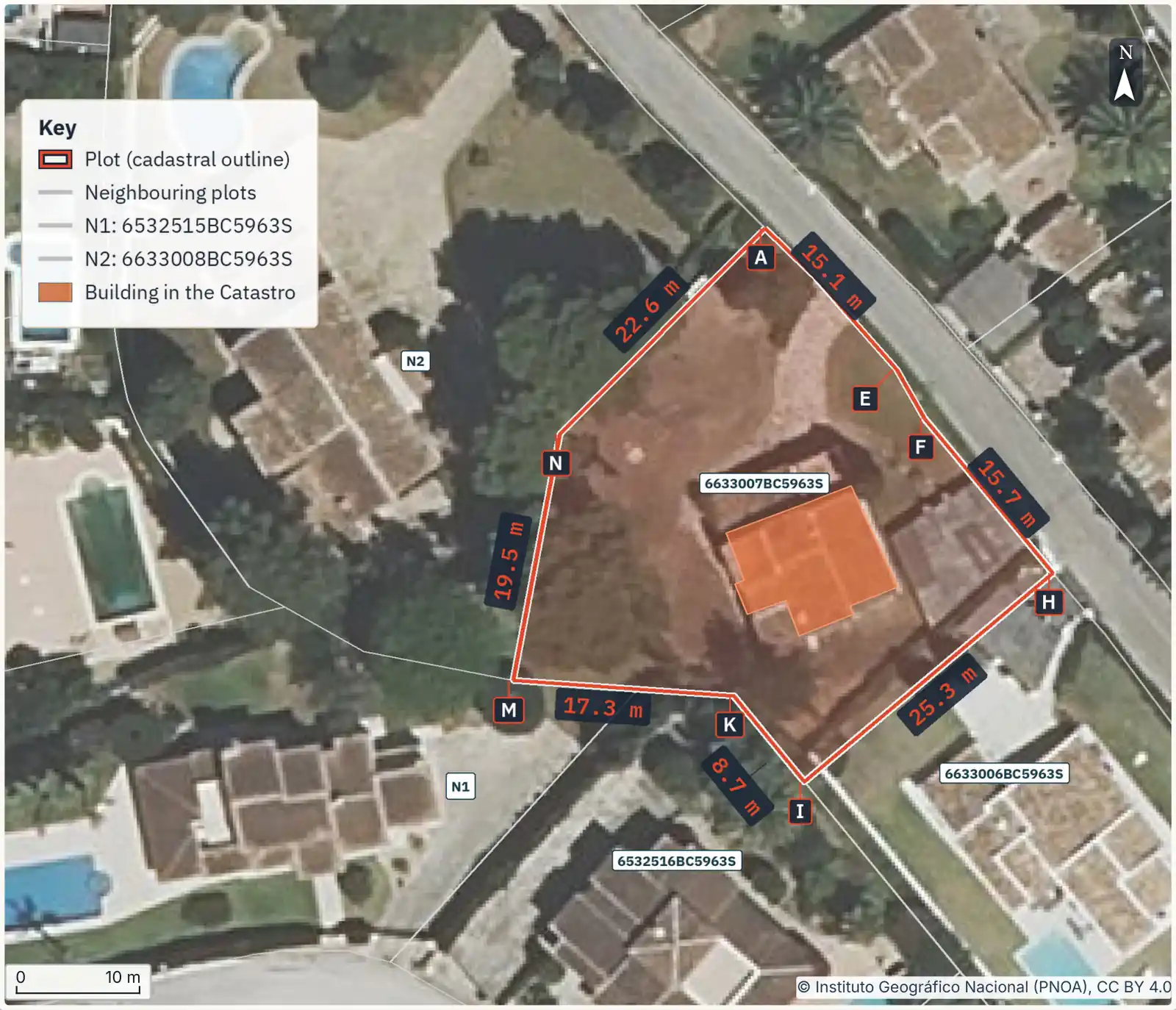
- Only then set the price. A TerrenoCheck report marks the plot’s sides that run along mapped tracks, but it does not replace these documents or your lawyer.
Questions to send before you pay
- Which plots does the access cross on its way to the public road?
- What title allows passage over each one? Is it registered on the servient plot?
- What use does it cover: on foot, vehicles, farming, residential, works?
- What width and route does the title set? Do they match the track on the ground?
- Are there mortgages older than the easement on the plots crossed?
- If the track is public, which authority owns it and which entry proves it?
- Who pays for upkeep and works on the way?
- Is there any dispute, closure or claim with the neighbours?
- What happens to each payment if access is not proven by the agreed date?
Access to a plot is bought with documents, not on the viewing. With the title, the extracts for the plots crossed and the surveyor’s plan you will know whether the house you like has a real way in.
Common questions
Can I demand access if my plot has no outlet to a public road?
Article 564 of the Civil Code allows a claim if its conditions are met, after compensation unless an exception applies. The route and scope still have to be defined; it does not let you open a track yourself. In Catalonia an insufficient outlet also counts (article 566-7).
Is a right of way acquired by twenty years of use?
Not under the common Civil Code: passage is a discontinuous easement and is acquired only by title, even if the track is visible. Check whether there is a title or a case like article 541. In Catalonia no easement is acquired by long use.
What is the minimum width of a right of way?
Article 566 requires whatever the dominant plot needs, with no general figure. Check the title and have the planned use checked on the ground. The access the planning rules require before approving works is a separate check.
Can an easement exist if my nota simple does not show it?
Yes. Check the burdened plot’s extract and the deed that creates the easement too. To bind third parties the burden must appear on the plot that carries it (Mortgage Law, article 13); the effect of a missing entry needs legal advice.
Can the neighbour put a gate across the track?
They may not impair an existing easement (article 545). Whether a given gate is compatible depends on the title and how it affects passage: keys, vehicles and other circumstances. Record the obstacle and take advice before acting.
Does the report check legal access?
Not fully. It marks the plot’s sides that run along streets or tracks on the IGN map and measures each side. It does not read deeds, registered easements or the municipal inventory, so it does not prove you may use that track.
Keep reading
Check this on your own plot
Pin the plot on the map and confirm the cadastral reference: the report gathers the public data and official maps for it, each with its source and date. It does not replace the land registry extract, the notary or a tax adviser. €29 VAT included.