Pillar: Planning and buildings
Buying an illegal house on rustic land in Spain: what are the risks?

On this page
A cheap finca may come with a demolition order or a house that is merely tolerated. Before paying a deposit, find out what you can keep, renovate and connect to utilities.
Have a specific plot in mind? The report gathers the public data and official maps for it, with source and date, for €29 VAT included. Pin it on the map →
A cheap rustic plot with a house may hide a pending demolition order or a home the authorities only tolerate. Being old, on the Catastro or connected to the grid does not make a house lawful. This page sets out what to check before you pay a reservation fee or a deposit (arras): whether demolition can still be ordered, which document covers the house and each addition, which works and connections would be allowed and what to agree so you get your money back if something fails.
For preparing an application, see the legalisation procedure.
Where proceedings exist, check the new owner’s responsibilities.
First: what is the house’s status?
There are four different situations, and listings rarely say which one applies. A lawful or legalisable house fits the plan or a special route. A house whose enforcement period has run out is still unlawful but can no longer be demolished, and few works are allowed on it. A house the authorities can still act against puts the price directly at risk. And works registered by age are an entry in the Land Registry, not a permit.
| House status | What it means | What it does not prove | First step |
|---|---|---|---|
| Lawful or legalisable | It fits the plan, or a special route applies such as the Balearic extraordinary legalisation. | That the house you saw is the one licensed, with the same floor area and use. | Ask for the licence, or make it a condition of the deposit. |
| Time to act has run out, but not lawful | The house is tolerated and works are limited (AFO in Andalusia; the regime varies by region). | That works, extensions or connections will be allowed. | Written confirmation of the status and of the works and supplies allowed. |
| Can still be demolished | The period has not run, an exception applies or an order is pending. | Nothing in the buyer’s favour: price and plans are at risk. | Do not pay; your lawyer reviews the file. |
| Registered by age | The Registry holds the works because demolition can no longer be ordered (TRLSRU, article 28.4). | That the house is legal or that it may be extended. | Ask the Registry for any marginal note on its planning status. |
An old house is not a lawful house for that reason. Sources: BOE, Andalusian LISTA, articles 153 and 174; BOE, State Land Act (TRLSRU), article 28.4. Accessed 30 October 2026.
Ask the town hall to confirm in writing whether it can still order demolition and which renovations and connections it could authorise. If the seller cannot prove when the house was finished, or nobody has answered that in writing, wait.
When does an unlicensed building on rustic land become safe from demolition?
Spain has no single period. The region, the class of land, the proven completion date and any action already started all matter. Several regions have land with no period at all: the authorities can act at any time. How the limit for a fine differs from the limit for ordering demolition, and what interrupts each, is explained in the guide to planning-offence time limits.
| Region | General period | No period, among others | Basis |
|---|---|---|---|
| Andalusia | 6 years from full completion, or from when the works became visible | Public domain and its easements, rustic land at certain risk while it lasts, the coastal zone of influence, catalogued heritage, green areas | LISTA, article 153 |
| Valencia | Rustic land: the law in force when the works were finished | All non-developable land under today’s law, green areas, public domain, catalogued heritage | TRLOTUP, article 255 |
| Balearics | 8 years from full completion; whoever claims the date proves it | Land that was protected rustic when built, catalogued assets, parks, open spaces, public facilities | LUIB, article 196 |
| Canaries | 4 years from full completion | Protected rustic land already classed when works began, public domain and its zones, heritage, green areas | LSENPC, article 361 |
| Catalonia | 6 years from the breach or completion | Public open spaces, roads, and land that is or must be non-developable (article 32.a) | TRLU, article 207 |
| Galicia | 6 years from full completion | Green areas, open spaces, roads, the 4 m setback in article 92.1, public facilities | LSG, articles 153 and 155 |
| Murcia | The law does not say when restoration lapses | General systems, green areas, roads, specially protected natural areas | LOTURM, article 294 |
Periods run from the proven completion of each piece of work, and every extension has its own. Sources: BOE, Canary LSENPC; BOE, Catalan TRLU; BOE, Galician Land Act; BOE, Murcian LOTURM. Accessed 30 October 2026.
Every extension, pool or annexe has its own date and its own period. What each region requires for a pool on rustic land, and the fines it sets, is covered in the guide to pools on rustic land. In Andalusia, where rustic land was illegally parcelled up, the 6-year period can only cover the specific plot the house stands on, not the rest of the parcelling (LISTA, article 153.2.f). See also the guides to flood zones and the Coastal Law, since that land is often outside any period.
A demolition order has its own deadline
The end of the period for opening a file does not erase an order already made. What follows applies to administrative orders; a court judgment is enforced through the court.
- Andalusia: 5 years from the end of the voluntary compliance period, interrupted by steps taken by the person bound or by the authorities (LISTA, article 154.5).
- Canaries: 10 years from when the order became enforceable, if the works were finished when it was made; no limit on the land in article 361.5 (LSENPC, article 361.2.c).
- Catalonia: 6 years, except on land where the action never lapses either (TRLU, article 207.2 and 207.3).
- Elsewhere: it depends on regional law.
Sources: BOE, Andalusian LISTA, article 154.5; BOE, Canary LSENPC, article 361; BOE, Catalan TRLU, article 207. Accessed 30 October 2026.
Have your lawyer review the specific order, its dates and every notification before you pay.
How to prove the age of the house and its additions
The evidence must identify this house and each extension and give a specific completion date. To register works by age, State law accepts these documents (TRLSRU, article 28.4.a):
- A certificate from the town hall or a qualified professional.
- A notarial record describing the property.
- A descriptive and graphic cadastral certificate.
Each must state completion on a given date and a description matching the title deed. Have a surveyor compare the documents with the house you saw and with old aerial photos. In the Balearics whoever claims the date must prove it, and an unlicensed use or change of use is continuous: its period starts only when it stops (LUIB, article 196.3 and 196.4).
Andalusia: what a house with an AFO allows
AFO (asimilado a fuera de ordenación, treated as outside the plan) is the status of a building finished without a licence, or in breach of one, once the period to act against it has run out: as a rule, 6 years from full completion (LISTA, articles 153.1 and 173.1). The house is still not lawful. The decision has no effect on other proceedings or on what the courts decide (article 174.1).
If the agent says the house “can get its AFO”, ask for the town hall’s recognition decision. An application is not one. The town hall has six months to decide and, if it does not, the application counts as refused (article 173.2). Nor will it recognise an AFO while it can still act against the house, if the house lacks minimum safety and health conditions, or on land at definite risk of erosion, landslides or flooding until the required measures are taken (article 173.4).
Works that fit the plan can be legalised at any time (article 152.8). If a file was closed because the period had run, ask for the decision saying so: it is evidence, but it does not replace AFO recognition (article 152.7). Recognition is noted in the Land Registry and shows the building is fit for use, not that any activity carried on in it is authorised (article 174.4 and 174.6).
On rustic land in the coastal zone of influence the LISTA sets no period, so a house finished since it came into force on 23 December 2021 cannot obtain an AFO. If the house was finished earlier, the period in force at completion applies (Decree 550/2022, article 354.5): your lawyer must check whether that period had already run. Source: BOJA, Decree 550/2022, consolidated text. Accessed 30 October 2026.
Valencia: can it still be demolished?
Today’s law sets no period on non-developable land, but the period in the law in force when the works were finished applies (TRLOTUP, article 255.5 and 255.6). By completion date:
- 1 February 2006 to 19 August 2014: 4 years, except on protected non-developable land, green areas, roads, public domain and listed heritage (Law 16/2005, article 224).
- 20 August 2014 to 7 February 2019: 15 years (Law 5/2014, article 236). A house from that period can receive a demolition order until at least August 2029.
- From 8 February 2019: no period on any non-developable land. Without a licence, do not pay a deposit.
Sources: BOE, Valencian TRLOTUP, article 255; BOE, Valencian Law 16/2005, article 224; BOE, Valencian Law 5/2014, article 236. Accessed 30 October 2026.
If the period has run, demolition can no longer be ordered, but the unlawful parts still cannot be renovated, extended or consolidated, except for safety, health and appearance works the authorities order (article 256). Have your surveyor separate what is lawful from what is not, and ask the town hall for the enforcement file.
Isolated buildings on non-developable land finished before Law 19/1975, with no licence for their location, are treated as licensed if they keep their use and type and are not in legal ruin (DT 26ª). Minimización de impacto territorial (impact reduction) only legalises buildings completely finished before 20 August 2014 (article 228.3). The plan can mark out a cluster of at least three homes per hectare, or fewer if they are close together (article 228.2). An isolated house needs an individual declaration by the full council and then a licence backed by a landscape study, a risk analysis and a project for the works (article 230). The step-by-step route, the role of the Valencian Agency for the Protection of the Territory and the PATRICOVA maps are in the Valencian non-developable land guide.
Balearics: the extraordinary legalisation
It can only be requested when the authorities can no longer order restoration, demolition included (Law 7/2024, DA 7ª.1, an additional provision). Before you pay, your lawyer must answer two questions: can demolition still be ordered? Does the house meet the conditions of this route?
The general period to act is 8 years from completion, with no period for land that was protected rustic when built, catalogued assets, parks, open spaces and public infrastructure or facilities (LUIB, article 196). For the extraordinary legalisation the classification and rules at completion apply, or later, more favourable ones; on protected rustic land the works must also predate their express ban on that land (DA 7ª.1.a and 1.b). A changed use can only be legalised if action against it has also lapsed; uses begun before 29 May 2014 count from when they started (DA 7ª.1.c).
| Island | Island agreement published in the BOIB | Three years end |
|---|---|---|
| Mallorca | 15 February 2025 | 15 February 2028 |
| Menorca | 25 March 2025 | 25 March 2028, a Saturday: it moves to the next working day |
| Ibiza | 3 April 2025 | 3 April 2028 |
| Formentera | 18 June 2026 | 18 June 2029 |
The period runs from publication of the agreement (DA 7ª.9); if the last day is not a working day it moves to the next one (Law 39/2015, article 30.5). File early. Sources: BOIB 21/2025 (Mallorca); BOIB 37/2025 (Menorca); BOIB 41/2025 (Eivissa); BOIB 76/2026 (Formentera). Accessed 30 October 2026.
What legalising by this route costs (DA 7ª.3 and 7ª.4):
- Levy: 10% if applied for in the first year of the procedure, 12.5% in the second and 15% in the third, on the construction cost of what is legalised, valued at the application date. Ask the town hall how it counts the years on your island.
- Reduction: 50% for Spanish income-tax payers whose average total taxable base over the last four years is no more than €33,000 (€52,800 joint) and 25% up to €52,800 (€84,480 joint). A non-resident outside Spanish income tax may not qualify.
- On top: taxes, fees, the project, a waste-water treatment system that fits the Balearic Water Plan and any measures set by the town council. Failing them means refusal (DA 7ª.8).
- The whole property: the application covers every irregular work and use on the same holding; anything that can still be ordered restored is demolished (DA 7ª.2).
For example, if building what is legalised would cost €100,000 today in construction cost, at 12.5% the levy is €12,500 before any reduction. The base is not the purchase price.
Excluded, among others, are preferential flow zones and other flood zones, public-domain land and whatever the town council has excluded (DA 7ª.5). A licence for a home must ban its use as a holiday let, and that condition is entered in the Land Registry within three months (DA 7ª.8), except for homes lawfully let to tourists before 29 May 2024 while their permit lasts (DT 4ª). The property cannot be split while the activity continues, unless it exceeds the minimum area and is first released from the link (DA 7ª.7). In Formentera the island agreement limits the route to residential use, farming and the activities in annex IV of its island plan.
Sources: BOE, Balearic Law 7/2024, DA 7ª and DT 4ª; BOE, Balearic LUIB, article 196. Accessed 30 October 2026.
Canaries, Catalonia, Galicia and Murcia
Canaries. Once the 4 years have passed the house is outside the plan, but still not lawful (LSENPC, article 361.4). For a use in a lawful building or one outside the plan, the period runs from its first visible, verifiable sign (article 361.1.d); if a store is now used as a home, ask for its status in writing. Repairs for habitability and appearance and works for the established use are allowed, without extra volume or height (article 362). The rest of the Canarian regime is in the guide to rustic land in the Canary Islands.
Catalonia. On public open spaces, roads or land the plan classes, or must class, as non-developable under article 32.a, neither the action nor the order ever lapses (TRLU, article 207.3). Elsewhere, 6 years from the breach or completion, or from the annulment of an unlawful licence.
Galicia. Six years after completion without measures, the works fall under the article 90 regime (LSG, article 153.2). A later extension without a permit does not restart the period for the original house, but has its own file (article 153.1). Ask the town hall and the Agency for the Protection of Planning Legality, which handles green areas, roads and public facilities (article 155.1), for the file.
Murcia. Do not confuse the fine with demolition. The 4 years (serious and very serious breaches) or 8 years (general systems, green areas, roads and specially protected natural areas) are limitation periods for the offence. On that protected land the power to require restoration never lapses (LOTURM, article 294.1 and 294.2). Ask your lawyer which period protects the house, if any.
Sources: BOE, Canary LSENPC, articles 361–362; BOE, Catalan TRLU, article 207; BOE, Galician LSG, articles 153 and 155; BOE, Murcian LOTURM, article 294. Accessed 30 October 2026.
Is registering by age the same as legalising?
No. Registering works by age (obra nueva por antigüedad) is only possible once demolition can no longer be ordered. The registrar checks that no enforcement file is noted and that the land is not public domain, and tells the town hall about the entry (TRLSRU, article 28.4.a and 28.4.b). If it was registered without a town hall certificate, the town hall must enter a marginal note stating the works’ planning status and its limits (article 28.4.c). Ask the Registry for that note before you pay. The deed itself, its requirements and its cost are covered in the guide to the declaration of new build by age.
The deed of sale must state the planning status where buildings are outside the plan. If it does not, the buyer can rescind within four years and claim damages (TRLSRU, article 27.2.a and 27.3). Your lawyer must confirm whether a specific AFO decision falls under that rule.
Power, water and works in an unlicensed house
In Andalusia, without AFO recognition the house cannot be connected to basic services or have any works done, except those the town hall orders for safety and health (LISTA, article 173.3). Afterwards connections can be allowed if only the works to hook up to existing networks are needed, and the companies require the decision before signing a contract (article 174.3). In the Balearics, an unlicensed building that can no longer be demolished only allows repairs for health, safety or hygiene and, if built after 1 March 1987, cannot contract power, gas, water or sewerage (LUIB, article 129.2.b); the extraordinary legalisation licence is enough to sign those contracts (Law 7/2024, DA 7ª.11).
If the house already has power or water, ask the seller and the company under what authorisation it was connected. More in the guide to power, water and sewerage on rustic land.
Sources: BOE, Andalusian LISTA, articles 173–174; BOE, Balearic LUIB, article 129. Accessed 30 October 2026.
Four hypothetical scenarios
These are invented teaching examples, not real houses or the outcome of any file.
1. A house with an AFO and a later pool
Imagine an Andalusian house with a 2019 AFO decision describing 90 m² of living space. The pool and a porch were added in 2022. The decision does not cover them, and each addition has its own 6-year period, which has not run yet. Before the deposit: a surveyor comparing the decision with what is built, and a price based on the house without the additions.
2. A Valencian house from 2016 that is “time-barred”
Imagine a house on ordinary non-developable land finished in 2016 without a licence. Works finished in that period have 15 years: a demolition order remains possible until 2031. The seller saying it is “more than ten years old” does not protect it. Do not pay.
3. A Balearic application still pending
Imagine a house on ordinary rustic land in Mallorca with an extraordinary legalisation application filed and not yet decided. The town hall has six months and silence means refusal. Before the deposit: a copy of the application, a costing of the levy, the treatment plant and the council’s measures, and a condition letting you withdraw with a full refund if the licence does not arrive by the agreed date.
4. A house registered by age with a marginal note
Imagine a nota simple showing the works registered by age and a town hall marginal note declaring them outside the plan. The entry does not allow extending or rebuilding. Ask the town hall which works that regime allows and value the house as it stands.
When the deposit should wait
The list does not replace your lawyer. It tells you whether you can pay now or which document is still missing.
What to write into the arras contract
Hire your own lawyer. On buying you take on the planning duties attached to the property (TRLSRU, article 27.1), so find out which are outstanding and what they cost. Agree which document the purchase depends on, who obtains it and by when, and who pays for legalisation, works, any demolition or connections.
Check which kind of arras the contract uses. With arras penitenciales, agreed expressly, either party may withdraw: the buyer loses the deposit or the seller returns it doubled (Civil Code, article 1454). Otherwise, a party harmed by a breach can demand performance or termination with damages (article 1124). Either way, agree in writing a full refund if a check or an authorisation fails.
The town hall’s six months to decide an AFO or a Balearic legalisation start with the application and can be suspended (Law 39/2015, article 22). Set your own refund date in the arras that also allows for preparing the application. More in the guide to the arras contract.
The buyer’s sequence before the deposit
- Get the cadastral reference, the nota simple and the exact registry details: check whether you are buying a property of its own or an undivided share of a larger one.
- Ask the seller for the licences, legalisation or AFO decision for the house and every addition.
- Have a surveyor compare those papers with the house, pool, porch and annexes you saw, and date each one.
- Ask the town hall, and the regional or island authority, for open and closed enforcement files and unexecuted orders on the property.
- Ask the town hall for the land class and category, any restrictions and whether it can still order demolition.
- Confirm which works would be allowed and whether the companies can connect; with no mains, where the water comes from and how waste water is treated.
- Have your lawyer review deadlines, criminal proceedings or judgments and the arras condition; in Andalusia the AFO decision must mention criminal proceedings (LISTA, article 173.2).
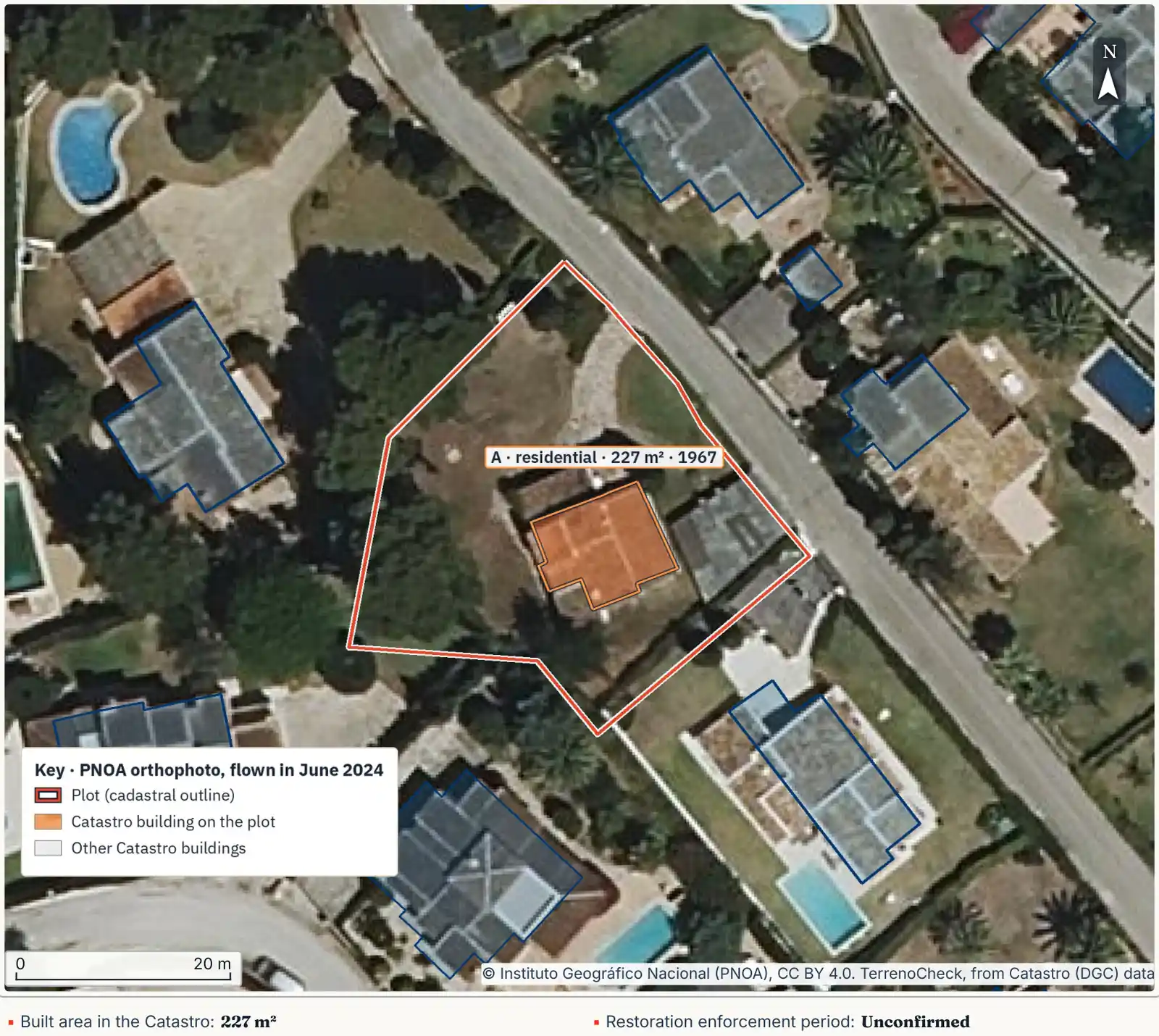
- Only then compare the price with what you can really do with the house. A TerrenoCheck report sets out what the Catastro and aerial photos show, but it does not replace these documents or your lawyer.
Questions to send before money moves
- Which licence, legalisation or decision covers the house? Does it cover today’s floor area and residential use?
- When was the house finished, and each addition? On what document?
- Are there open or closed enforcement files, or unexecuted demolition orders?
- Can the authorities still act against the house or any part of it?
- Is the land in a category with no period: protected, flood-prone, coastal, public domain?
- Which works would be allowed: renovation, consolidation, extension?
- Under what authorisation were power and water connected? Can they be contracted in my name?
- Is there a marginal note in the Land Registry about the planning status?
- Am I buying a registered property of its own or a share of a larger one?
- What happens to each payment if a document does not arrive by the agreed date?
A cheap country house is only a bargain if you know what you can do with it. Keep the licence or decision, the date of each part and the town hall’s written answer together, and let your surveyor and lawyer confirm whether the price makes sense.
Common questions
Does AFO recognition make the house lawful?
No. It recognises that the period to act against the house has run out and has no effect on other proceedings or on what the courts decide (LISTA, article 174.1). Afterwards renovation and consolidation are possible with a licence, without extra footprint or volume.
When can a house on rustic land no longer be demolished?
When the applicable period has really run out, no exception applies and no earlier file or order is pending. The period depends on the region, the class of land and the law in force when each piece of work was finished.
Can I extend a house with an AFO in Andalusia?
As a rule, no. With a licence you can renovate and consolidate it without extra footprint or volume, except ancillary elements a sectoral rule requires (LISTA, article 174.7).
How long does an AFO take, and what if the town hall does not answer?
The town hall has six months to decide; if it does not, the application counts as refused (LISTA, article 173.2). Budget for the technical work, the municipal fee set by the tax bylaw, any safety and health works required and, separately, the connections.
Can I let to tourists a home legalised by the Balearic extraordinary route?
Generally, no: the licence must ban it and the condition is entered in the Land Registry (Law 7/2024, DA 7ª.8). The exception covers homes lawfully let to tourists before 29 May 2024 while their permit lasts (DT 4ª).
Keep reading
Check this on your own plot
Pin the plot on the map and confirm the cadastral reference: the report gathers the public data and official maps for it, each with its source and date. It does not replace the land registry extract, the notary or a tax adviser. €29 VAT included.