Pillar: Documents and contract
How can an arras contract protect your deposit in Spain?

On this page
Your first reservation payment may commit you before the notarial deed. Decide what must be checked, who holds the money and whether the seller can withdraw by returning twice your deposit.
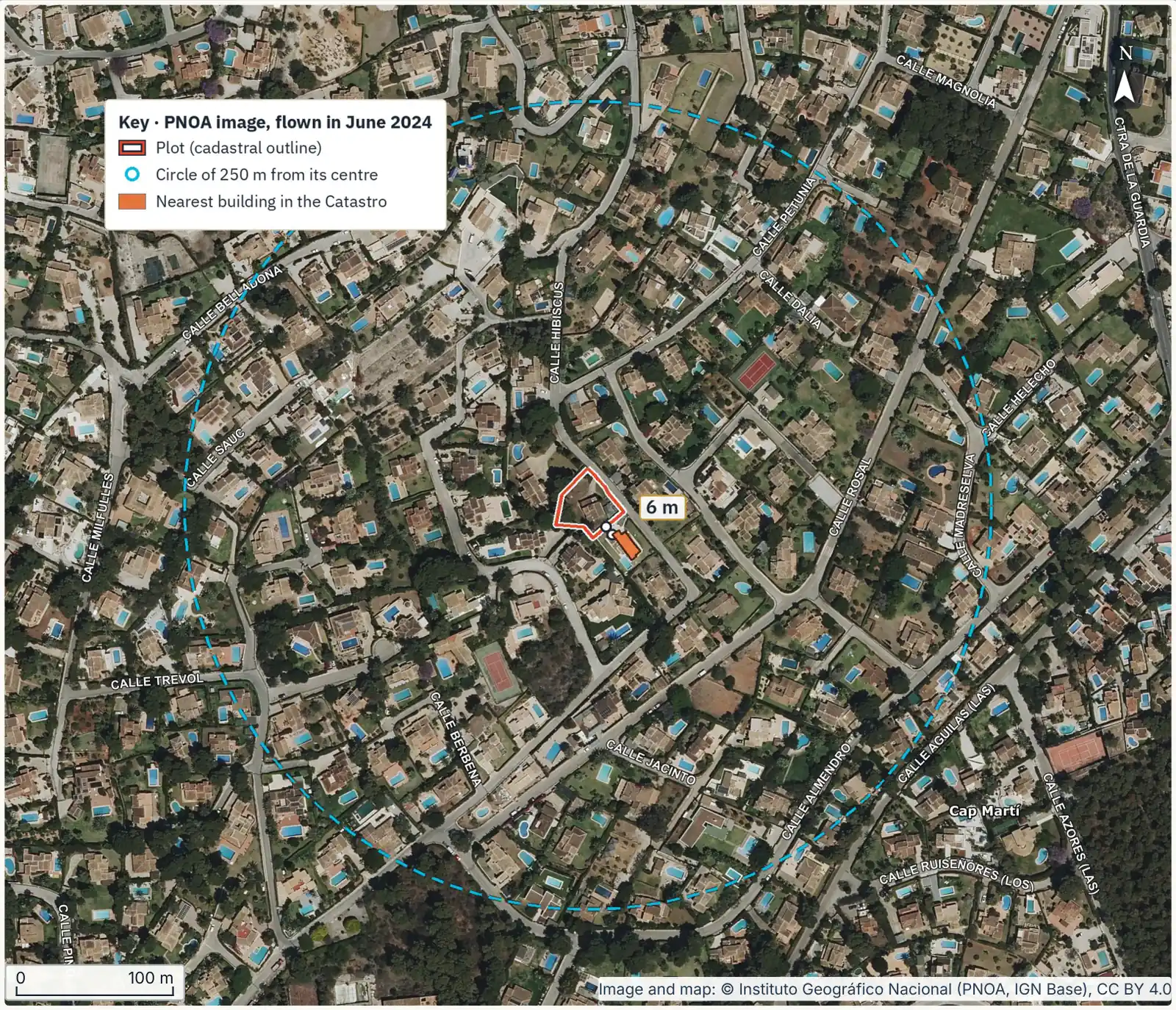
Have a specific plot in mind? The report gathers the public data and official maps for it, with source and date, for €29 VAT included. Pin it on the map →
A reservation or a deposit can bind you before you ever reach the notary. This page explains which kind of arras you are signing, how much to pay and to whom, how to agree a refund if the mortgage or a check fails, and what to write into the contract before any money moves.
If you intend to build, consider a purchase conditional on a licence.
Reservation, deposit and arras are not the same
Do not trust the heading. A “reserva” may be an offer awaiting acceptance, an agreement to take the listing down or a document that already commits you to buy. A “señal” describes a payment but not whether you can get it back. The content decides: under the common Civil Code, a sale binds both sides once they agree on the property and the price, even if neither has been handed over (article 1450).
Preliminary arras are not compulsory; the parties can go straight to the deed. A valid private document binds you without a notary (article 1278). That is why the review happens before the reservation, even if the agency says the “real” contract comes later.
If the owner still has to accept your offer, set a date and say what happens to the money if they refuse or do not reply. Ask for any agency service charged separately to be identified: do not assume that fee is part of the price or comes back with the deposit.
Confirmatory, penitential and penalty arras
These are the effects under the common civil law. Where a regional civil law applies, your lawyer checks its rules; the Catalan case is below.
| Type | What it means | What it does not do | First step |
|---|---|---|---|
| Confirmatory | The money proves the deal and is paid on account of the price. | It gives no one a right to withdraw. A breach can lead to performance or termination with damages (article 1124). | Check that the contract does not also call them penitential. |
| Penitential | Either side may withdraw: the buyer loses the arras, the seller returns double (article 1454). | Double is the total repaid, including the sum received. It is not a refund for a failed mortgage. | Write how and until when each side may withdraw. |
| Penalty | An agreed sanction for breach that, as a rule, replaces damages (article 1152). | Paying it does not release anyone from buying or selling unless that right was expressly reserved (article 1153). | Name the event that triggers it and the amount. |
| Reservation or “on account” | A payment whose effect depends on what the document says. | The word alone does not tell you whether you can get the money back. | Ask your lawyer to classify it before you pay. |
Effects under the common Civil Code; where another civil law applies, your lawyer checks its rules. Sources: BOE, Civil Code, article 1124; BOE, Civil Code, articles 1152 and 1153; BOE, Civil Code, article 1454. Accessed 30 October 2026.
Writing “arras” or “on account” is not enough. If you want a penitential right, spell out its effects for both sides and how it is used. A clause that allows withdrawal and another that demands the purchase in every case must be fixed before signing. Also agree until when each side may withdraw: if the deed date is extended, say whether that period moves too, because they are not necessarily the same date.
How much to pay and how it is credited
Article 1454 sets no compulsory percentage and no general period until the deed. Negotiate the amount by the risk you can bear and what has already been checked. What the agency calls “usual” is not a legal requirement.
The document should separate the total price, the reservation already paid, the new payment and the balance. Say which sums count towards the price and which work as arras. If the reservation becomes part of the arras, say so expressly; avoid receipts that seem to ask for it twice.
Identify the account holder and in what capacity they receive the money. An agency advertising the property does not prove it can bind the owner or receive money for them: no one contracts in another’s name without authority, and selling needs an express mandate (articles 1259 and 1713). Ask for proof and a receipt that matches the contract.
The property, the documents and the occupants
Your lawyer checks the seller’s identity and title against a recent nota simple. It reports the plot, the owners and the registered limitations, but does not certify the entries (Mortgage Law, article 222.5). To buy the whole property, check the signatures or authority of every owner. If the contract requires proof of charges for a third party, a Registry certificate is what counts; the guide to nota simple, certificate and simple copy explains which to order.
Include the registry property number, the cadastral reference and an attached plan. Say whether you buy the whole plot, a share or a portion still to be split off, and describe the buildings and rights included. For a rural house, ask for the permits for what is built; for land, a written town hall answer on your project. Have your surveyor check access, water and area differences.
Ask who lives in the house or farms the land and get the contracts. The buyer of a let home may take over the landlord’s position (Urban Leases Act, article 14), and so may the buyer of let farmland, where the tenant also has pre-emption rights (Rural Leases Act, article 22). If you need it vacant, agree that state of handover, how it is proved and what happens to the deposit if it is not met.
A private promise does not let you build: every building act needs its own authorisation (TRLSRU, article 11.3), and the sale does not remove planning duties, which pass to the buyer (article 27.1). Before accepting “suitable for a house”, read the guide to rustic and urban land.
Refunds if the mortgage or a check fails
Keep the cases apart: a condition that is not met, a buyer who changes their mind and a seller in breach are different, and each needs its own consequence. Article 1454 gives no automatic refund because a bank refuses the mortgage.
If you depend on a loan, state the amount and the lender or lenders you will apply to. Say what happens if the offer falls short, the valuation is low or the bank does not answer and, if it matters, the maximum cost of the loan. Agree due diligence in the application, documentary proof and a notice date. Telling the agency you need a mortgage does not replace that condition.
For checks, name the result: a town hall report on a specific house, an identified permit or proof of the agreed access. A favourable planning report is not the building licence; if you need the licence, do not write a condition that ends with the report.
| What happens | What decides the money | Note |
|---|---|---|
| The bank refuses the mortgage | Nothing, under article 1454 alone: you need a financing condition. | Catalonia: article 621-49 may let you withdraw if its conditions are met. |
| The town hall answer is negative or missing | What the condition says; without one, the arras rules apply. | Write what a conditional or late answer means. |
| You change your mind | With penitential arras you lose them; with confirmatory arras you may owe more. | Check whether a withdrawal period was agreed. |
| The seller gets a better offer | Penitential: double back. Confirmatory: you may claim performance or terminate with damages. | Ask your lawyer about protective measures at once. |
| A date passes | Not automatically a withdrawal: what each party still owes and any formal demand count (article 1100). | Sign extensions before the deadline. |
Identify which case you are in before arguing about the amount. Sources: BOE, Civil Code, article 1100; BOE, Civil Code, article 1454; BOE, Catalan Civil Code, book six, articles 621-8 and 621-49. Accessed 30 October 2026.
Dates, extensions and notices
Separate the delivery of documents, the check of conditions and the signing of the deed. Add how the parties are called, the notary, the final payment and the handover. If charges are to be cancelled, say which, how it is proved and who handles it.
Agree who may ask for an extension, why and until when, and sign it before the deadline. A missed date is not always a withdrawal: in mutual obligations, neither side is in default while the other does not perform or offer to perform (article 1100).
Leaving the money in escrow
You can negotiate for a third party to hold the money under rules for release or refund. Paying it into the agency’s account does not prove such custody exists or stop the owner receiving it before the checks.
A notary may accept money on deposit, but doing so is voluntary and they may set conditions, except for deposits required by law (Notarial Regulations, article 216). Ask first whether the office will take it, the cost and which document proves the right to withdraw the funds. Buyer, seller and holder must accept compatible instructions, including for a dispute.
Source: BOE, Notarial Regulations, article 216. Accessed 30 October 2026.
Holding the deposit does not provide the extra sum the seller would owe if they withdraw. Ask how that amount would be claimed.
If Catalan civil law applies
In Catalonia, confirm with your lawyer which law governs the contract. Under the Catalan Civil Code, money handed over is presumed to be confirmatory arras, and penitential arras must be agreed expressly (article 621-8.1 and 2).
Article 621-49 lets the buyer withdraw, unless agreed otherwise, if the contract provides for financing all or part of the price by a credit institution and the buyer proves in writing, within the agreed period, that the named lender refused the loan or refused to let the buyer take over the mortgage, provided this was not the buyer’s negligence. The seller returns the price received and, where relevant, the penitential arras; the buyer must put the seller back where they would have been without the contract.
Penitential arras agreed for up to six months and deposited with a notary can be recorded in the Land Registry, and the property then secures their return. That charge ends, among other cases, sixty days after the agreed period, unless the buyer’s claim was noted earlier (article 621-8.3).
Source: BOE, Catalan Civil Code, book six, articles 621-8 and 621-49. Accessed 30 October 2026.
If the seller backs out
Ask for their position in writing and keep the contract, annexes, payments and messages. Show that you were ready to perform. Before accepting a transfer as full settlement, let your lawyer work out what is due: with penitential arras validly used, double; with confirmatory arras, a better offer gives the seller no way out by paying, and you may claim performance or terminate with damages; with penalty arras, the agreed sanction.
Claiming performance does not by itself reserve the property: rights acquired by third parties can limit the remedy (article 1124). If you buy as a consumer from a business, a clause that keeps what you paid if you withdraw, without an equivalent payment if the business withdraws, is unfair (consumer law, article 87.2).
Sources: BOE, Civil Code, article 1124; BOE, Consumer Protection Act, article 87. Accessed 30 October 2026.
Four hypothetical scenarios
These are invented teaching examples, not real purchases.
1. A €3,000 “non-refundable” reservation
Imagine the agency asks for €3,000 to take the listing down, with a receipt that does not name the owner. You do not know whether the money reaches the seller or whether you are already bound to buy. Before paying: who receives it and with what authority, what you are buying and when it comes back.
2. Penitential arras and a refused mortgage
Imagine €20,000 of penitential arras with no financing condition, and a bank that refuses the loan. Under the common Civil Code, if you do not buy you lose the arras. A condition with amount, lender, deadline and full refund would have kept that case apart from a simple withdrawal.
3. The seller gets a better offer
Imagine confirmatory arras and a seller offering to hand the deposit back because someone else pays more. With confirmatory arras that exit does not exist: your lawyer weighs claiming performance or terminating with damages, and whether to seek measures before the property is sold to someone else.
4. A licence that arrives too late
Imagine a condition requiring a “favourable planning report” by a date. The report arrives, favourable, but the licence is refused later. The condition was met. If what you need is the licence, the condition must name the licence.
When the deposit should wait
The list does not replace your lawyer. It tells you whether you can pay now or which document is missing.
What to write into the arras contract
Have your lawyer draft the text. Identify the parties and who receives the money, the property by cadastral reference, registry details and a plan, and the type of arras with its effects for both sides. Separate price, reservation, arras and balance.
For each open point, use a structure like this and adapt it with your lawyer: “Completion of the purchase of [property and plan] is subject to [objective result and the document that proves it] by [date]. [Party] will carry out [steps] and the other will provide [documents and access]. If [defined refusal] occurs or [document] is not obtained in time, the buyer may cancel the purchase by [notice and period], and [person] will repay [payments] in full by [date], with no loss of arras in this case.” The agreement with the agency must deal separately with refunding its fees.
The buyer’s sequence before the deposit
- Ask for the full reservation and arras draft, with annexes, before transferring anything.
- Get a recent nota simple, the seller’s title and the authority of whoever signs or receives money.
- Identify the property by cadastral reference, registry details and plan, and compare it with the visit.
- Ask the town hall for a written answer on the use and works the purchase depends on.
- Ask about occupants and leases and get the contracts.
- If you need a loan, talk to the bank before committing to a date.
- Agree with your lawyer the type of arras, the conditions, the dates and who holds the money.
- Only then pay, against a receipt that matches the contract. A TerrenoCheck report organises the public checks on the plot, but it does not review the contract.
Questions to send before money moves
- Who owns the property and who is authorised to sign and receive money?
- Is the document an offer, a reservation or already a sale?
- Which type of arras is it, and what happens if each side withdraws?
- Until what date may each side withdraw?
- Which part of the payment counts towards the price?
- What does the agency charge separately, and when is it refunded?
- Which refund conditions cover the mortgage, the licence or a pending document?
- Who holds the money until the deed, and on what instructions?
- Are there occupants or leases? Under which contract?
- What happens to each payment if a date passes with no answer?
An arras contract is useful if it says what happens to your money in each case you worry about. Read it with your lawyer before you pay, not after.
Common questions
Do I have to sign an arras contract before buying?
No. You can go straight to the deed. What you should not do is treat a reservation as harmless: a valid private document can bind you before you reach the notary.
Do I always lose the deposit if the bank refuses the mortgage?
It depends on the contract and the governing law. Negotiate a financing condition. If Catalan law applies, check the requirements of article 621-49 and any clause excluding it; the bank’s refusal alone does not settle every case.
Must the seller always pay back double?
No. Double applies to a valid penitential withdrawal, and it can be agreed as a penalty for breach. A refund condition can provide for the payment to come back with no penalty. First identify which case you are in.
Does paying the estate agency protect the money like a notarial deposit?
Not just by paying it in. Check who receives it, on whose behalf and with what authority. Conditional custody needs rules accepted by the holder and the parties; a notarial deposit needs the notary to accept it.
Can I insist on the house if the seller gets a better offer?
With confirmatory arras you can consider a claim for performance after a breach. With penitential arras that let the seller withdraw, validly used, you cannot force the sale for that reason. The wording and the facts decide.
Keep reading
Check this on your own plot
Pin the plot on the map and confirm the cadastral reference: the report gathers the public data and official maps for it, each with its source and date. It does not replace the land registry extract, the notary or a tax adviser. €29 VAT included.