Pillar: Land, rights and services
Can I use the well water on a property I buy in Spain?

On this page
A working well does not prove a right to use its water. Check the water-use entitlement, permitted land and uses, aquifer restrictions and transfer procedure before committing to the purchase.
Have a specific plot in mind? The report gathers the public data and official maps for it, with source and date, for €29 VAT included. Pin it on the map →
A well that gives water does not prove you may use it. Groundwater is part of Spain’s public water domain, with the exceptions the law sets, and buying the land does not give you free use of the aquifer. This page explains which title a well needs, what the 7,000 m³ a year rule allows, what to look for in the Water Register, how aquifer restrictions bite and how the holder changes, so you know before you pay a reservation fee or a deposit (arras).
For a property with private drainage, also check the septic system and its outlet.
What shows the well has a right to draw water
A working pump shows water comes out that day. The deed may describe the well, but you need to know under what title water is drawn, for what use and how much. The Water Law (texto refundido de la Ley de Aguas) allows only two routes to a private right of use: by law or by administrative concession. It is never acquired by long use: “we have always irrigated” is not a title (article 52). There are also historic private-water rights, with their own documents.
Have your lawyer match the documents to the physical well. A file for another plot, an undecided application or a permit for works alone does not show the extraction right you need. If the seller cannot identify the file, ask for authority to consult it with the water authority before you value the land as if it had legal water.
What the 7,000 m³ a year rule allows
Article 54.2 of the Water Law allows water from springs on an estate to be used there, and its groundwater to be drawn, when the total annual volume does not exceed 7,000 m³, on the conditions set by regulation. It is a regime with conditions, not a free allowance for any land.
| Small use by law (article 54.2) | Concession | |
|---|---|---|
| Volume | Up to 7,000 m³ a year in total for the estate, however many wells (Regulations, article 87.1). | Whatever the concession grants; over 7,000 m³ you apply for the whole volume, not only the excess. |
| Where the water is used | Only on the estate where it rises; never on another property (article 84.3). | On the land and for the use named in the title (Water Law, article 61.2). |
| Paperwork | Notice to the basin authority with proof of ownership, flow, volumes, use and works; the authority checks and enters it, or refuses (articles 85 and 88). | Application and decision; the State deadline to decide is 18 months (Water Law, DA 6ª). |
| Register section | Section B of the Water Register (article 189.3.b). | Section A (article 189.3.a). |
| After you buy | Notify the change of holder as if it were a new use (article 85.3). | Apply to register the transfer within three months of the sale (article 146.1). |
A private right to use the water is never acquired by long use (Water Law, article 52.2). Sources: BOE, Water Law, article 52; BOE, Water Public Domain Regulations, article 85; BOE, Water Public Domain Regulations, article 87; BOE, Water Public Domain Regulations, article 146. Accessed 30 October 2026.
All extraction points on the estate are added together: a second well does not double the volume. The user must show the amount fits the use, without abuse or waste (Regulations, article 87.1). The word “estate” (predio) matters if you are buying part of a farm: give the authority a plan of the portion, the cadastral references and the existing title. Do not assume each cadastral reference brings its own right or that splitting the land multiplies the water.
Is a notice to the authority enough?
Under this regime the planned use must be notified to the river basin authority (organismo de cuenca) with proof of ownership. The notice gives the maximum instantaneous flow, the maximum annual and monthly volumes, the purpose, the municipality and the works (Regulations, article 85). For groundwater it adds the cadastral certificate for each plot of the estate with the works and irrigable area, and the position of the wells (article 87.3).
The authority checks the documents and whether the works and flows are technically suitable. If it agrees, it says so and enters the use in the register; if not, it states the problem and prohibits the extraction (article 88). A filing receipt is not the approval or the register entry. Before buying, ask for the outcome of the file.
For an existing well, also ask for the drilling and pump permits and the completion documents, and compare them with what was built. Check with the water authority, the town hall and the industry or mining office as the case requires: a Water Register certificate does not by itself prove all those permits. Opening wells and installing extraction equipment without a concession or authorisation is an infringement, and the landowner, the promoter, the contractor and the supervising engineer are all liable (Water Law, article 116.3.h). Source: BOE, Water Law, article 116. Accessed 30 October 2026.
What to check in the concession and the Water Register
Every private use outside article 54 needs a concession (Water Law, article 59.1). Read its conditions and term: a concession does not guarantee the granted flow is available (article 59.2) and does not replace other licences (article 59.8). Check too whether extraction has stopped: three consecutive years of interruption attributable to the holder allow the right to be declared lapsed, whatever its title (article 66.2). It is not automatic; ask whether a file is open.
The Water Register (Registro de Aguas) is public and issues certificates. It has three sections, and each tells you something different.
| What you find | What it is | What it does not prove | First step |
|---|---|---|---|
| Section A | Concessions and other legal titles (article 189.3.a). | That the granted flow is physically there: the title does not guarantee it (Water Law, article 59.2). | Read the conditions, term and any caducity file. |
| Section B | Small uses up to 7,000 m³ within the estate (article 189.3.b). | That the use can grow, move to other land or survive a suspension on the aquifer. | Check the estate, volume and use against what you are buying. |
| Section C | Temporary private-water uses from before 1986 (article 189.3.c). | That a concession is already granted: there is a preferential right to one. | Ask for the historic title; the term ends on 31 December 2035. |
| A filing receipt | A notice or application was lodged. | That the authority approved or entered it. | Ask for the decision and the current certificate. |
| Nothing on record | No entry is found for the well. | That water may be drawn: drilling and pumping without title is an infringement. | Ask the basin authority about the file before you value the water. |
The Water Register is not the Land Registry. Sources: BOE, Water Public Domain Regulations, article 189; BOE, Water Law, DT 3ª; BOE, Water Law, article 116. Accessed 30 October 2026.
If you are told of old private water, ask for the historic title. Temporary private-water uses from wells or springs entered in the register keep their regime for fifty years from 1 January 1986, that is until 31 December 2035, with a preferential right to obtain the concession (Water Law, DT 2ª and 3ª; Regulations, article 189.4). Increasing the flows or changing the conditions needs a concession for the whole use, and changing the depth, diameter or position of the well counts as a change, as does changing the use or the irrigated area (DT 3ª bis.1). Granting the concession ends the earlier private right (DT 3ª bis.6). Check this before you budget for reviving an old well.
If the aquifer is declared at risk
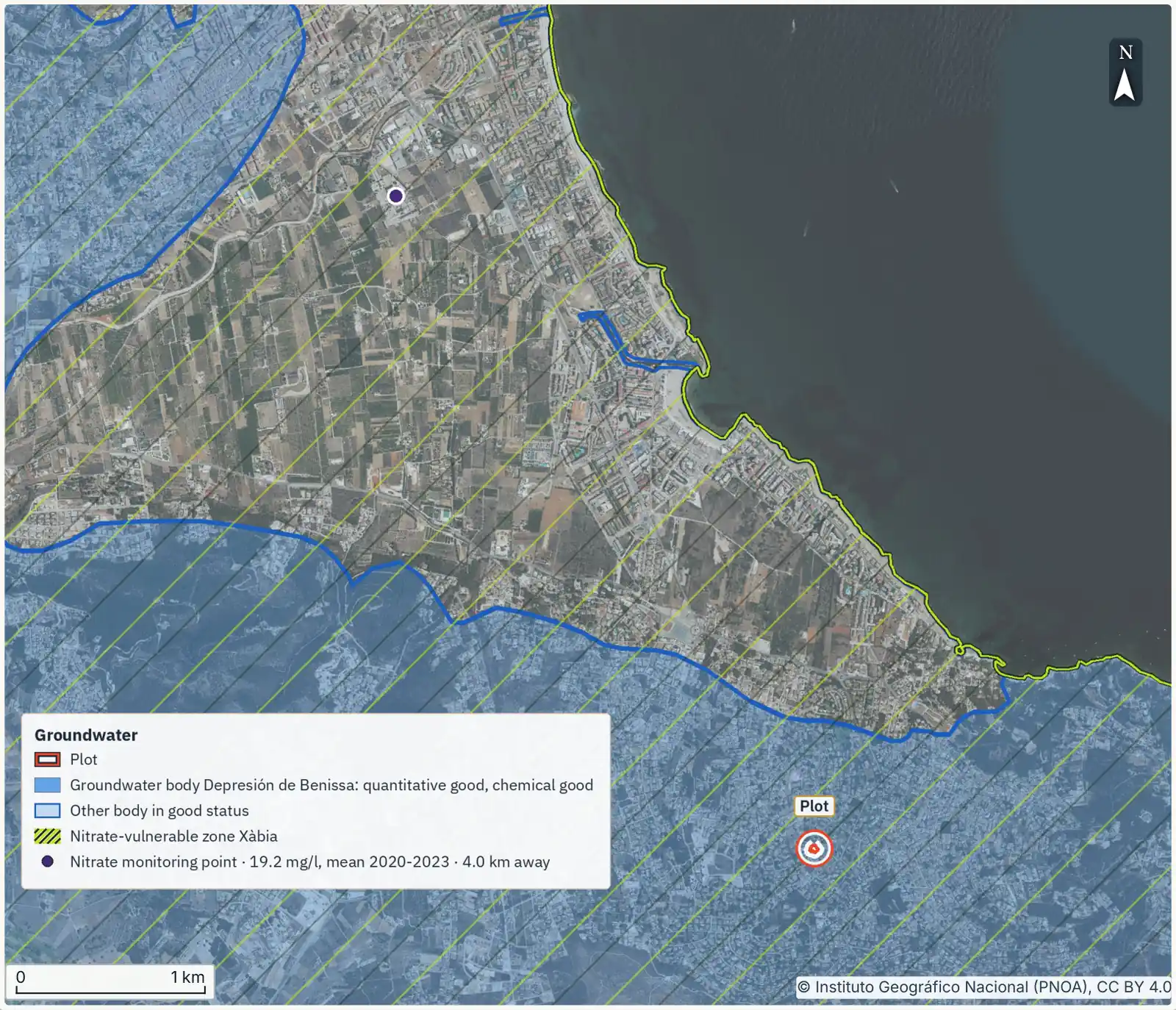
Ask which groundwater body lies under the plot and whether it has a risk declaration, interim measures or an action programme. The status on a map helps locate the problem but does not contain every legal restriction on the use.
Declaring a groundwater body at risk of not reaching good status can bring interim measures: temporary limits on volumes already granted, a halt to concession files and a temporary suspension of new article 54.2 rights (Regulations, article 171.5). The action programme can replace individual wells with shared ones and set areas with no new concessions (Water Law, article 56.2). A seller cannot promise you can always sink another small well if the current one fails.
Ask what volume you may use today, for what and on what conditions, and ask for meter readings and the consumption history. The ceiling in the title is not a guaranteed yearly supply.
Does an irrigation right cover the house?
Do not assume so. Granted water is tied to the uses in the title and, for irrigation, cannot be applied to other land (Water Law, article 61.2). Any change to its features needs prior authorisation (article 64). Say whether you need water for crops, the house or both, and check each use against the file.
If an irrigation community (comunidad de regantes) supplies the water, the title may be collective. Ask it to confirm in writing the plots and area included, the source, the turns or allowances and current restrictions, with its bylaws, charges and pending works. If the irrigated farm comes with a farmer working it, check their lease and the SIGPAC record too, using the guide to buying a farm with a tenant.
If the water comes from a neighbour, check their title and the plots it may supply. A private supply deal does not show the well can serve the plot you are buying. Your lawyer reviews the rights over the well, pump and pipe, access for repairs, and who pays for power, breakdowns and replacements.
Which authority to ask
In basins that cross regional borders the State basin authority (confederación hidrográfica) decides; internal basins may be run by the region. Send coordinates and a plan as well as the cadastral reference.
| Region | What to check |
|---|---|
| Andalusia | Within the Junta’s basins there is a notice for uses up to 7,000 m³ and a procedure to change an entry. Check first whether the well falls to the Junta or to a State basin authority. |
| Valencia region | Find the well in the right basin district: the Júcar and the Segura both cover Valencian land. Do not choose the procedure by province alone. |
| Murcia | Check the basin district. The Segura publishes its own article 54.2 authorisation besides concessions. |
| Catalonia | In the internal basins the ACA lists the procedure up to 7,000 m³ a year and requires a concession above it or when the water is used outside the estate. |
| Balearic Islands | A concession is also needed for a flow above 1 litre per second or for use outside the estate. |
| Canary Islands | Their own Water Law and an island water council on each island. Do not carry over the national 7,000 m³ notice; ask the council about the title and island register. |
Who decides depends on the river basin, not only on the region. Sources: Junta de Andalucía, water procedures; Confederación del Segura; ACA; Govern de les Illes Balears; BOE, Canary Islands Water Law 12/1990. Accessed 30 October 2026.
Will there be enough water, fit for the house?
The legal check and the technical check answer different questions. An engineer looks at the borehole, pump and tank, the operating history and what is known of the well in the dry season, and tells you whether a pump test is needed. A demonstration on the viewing does not prove a sustained yield.
For domestic use, ask for a recent, representative water analysis, and ask the laboratory and the health authority which checks and treatment apply. Royal Decree 3/2023 sets the health and technical criteria for drinking-water quality, its monitoring and supply. A register entry or an old analysis does not say the water reaching the tap today is fit to drink. For mains and drainage options, see the guide on utility connections on rural land.
How the holder changes when you buy
When a concession is sold, the new holder must apply to register the transfer within three months of the change, with the document proving the transfer and a statement on whether the features match the register and whether the use is working (Regulations, article 146). The authority approves the transfer and orders its entry, and from then the new holder takes over the previous holder’s rights and duties (article 147.2). If there are differences, the entry is provisional (article 147.3): selling the land does not legalise them.
For a small use by law, the change of holder is notified as if it were a new use, identifying the entry being changed (article 85.3). Transferring a water use that serves the public needs prior authorisation (Water Law, article 63). Agree who files and which documents the seller hands over.
For a new concession, the State deadline to decide and notify is 18 months (Water Law, DA 6ª), counted from the day the application enters the competent authority’s electronic register (Law 39/2015, article 21.3.b). Silence means refusal when the application would transfer rights over the public domain (article 24.1): no decision, no right.
Four hypothetical scenarios
These are invented examples to show the method, not real plots or readings from any map viewer.
1. A split-off plot with “its” well
Imagine you are offered two hectares split off a larger farm, and the listing says the 7,000 m³ well goes with them. The entry is in the name of the original estate. The volume belongs to the estate, not to each piece, and the water cannot be used on another property. Before the deposit: what the authority will say about the portion and how the right passes.
2. A house supplied from irrigation water
Imagine a house drawing water from an irrigation community’s concession. The title is for irrigating certain plots. Using that water in the home is a different use that needs authorisation. Ask the community for its statement of plots and debts, and find another source for the house before you agree a price.
3. An old well that needs deepening
Imagine a well entered in section C that runs dry in August. The seller suggests deepening it. Changing the depth is a modification that needs a concession for the whole use. If the aquifer is declared at risk, the concession is subject to its limits. Budget for the file before the works.
4. An application lodged years ago
Imagine the seller shows the filing stamp of a concession application from three years ago, with no decision. The deadline was eighteen months and silence does not grant the right. Today there is no title. Do not pay as if the land had legal water.
When to hold the deposit
The list does not replace a lawyer. It tells you whether you can pay now or whether a specific document is still missing.
What to write into the arras contract
Ask your lawyer for a condition naming the property and the well, the use and volume you need, the documents or decisions required (Water Register certificate, plan of the well and area, irrigation community statement, water analysis) and a deadline. It should say what happens if the answer is no, comes with conditions that do not work for you, or arrives late, who cooperates in each step, who files the transfer and how money is returned. Repayment is not automatic: if you pay a reservation fee, agree the same there. More in the guide on the arras contract.
Steps before the deposit
- Ask the seller for the title and the file reference of the water use.
- Ask the basin authority for a current Water Register certificate.
- Compare the holder, well, plots, volume and use with what you are buying and what you need.
- Ask about the groundwater body: risk declaration, interim measures and programme.
- Ask for the drilling and pump permits and compare them with what was built.
- If an irrigation community is involved, ask for its statement of plots, allowance and debts.
- Have an engineer check the well and get an analysis for the domestic use you plan.
- Only then set the price. A TerrenoCheck report places the plot over its groundwater body with its status, but it does not replace these documents or your lawyer.
Questions to send before you pay
- What title covers the well: concession, use by law or a historic right?
- Is it entered in the Water Register? In which section and in whose name?
- What annual volume, flow and use are recorded, and for which plots?
- Were the drilling and the pump authorised? Has the well been altered?
- Is the groundwater body declared at risk? Are extraction limits in force?
- Has the well been idle for three years in a row? Is there a lapse file?
- If there is an irrigation community, which plots does it cover and are there debts?
- Are there recent water analyses? How much does the well give in summer?
- Who will file the transfer, and what happens to each payment if it is late?
The water in a well is bought with its title. With the certificate, the plan and the analysis you will know whether the land has the water the listing promises, for the use you need.
Common questions
Can I draw 7,000 m³ without telling anyone?
No. The national rules require notifying the basin authority and meeting the conditions, and the limit is the estate’s total annual volume. Aquifer restrictions, works and the basin plan can require further authorisations or prevent a new use.
Do two wells on the same land double the volume?
No. Extraction from every well on the estate is added together (Regulations, article 87.1). If you need more than 7,000 m³ a year, you must apply for a concession for the whole volume and check whether it can be granted.
Does the nota simple show the water right?
Not on its own. It helps with the property, but water rights are in the Water Register, a separate register. Ask for the certificate and the decision, or the historic title, and check they match the actual well and use.
Does irrigated farmland guarantee water for the house?
No. The water is tied to the uses and land in the title. If there is an irrigation community, check the plot is included and on what terms. A right to irrigate does not show domestic use is allowed or that the water is drinkable.
Can any old well be legalised?
Nobody can promise that without studying its history and current restrictions. There may be a historic right, or the required title may be missing. Ask for an answer on that specific file: age alone settles nothing.
Does the report check the well?
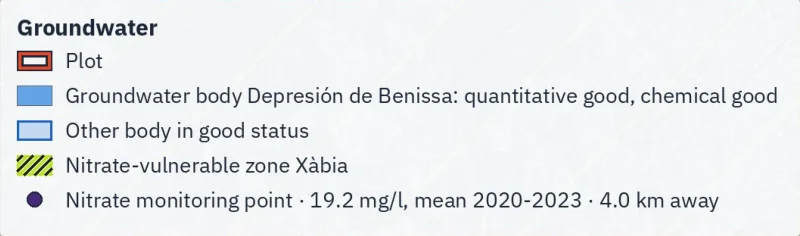
No. It places the plot over its groundwater body with the quantitative and chemical status from the basin plan and the nearest monitoring point. It does not say whether there is a well, whether it has a registered right or whether the water is drinkable.
Keep reading
Check this on your own plot
Pin the plot on the map and confirm the cadastral reference: the report gathers the public data and official maps for it, each with its source and date. It does not replace the land registry extract, the notary or a tax adviser. €29 VAT included.