Pillar: Planning and buildings
Buying rustic land in Spain: can you build a house on it?

On this page
An advert calling a 10,000 m² rustic plot ‘ideal for a house’ does not mean you can legally build there. This guide explains what to ask the town hall, the rules in Andalusia, the Valencia region and elsewhere, and what the contract needs.
Have a specific plot in mind? The report gathers the public data and official maps for it, with source and date, for €29 VAT included. Pin it on the map →
A listing calling a 10,000 m² rustic plot “ideal for a house” does not mean you can legally build one. Sometimes you can: in Andalusia, a house with no farming or forestry link needs 2.5 ha as a rule; in the Valencia region, 1 ha may be enough where the zoning and the plan allow it. This page sets out what to check, in order, before you pay a reservation fee or a deposit (arras): which class the town plan gives the land, which protections limit it, what your region requires and what to agree in writing.
The short answer, in numbers
The figures quoted in listings are legal minimums, not permissions. A plot that meets them can still be ruled out by the plan, by a protection or by being close to other houses.
Do not pay a deposit without the town hall’s written confirmation on the specific house you want to build.
First question: urban, urbanizable or rustic in the plan?
Check the town plan (PGOU or normas subsidiarias), not the Catastro. Andalusia’s LISTA has only urban and rustic land (article 12), but older plans stay in force until carried out or replaced (DT 2ª), so you will still see “urbanizable” land. State law sets no national minimum plot for a house: each region and each plan does (TRLSRU, articles 13.1 and 21).
| Class you are told | What it means | What it does not prove | First step |
|---|---|---|---|
| Urban (urbano) | The plan places the land inside the built-up area. | That it is a serviced building plot (solar) or that your house meets the local rules. | Ask whether it is a solar and, if not, which works are missing and who pays. |
| Urbanizable | The plan foresees its development through urbanisation. | That you can build now: until urbanisation ends, State law treats it as rural land. | Ask what stage the sector is at and which costs fall on the owner. |
| Rustic or non-developable | Land kept out of urbanisation. | That a house is banned outright: some regions allow one on conditions. | Ask for the category of rustic land and the route for a house. |
| Urban for the Catastro | A tax class, under its own law. | What the plan allows: it also covers some urbanizable land and settlements. | Read the plan’s class, not the IBI bill. |
Each label leads to a different question for the town hall. Sources: BOE, State Land Act (TRLSRU), article 21; BOE, Catastro Act, article 7. Accessed 30 October 2026.
Urban land also needs a building licence (TRLSRU, article 11.3). A road running past does not make land urban: it must be lawfully part of the urban fabric and meet the urbanisation, service or building conditions that apply (article 21.3). In Andalusia a building plot (solar) needs at least access by a paved urban street, unless the plan says otherwise, street lighting on the road it faces, except in private spaces, and drinking water, sewerage and electricity with enough capacity for the planned use (LISTA, article 13.3). “Power nearby” is not enough.
Until streets and services exist, urbanizable land is not a building plot. Urbanisation normally comes first, though building at the same time is sometimes allowed, with guarantees and following the approved phases (in Andalusia, LISTA, article 90.4). Ask which works are missing, who will carry them out and what you would pay.
What to ask the town hall before paying
Ask for a planning report or certificate on the plot (informe or certificado urbanístico), or the town hall’s equivalent. It is information, not a licence, and does not guarantee approval of a project (TRLSRU, article 11.3). In Andalusia it is the cédula urbanística: issued within one month at most and valid while the planning it relies on stays unchanged, six months at the longest (LISTA Regulation, article 3). More in the guide to the cédula urbanística.
In English: it asks for the plan in force, the class and category of land, whether a detached house of the stated size with no farm link is allowed and by which route, the minimum plot, coverage, floor area, height, setbacks and prior approvals, any constraints, pending plan changes, licence suspensions or enforcement files, and whether the plot is a solar and what urbanisation and costs the buyer would take on. File it at the town hall’s online office or registry and ask about the fee and the deadline.
Second question: which protections or hazards limit building?
Whatever the class, find out which protection (nature, heritage, public domain) or hazard, such as flooding, affects the house. Where the law protects land, only what its regime expressly allows is possible (TRLSRU, article 13.1). A flood map or protected-area map that shows nothing does not prove there are no restrictions: get it confirmed in writing. In Andalusia, a detached house with no farm link must also stand outside flood zones (LISTA Regulation, article 31.1.h). What each region calls its protection categories, and where to read them, is in the guide to common and specially protected non-developable land.
Andalusia: prior approval, plot rules and costs
Ask for the report to state the category of rustic land: common, specially protected, or kept rural for hazards or by the plan. A house not linked to an ordinary rustic use, such as farming or forestry, is an “extraordinary” action and needs prior approval before the licence (LISTA, articles 21 and 22). The main conditions, all at once (LISTA Regulation, articles 24.2 and 31):
- a plot of at least 2.5 ha, or 5 ha on forest land, that can hold a circle of 50 m radius;
- one house per plot;
- more than 100 m from any other residential building and at least 25 m from the boundaries;
- the house covers at most 1 % of the plot and the floor area, over two storeys at most, is also capped at 1 %: 250 m² in all on 2.5 ha;
- cut-and-fill levelling no more than 30 % of the house’s footprint, which matters on a slope;
- its own basic services, preferably renewable self-supply; mains connection only as an exception, with sector approval and if only the service connection is needed;
- outside flood zones and, on forest land, meeting the wildfire safety conditions;
- at least 200 m from a settlement, a cluster of irregular homes or a hábitat rural diseminado;
- with the new house, a 200 m radius circle may not hold six residential, industrial or commercial buildings, or ten of any use. Removable farm structures such as greenhouses and ordinary-use huts under 10 m² and 4 m high do not count.
The house cannot prevent farming on the plot or neighbouring ones, and neighbours can object during the procedure (article 31.2). A regional land-use plan can adjust these parameters for an area, up or down (article 21.4). Your plot is 2 ha? Unless a territorial plan lowers the minimum for your area, you cannot build a house with no farming or forestry link.
“Extraordinary residential”? Ask which route is meant: in 2024 the Constitutional Court struck out the words allowing homes to be approved alongside other extraordinary actions. The detached house remains possible on the conditions above (STC 25/2024; LISTA, article 22.2).
You apply for the approval yourself, as developer, with a Proyecto de Actuación usually drawn up by an architect (Regulation, articles 32 and 33). After public consultation and at least one month’s hearing for neighbours, the town hall decides, with a binding regional report where the impact goes beyond the municipality. If no decision is notified within six months, treat it as refused (LISTA, article 22.3). You can apply for the building licence at the same time with the building project (Regulation, article 32.5). An approval lapses if the licence is not applied for within a year: check its date (article 33.4.d).
Valencia region: 1 ha may be enough, on conditions
The Valencian planning law (TRLOTUP) allows, as an exception, a detached family home on non-developable land where the zoning provides for it and these conditions are met (article 211.1.b):
- an unbroken plot reaching the plan’s minimum, never less than 1 ha per house;
- the house covers at most 2 % of the plot (200 m² of ground on 1 ha), counting the ground it stands on, not the sum of its floors; the rest stays natural or farmed, and the plan may allow ancillary services with no masonry above ground on another 2 %;
- clear of natural run-off channels, respecting trees and the lie of the land;
- drinking water, waste and sewage treatment at the owner’s cost;
- no forming of a population nucleus under the plan, and no grouping of homes on one plot.
The farming exception can waive the hectare and the 2 %, but only in zones the plan has marked and with a favourable report from the agriculture department, given only for houses tied to a holding of at least one farm work unit or whose owner is a professional farmer. The seller’s promise to put the land into cultivation is not enough.
The house is approved by a municipal licence, without a prior declaration of community interest, but with the reports that apply; on protected land, also the Generalitat’s planning report (article 215). The licence requires the minimum area tied to the house to be registered as indivisible, and if it is not granted in time it counts as refused (article 214.4 and 214.5). The Valencian non-developable land guide covers the regional rules, the PATRICOVA flood maps and the routes for a house already built.
Other regions: Murcia, Catalonia, Galicia and the Canaries
In these four regions a new house on rustic land usually needs a link to a farm or another accepted rustic activity, or a rural settlement.
| Region | What to check for your house | Reference |
|---|---|---|
| Murcia region | On irrigated land the plan classes as unsuitable for urban development, the house must be tied to the farm’s production. Minimum holding: 10,000 m², or 5,000 m² if the plot was created by public deed before 17 June 2001; 20,000 m² on land the plan protects. The holding may span several plots. | LOTURM, article 95.1 |
| Catalonia | A new family home needs a direct, justified link to a farming, livestock, forestry, natural-resource or other rustic activity. Re-using a listed masia or rural house is a separate route. | TRLU, articles 47.3, 47.3 bis, 47.6 and 47.6 bis |
| Galicia | A new home needs a link to a farm and prior regional approval. Re-using traditional buildings has its own route. | LSG, articles 35.1.n, 36.3 and 40 |
| Canary Islands | Ordinary residential use needs a rural or agricultural settlement; in an agricultural one, a working farm. The plot is legally tied to the house. | LSENPC, article 60.1 |
In the Balearics, Madrid, Castilla-La Mancha and the rest, regional law and the plan decide. Sources: BOE, Murcia LOTURM; BOE, Catalan TRLU; BOE, Galician Land Act; BOE, Canary Islands LSENPC. Accessed 30 October 2026.
Catalonia: the farm link is presumed in rural municipalities under 5,000 inhabitants, for a descendant of the holder of a family farm in the municipality who lives on it, if the developer works on the farm or earns from it and the presumption has not been used before for that farm (TRLU, article 47.6 bis). The link is presumed, not the permission. Galicia: a traditional building, one that existed before Law 19/1975 whatever its style, can become a home with a municipal permit, keeping the essential features of the building and the place (LSG, article 40). Before the deposit, get proof of its age. If the plot lies inside a village boundary drawn by the plan, other rules apply, set out in the guide to rural nucleus land in Galicia.
If the Catastro says urban, can I build?
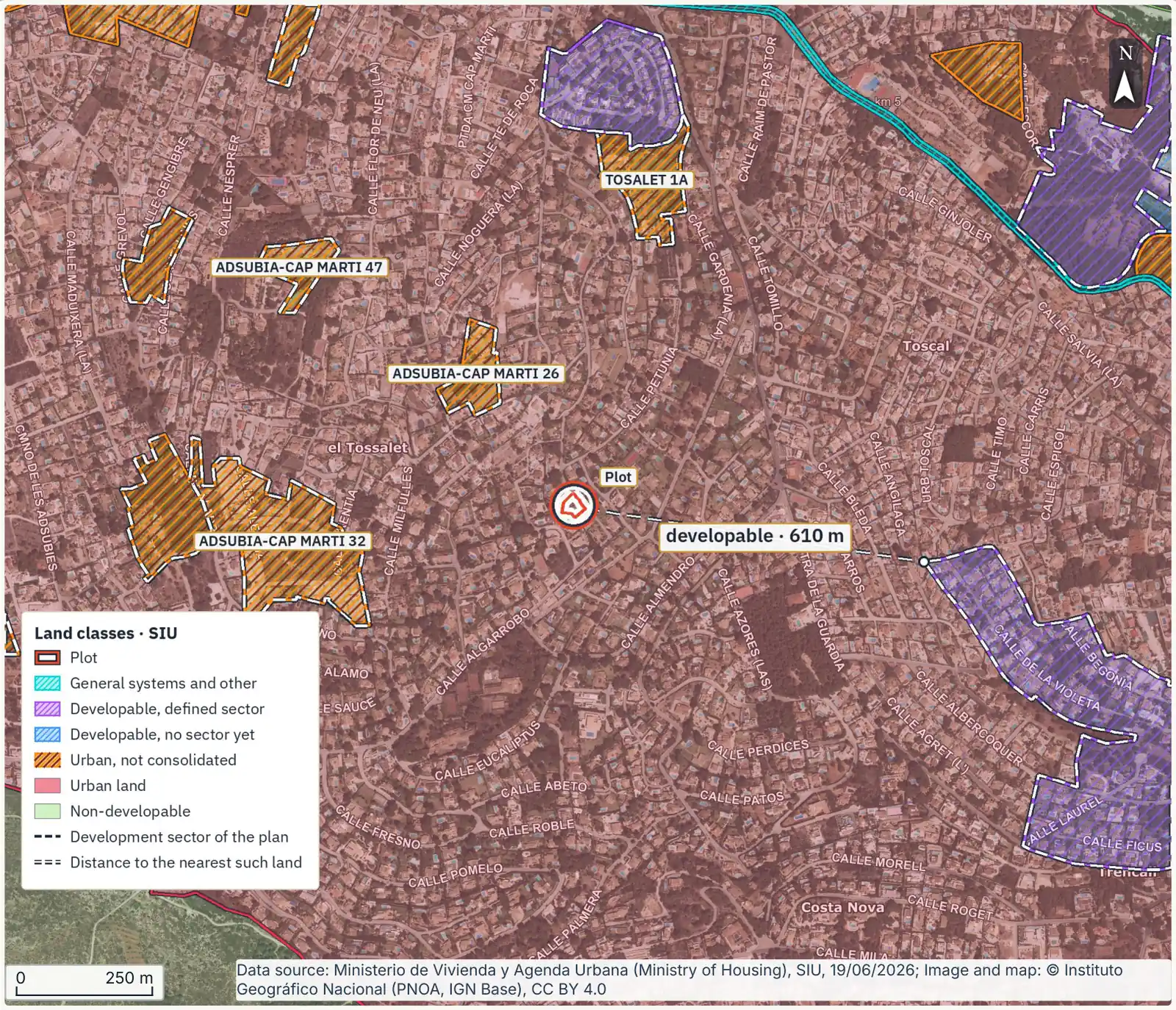
The Catastro’s class is for tax and may differ from the plan’s. It covers the plan’s urban land but also urbanizable land with detailed planning, villages and settlements, and land with urban services, so on its own it does not tell you whether your house is allowed (Catastro Act, article 7). The same plot can be rustic in the Catastro and urbanizable on the SIU viewer. When the two classes differ, and how to correct the record, is explained in the guide to rustic or urban plots in the Catastro.
Use the cadastral reference guide to pin down the exact portion. If there is already a building, read the guide on unlicensed houses on rustic land.
What if you are sold only part of the plot?
Check that the part can lawfully be split off. Each resulting plot must meet the law and the plan, also when you are sold a share of the whole plot with the exclusive use of one part, and the notary and registrar require the administrative approval (TRLSRU, article 26.2).
The minimum farming unit (unidad mínima de cultivo) is the smallest farm area each region sets, different for dry and irrigated land. Splitting below it is void save for legal exceptions (LMEA, articles 23.2 and 24). Meeting it is not enough to split off the portion and does not allow a house. If the seller relies on the exception for a permanent non-farm building, your lawyer must check the licence, actual use within the following year and completion on time (article 25.b).
Pre-emption: can a neighbour take over your purchase?
A neighbour holding a priority farm can step into your place if a rustic plot smaller than twice the minimum farming unit is sold. Deadline: one year from registration or, if the sale was formally notified earlier, sixty days from that notice (LMEA, article 27).
Where the general Civil Code applies, neighbours also have pre-emption on rustic plots of 1 ha or less, unless separated by streams, ditches, ravines, tracks or other visible easements (article 1523). The period is nine calendar days from the day after registration; earlier, if full knowledge of the completed sale, its terms and price is proven. Without registration the same proof is needed: rumour is not enough. Registering later does not restart it (article 1524). Note that 1 ha is exactly the Valencian minimum for a house.
In Catalonia only a neighbouring owner who farms the land personally can use it, if the plot sold is smaller than the minimum farming unit and the buyer is not another neighbour; it does not apply if lawful buildings are worth more than two thirds of the plot. The deadline is two months from learning of the sale or from its registration (Catalan Civil Code, articles 568-17 to 568-19).
Three hypothetical scenarios
These are invented examples to show the method, not real plots.
1. Two hectares “with a house project” in Andalusia
Imagine a 2 ha plot of common rustic land with no farm. It falls short of the 2.5 ha for a house with no farm link, and no territorial plan lowers the minimum for the area. The project in the listing has no route. Before negotiating, ask for the planning report: if it confirms this, the price should be that of land without a house.
2. One hectare in the Valencia region, with a neighbour’s house 40 metres away
Imagine a 1.1 ha plot in a zone where the plan allows detached houses. It meets the hectare and the house would fit in the 2 %, but the architect must check that, with nearby houses, no population nucleus forms under the plan. At over 1 ha the Civil Code pre-emption does not apply, but ask about the LMEA one if the plot is under twice the minimum farming unit.
3. Half a plot as an undivided share
Imagine you are sold 50 % of a plot with exclusive use of the northern half. For the law this counts as a split: each part must meet the plan and the minimum unit, and the notary and registrar will ask for the approval (TRLSRU, article 26.2). Without it, pay nothing.
When to hold back the deposit
The list does not replace a lawyer. It tells you whether you can pay now or which document is still missing.
What to write into the arras contract
Outstanding planning duties pass to the buyer. The deed must state if the land cannot be built on, if there are buildings outside the plan’s rules or if urbanisation works remain to be paid; if it does not, the buyer may cancel within four years (TRLSRU, article 27). Choose the type of arras with your lawyer:
| Payment | What it does | What to agree |
|---|---|---|
| Penitential arras (Civil Code, article 1454) | Either side may withdraw without a reason: if you withdraw you lose the deposit; if the seller does, it is returned doubled. | The contract must say clearly that this right is agreed. Agree who bears costs such as the architect’s fee. |
| Confirmatory arras | The usual reading when the contract is silent: the deposit is part of the price. | If you do not complete, the seller can demand completion or damages, not just keep the deposit. |
| Agency reservation | Money paid before the arras to hold the plot. | Same planning condition, signed by whoever receives the money, with the agency’s fee refundable too. |
With either type of arras, add the refund condition separately. Source: BOE, Civil Code, article 1454. Accessed 30 October 2026.
A favourable report meets this condition even if the licence is later refused. In Andalusia, if the seller accepts a longer period, make the sale conditional on the prior approval as an extraordinary action; in the Valencia region, on the municipal licence. If you buy only part of the plot, add conditions for the split licence and access. Need a mortgage? Confirm before signing that the bank will finance the plot and the build. More in the guide to the arras contract.
The buyer’s sequence before the deposit
- Pin down the exact plot: cadastral reference and a plan of the portion you are buying.
- Ask the town hall for the planning report on the planned house, with the wording above.
- In parallel, a lawyer independent of the seller and the agency reviews the nota simple, which is for information only (Mortgage Law, article 222.5), the title, access and any split.
- If you are not a national of an EU member state, ask them to check whether the plot is in a restricted defence zone: there the notary requires military authorisation before signing (Law 8/1975, articles 18 and 20 and additional provision).
- If neither the report nor the lawyer finds an obstacle, an architect checks whether the house fits and what water, power and sewage will cost.
- Allow time: the report can take weeks, and the Andalusian prior approval has a six-month deadline that can be suspended (Law 39/2015, article 22).
- Sign the arras only with the planning condition, a deadline and a full refund if it is not met.
Questions to send before money moves
- What class and category of land is the plot under the plan in force?
- Is a detached house with no farm link allowed? By which route?
- Which minimum plot, coverage, floor area and distances apply here?
- Does a territorial plan change those minimums in the area?
- Which protections or hazards affect the plot?
- Is it a solar? If not, what urbanisation is missing and who pays?
- Can the portion I am buying lawfully be split off?
- Are there houses within 100 or 200 m that would block approval?
- Do any neighbours have a pre-emption right?
- What happens to each payment if the report does not arrive or is unfavourable?
A listing that says “ideal for a house” gives you the question, not the answer. Keep the town hall’s report, the plan and their dates together, and let your lawyer and architect confirm whether the house you have in mind really fits on that plot.
Common questions
How much land do I need to build a house on rustic land in Andalusia?
With no farming or forestry link, 2.5 ha as a rule (5 ha on forest land), unless a regional land-use plan adjusts that minimum for your area, plus the other conditions in the LISTA Regulation (articles 21.4, 24 and 31).
What does urbanizable land mean: can I build now?
Not necessarily. Until urbanisation is finished, State law treats it as rural land (TRLSRU, article 21). Urbanisation normally comes first, though building at the same time is sometimes allowed with guarantees and following the approved phases (in Andalusia, LISTA, article 90.4).
Can I use a tool shed as a home?
No. A licence for a tool shed does not allow living in it: the plan must allow the home, with its own licence. In the Valencia region, farm buildings on non-developable land may not have kitchens, bathrooms or bedrooms for residential use (TRLOTUP, article 211.1.a).
Can I place a prefab or mobile home without a licence?
No. Placing a prefabricated house, temporary or permanent, needs an express decision by the town hall, and silence means refusal: do not treat it as approved because nobody answered (TRLSRU, article 11.4.c). The plot must also allow that home.
Does the TerrenoCheck report say whether I can build?
No. The planning chapter shows the land class the Ministry’s SIU publishes and the Catastro class, and says what to ask the town hall. It does not certify what can be built or replace the town hall’s planning report.
Keep reading
Check this on your own plot
Pin the plot on the map and confirm the cadastral reference: the report gathers the public data and official maps for it, each with its source and date. It does not replace the land registry extract, the notary or a tax adviser. €29 VAT included.