Pillar: Planning and buildings
Spanish planning certificate (cédula urbanística): how to apply

On this page
The cédula or planning report is the town hall's written answer on the planning rules for one plot. Here is what to send, what Madrid and Marbella charge, the deadlines in the rules and what the document will not tell you.
Have a specific plot in mind? The report gathers the public data and official maps for it, with source and date, for €29 VAT included. Pin it on the map →
The cédula urbanística, or planning report depending on the town, is the town hall’s written answer on the planning rules for one plot. You apply to the planning department or the online office (sede electrónica) of the town where the plot is, with the cadastral reference, a plan and what you intend to do. In Madrid and Andalusia the deadline is one month; where the procedure sets none, national law gives three months. It is for information only: it is not a licence.
What a cédula is, and how it differs from the Catastro and the nota simple
They are three documents from three different authorities.
The cédula urbanística comes from the town hall. Madrid’s bylaw calls it the document that certifies the planning regime and circumstances of a property, implementation unit, sector, plot or building site (Bylaw 6/2022, article 14). In Andalusia it reports the planning position of a specific piece of land, plot, site or building (LISTA Regulation, article 3). Other towns call it an informe urbanístico or a certificado de régimen urbanístico. Ask in writing for the rules on that plot; a chat at the counter proves nothing.
The Catastro describes the property for tax: location, reference, area, use, buildings, value and the recorded holder. Its data are presumed correct unless proven otherwise, but on legal questions the Land Registry prevails (Catastro Act, article 3). To read the reference, see the guide to the cadastral reference.
The nota simple comes from the Land Registry. It shows the registered owner and the charges, and it is for information only (Mortgage Act, article 222). How to get and read one: nota simple.
You are entitled to be told in writing, within a reasonable time, the planning rules for a property, on the terms of regional and local law (TRLSRU, article 5.d). You do not have to be the owner.
What you need to send
The name of the procedure changes from town to town, but the basics are the same: your identity, the cadastral reference, a plan or sketch with the plot marked and, if you know it, one plain sentence on what you want to do (a family house, an extension, a change of use).
In Madrid you apply online through the municipal licensing system (SLIM), with electronic ID and signature. Attach:
- a plan at 1:500 or 1:1000 on the Madrid Digital Map, downloadable from the city’s Geoportal, with the plot outlined;
- proof of payment of the fee, which you self-assess beforehand in a separate procedure and then add to the file.
If something is missing, the town hall will give you ten days to complete it, warning that otherwise your application will be treated as withdrawn (Law 39/2015, article 68). Keep the registration receipt: deadlines run from the date the application enters the electronic register of the authority handling it (article 21).
In Andalusia, unless the town has set its own content, the cédula must state at least the applicable plans with their amendments, suspensions and legal challenges, the land class, the rules on use, building, servicing and construction, whether the plot is a serviced building site (solar), and whether proceedings to restore planning legality are open (LISTA Regulation, article 3). The guide on what you can build has request wording you can adapt.
How much it costs
There is no national fee. Each town hall sets its own in its tax bylaw, and some charge nothing.
In Madrid, each cédula costs €87.25 (Tax Bylaw 10/2023, article 11, in its 2026 wording). You self-assess, and the payment is provisional, on account of the final assessment (article 29). A planning enquiry, a planning report and a planning certificate are separate services with their own fees in articles 8 to 10 of the same bylaw. Opening a business may require another document, the planning compatibility report.
In Marbella, the 2026 tax bylaw on issuing documents charges €102.70 for a cédula urbanística and €41.08 for a report on the characteristics of land or an enquiry (article 6). The fee falls due when you apply, and nothing is processed until it is paid (article 7).
Elsewhere, look up the current tax bylaw on the town hall’s online office or in the provincial gazette. The fee covers the town hall’s document only, not an architect’s study or approvals from the coastal authority, the river basin authority or environmental bodies.
| Where | How to apply | Fee | Deadline |
|---|---|---|---|
| City of Madrid | Online through SLIM; 1:500 or 1:1000 plan on the Madrid Digital Map; fee paid in a separate procedure | €87.25 | 1 month from the town hall register |
| Andalusia | Electronic registry of the town hall; minimum content set by regulation | Local tax bylaw (Marbella: €102.70) | 1 month at most, or less by local bylaw |
| Catalonia | Certificado de régimen urbanístico at the town hall | Local tax bylaw | Notified within 1 month |
| Other towns | Informe, certificado or cédula, by the town’s procedure | Local tax bylaw; some charge nothing | The procedure’s own; 3 months if it sets none |
The fee covers the town hall’s document, not the architect’s study or other approvals. Sources: Madrid, cédula procedure; BOJA, LISTA Regulation, article 3; BOE, Catalan TRLU, article 105; BOE, Law 39/2015, article 21. Accessed 30 October 2026.
How long the town hall takes
The procedure’s rules set the deadline. Where they set none, Law 39/2015 gives three months, and the maximum cannot exceed six months unless a statute or EU law provides for a longer one (article 21).
- Madrid: the cédula must be issued within one month of the application reaching the town hall’s register (Bylaw 6/2022, article 14).
- Andalusia: one month at most, or less if a local bylaw says so, from entry in the electronic register. If the month passes with no answer, that does not count as a favourable reply (LISTA Regulation, article 3).
There are no official figures on real waiting times at each office. If you sign a deposit contract (arras) while you wait, agree in writing what happens if the answer is late or unfavourable.
How long it stays valid
- Madrid: the information speaks as of the date of issue and holds while the plans or implementing instruments affecting the property do not change, and while the development rights acquired and the charges stay as they were at issue. It also covers plan changes in progress that may affect the property (Bylaw 6/2022, article 14).
- Andalusia: it is for information only, does not bind the authority and holds while the planning it relies on stays in force, for six months from issue at most (LISTA Regulation, article 3).
If time has passed or the plan is under review, ask for a new one before you pay anything.
How to read the answer
| The cédula says | What it means | What it does not prove | First step |
|---|---|---|---|
| “Suelo urbano consolidado” | The plan’s class for the plot. | That your house fits or that existing buildings are licensed. | Read the zoning and the ordinance it names. |
| “Ordenanza ZU-3” (or similar) | The zone rules that set uses and figures. | The figures themselves, unless the cédula copies them. | Get the ordinance text and give it to the architect. |
| “Solar” | The plot has the services the law requires. | That the buildings or accesses are in order. | Check access and connections on site. |
| “Modificación en tramitación” | A plan change is being processed. | How it will end or when. | Ask what it changes for the plot and hold the deposit. |
| No mention of coast, river or Natura 2000 | Nothing on file at the town hall. | That those constraints are absent. | Check the sector sources for each one. |
The cédula informs; it does not change the property’s rights and duties. Sources: City of Madrid, Bylaw 6/2022, article 14; BOJA, LISTA Regulation, article 3. Accessed 30 October 2026.
If the answer contradicts the published plan or describes another property, ask in writing for it to be reviewed before you go on.
What the cédula does not tell you
It sets out the planning rules the town hall applies to the property. It does not complete your checks.
- It does not prove who owns the land or what charges it carries: the Land Registry does that.
- It does not correct boundaries or the area.
- It is not a licence or a declaración responsable, and it is not the cédula de habitabilidad, which concerns a house already built; see the guide to the first occupation licence.
Nor does it replace decisions made by other authorities: the coastal boundary and its easements, flood zones or Natura 2000. The town hall may mention some of these if they are in its files; silence on them does not prove they are absent.
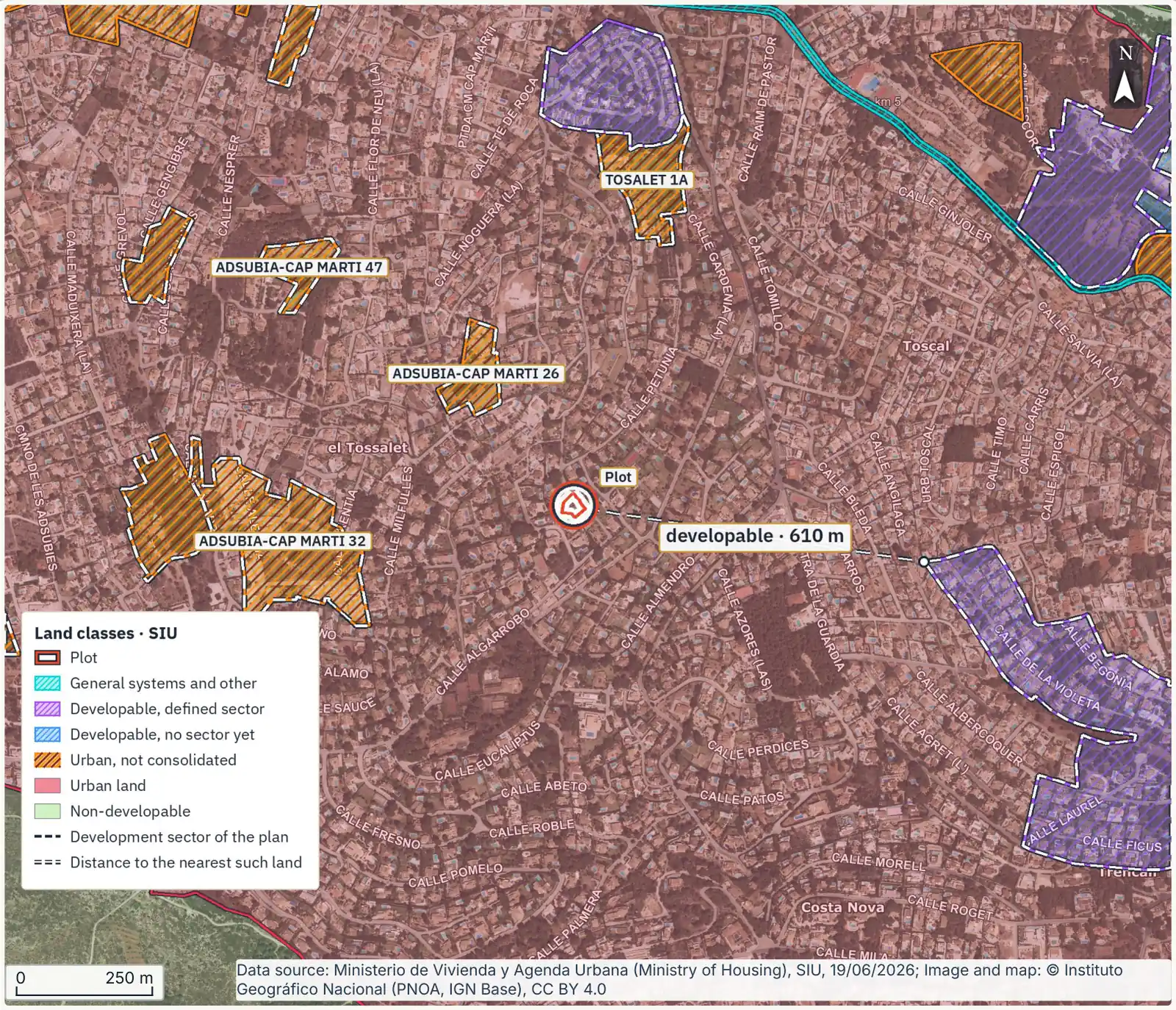
While you wait, you can get ahead with public sources, such as the land class in the SIU viewer. That helps you ask better questions, but the answer that counts is the town hall’s. If there is already a house on the plot, ask for the cédula to say whether it is fuera de ordenación (outside the plan) and which works it allows.
Three hypothetical scenarios
These are invented examples to show the method, not real plots.
1. An eight-month-old cédula in Andalusia
Imagine the seller hands over an Andalusian cédula issued eight months ago. Even if the plan has not changed, it is past the six-month maximum. Ask for a new one and make the deposit conditional on it.
2. The month passes with no answer
Imagine you applied in an Andalusian town and five weeks pass with no news. Silence authorises nothing. If your arras had that deadline, the refund clause protects you; if not, talk to your lawyer before paying more.
3. A cédula that mentions a change in progress
Imagine a Madrid cédula that confirms urban land and mentions a plan change in progress affecting the block. The cédula reports it but cannot say how it will end. Ask what it changes for the plot and hold the deposit until you know.
When to hold back the deposit
The list does not replace a lawyer. It tells you whether you can pay now or which document is still missing.
What to write into the arras contract
Applying for a cédula does not by itself entitle you to your deposit back. If you sign while you wait, the contract should identify the plot by its cadastral reference and a plan, say what result you need (for example, that a single-family house is allowed), set a deadline and provide a full refund if the cédula does not arrive in time or does not allow the use. Decide with your lawyer whether the cédula is enough or the licence is needed. More in the guide to the arras contract.
The buyer’s sequence before the deposit
- Get the cadastral reference and a plan with the plot marked.
- Find the procedure and the fee on the town hall’s online office.
- Pay the fee if it is charged up front and keep the receipt.
- File the application with your intended use and keep the registration receipt.
- Supply within ten days any document you are asked for.
- When the cédula arrives, check it is your plot and hand it to the architect.
- Sign the arras only with the condition, a deadline and a full refund.
Questions to send before money moves
- What is the procedure called in this town, and what does it cost?
- What is the deadline, and from when does it run?
- Which plans govern the plot, with their amendments?
- What land class and category does it have?
- Which zoning, uses and ordinance apply?
- Is it a solar? If not, what is missing?
- Are plan changes or suspensions in progress?
- Are any planning enforcement proceedings open on the property?
- Until when is the cédula valid?
- What happens to my deposit if the cédula does not arrive in time?
To place this check before the deposit and budget the taxes, follow the guide to buying land in Spain.
The cédula is the planning answer that counts, with a date on it. Ask early, check it describes your plot and pay nothing final until you have it in hand.
Common questions
Can I apply if I am not the owner?
Yes. Everyone has the right to written information on the planning rules for a property (TRLSRU, article 5). In Madrid the procedure is open to individuals, private bodies and public authorities.
Is it the same as a cédula de habitabilidad?
No. The cédula urbanística covers the planning rules for the plot. The cédula de habitabilidad, or the first occupation licence depending on the region, is about whether a finished home can be lived in.
If the town hall does not reply, can I build?
No. In Andalusia silence is not a favourable answer, and in Madrid the cédula is for information only. Neither replaces a licence or a declaración responsable.
Is a cédula from a year ago still good?
In Andalusia, no: it lasts six months at most. In Madrid, only if the plans and the property’s position have not changed. If in doubt, ask for a new one.
How long does it really take?
The rules give one month in Madrid and Andalusia, and three months where the procedure sets no deadline. There are no official figures for real times; ask the office and leave slack in the deposit contract.
Keep reading
What can I build on a plot in Spain, and how do I confirm it before buying?
SIU planning viewer: how to check a Spanish plot's land classification
How can an arras contract protect your deposit in Spain?
What if the plot has archaeological remains or sits in a protected setting?
Check this on your own plot
Pin the plot on the map and confirm the cadastral reference: the report gathers the public data and official maps for it, each with its source and date. It does not replace the land registry extract, the notary or a tax adviser. €29 VAT included.