Pillar: Documents and contract
How do I order and read a nota simple before buying in Spain?

On this page
Start with the registered property, the seller's actual rights and the entries that affect your purchase. A registered rural house still needs a separate planning check.
Have a specific plot in mind? The report gathers the public data and official maps for it, with source and date, for €29 VAT included. Pin it on the map →
The nota simple is the extract from the Spanish Land Registry that says who owns a plot, what right they hold and which charges are still registered. Order one for every registry plot (finca registral) in the sale before you pay a deposit, compare it with what you visited and clear up every charge and marginal note. The nota shows the entries on the day it is issued: it does not prove them against third parties and does not confirm that you may build on or live in the house.
An enforcement reference requires checking the buyer’s duties and the underlying file.
Where to order it and what it costs
You can order it from the Land Registry for the property or on the Registradores online office. The office publishes a price of €9.02 per property, taxes and withholdings not included. If the listing covers several plots, identify them all before you work out the cost, and check whether you are dealing with the official service or with an intermediary adding fees.
The most direct way to find the plot is the CRU (Código Registral Único, formerly IDUFIR), which every registry folio carries (Mortgage Law, article 9). Province, municipality, Registry and finca number also work; they appear in the seller’s deed. If you only know the owner’s name or tax number, the “nota de localización” tells you which Registry holds their property.
State why you are asking, for example: “I am considering buying this property and need to check its ownership and charges.” Anyone requesting information must show the registrar a legitimate interest, and anyone asking on someone else’s behalf must prove the instruction (Mortgage Regulations, article 332.3). Sources: BOE, Mortgage Regulations, article 332; Registradores, Land Registry online office. Accessed 30 October 2026.
Keep the full PDF and its date. If the plot cannot be found, provide the deed and ask the Registry: a search with no result does not prove the plot is unregistered or free of charges.
Does it match the land you are being sold?
Read the identification first. A registry plot is the unit with its own history in the Registry; a cadastral parcel belongs to the Catastro. Their numbers are not interchangeable and one finca can include several parcels. Do not assume the nota for the house also covers the orchard or the access you were shown.
Note the Registry, finca number and CRU and compare them with the seller’s deed and the draft contract. Then place the cadastral references on the plan with the cadastral reference guide. If you are buying part of a larger plot, have it defined in law: an undivided share does not become a separate plot because the seller draws a line on a photo.
| Part of the nota | What it means | What it does not prove | First step |
|---|---|---|---|
| Description | Nature, location, area, boundaries and buildings as entered. | That the area was measured, that the house has a licence, or that every building you saw is entered. | Compare it with the deed, the cadastral plan and the visit. |
| Coordination | Whether the plot is coordinated with the Catastro and as of which date (article 10.4). | That the fence follows the registered line. | If the boundary matters, read the guide on boundaries that do not match. |
| Owner | Who holds which right, and in what share. | That the person you deal with can sign alone, or that a spouse need not consent. | Ask for the seller’s deed and, if an agent signs, the power of attorney. |
| Charges | Mortgages, attachments, easements, conditions and restrictions entered. | The current loan balance, or that a paid loan has been cancelled. | Agree with your lawyer which charges stay and how the rest are cancelled. |
| Pending filings | Documents presented to the Registry and not yet dealt with. | What they say; a filing can affect priority before it is registered. | Ask the Registry for their content and status. |
At a minimum, the nota shows the plot’s identity, its owners and the extent, nature and limits of their rights. Sources: BOE, Mortgage Law, article 222.5; BOE, Mortgage Law, article 10.4; BOE, Mortgage Law, article 17. Accessed 30 October 2026.
Ownership: what right the seller holds
Look for the owner, the registered right and its extent. The law presumes registered rights exist and belong to their holder in the form the entry states (Mortgage Law, article 38), so read the whole entry.
If you want the whole plot in full ownership, your lawyer must check which rights must be transferred or extinguished and who must sign. If the house is the seller’s family home, where the Civil Code applies both spouses must consent, or a court must authorise, even if only one is the owner (article 1320). If a deceased owner appears and an heir is selling, clear up the inheritance papers before you pay. Source: BOE, Civil Code, article 1320. Accessed 30 October 2026.
The description proves neither a licence nor the area
Check the nature, location, area, boundaries and buildings described. Separate the land area from the built area and compare every building you saw with the entry. If an extension or a pool is missing, ask for an explanation and papers before you negotiate the price.
The nota must state whether the plot is graphically coordinated with the Catastro and as of which date (article 10.4). A cadastral reference on the nota is not coordination. If a gap affects what you are buying, read the guide to boundaries that do not match.
A description saying “urban” or “dwelling” is not a licence. Article 28.4 of the Land Law lets old buildings that can no longer be ordered demolished be registered, on its conditions; that registry route is not a building licence. Source: BOE, Land Law, article 28. Accessed 30 October 2026.
How to read the charges
Read the plot’s own charges and those carried over from an earlier plot it was split from. Check pending filings too: while a filing entry lasts, no conflicting title can be registered for sixty days (Mortgage Law, article 17).
Mortgage. The entry states the principal and interest or the maximum liability (Mortgage Law, article 12), not today’s balance. If the loan will be repaid from the price, ask for a bank statement of the balance on the signing date and agree with the notary that the bank is paid directly. The guide to charges, mortgages and attachments explains how to arrange it.
The five-year tax note
The usual marginal note for transfer tax (ITP/AJD) says the property is liable for any extra assessment that may be raised. It is entered even when the self-assessment was filed and paid, and it states the amount already paid (ITP/AJD Regulations, article 122.3). On its own it does not mean there is a debt.
The note lapses and must be cancelled when proof of payment of that extra assessment is filed and, in any case, five years after it was entered (article 122.4). Do not apply that period to every tax note, and do not confuse it with the tax limitation period. Ask the seller for the self-assessment and receipts. Source: BOE, ITP/AJD Regulations, article 122. Accessed 30 October 2026.
Marginal notes are not just reminders
“Marginal” describes the form of the entry, not its weight. In a mortgage enforcement, the registrar notes in the margin that the certificate of title and charges has been issued; until a court officer orders that note cancelled, the mortgage cannot be cancelled for reasons other than the enforcement itself (Civil Procedure Law, article 688.2). Do not treat it as routine.
Look also for warnings of recent first registration: under the routes in article 207 of the Mortgage Law, the article 34 protection for a good-faith buyer only starts two years later, and the limit must appear on the nota while it lasts. If you do not understand a phrase, ask the Registry: registrars must advise anyone who asks on registry matters (article 222.7). Sources: BOE, Civil Procedure Law, article 688; BOE, Mortgage Law, article 207; BOE, Mortgage Law, article 222. Accessed 30 October 2026.
Nota simple or certificate
| Document | What it proves | How it is secured | Cost |
|---|---|---|---|
| Nota simple | Information only; does not certify the entries (article 222.5). | Registry’s electronic seal and a verification code (article 222.2). | €9.02 per property online, taxes and withholdings extra. |
| Certificate | Proves free title or charges against third parties (article 225). | The registrar’s qualified electronic signature and a verification code. | Depends on what it covers; ask the Registry. |
A nota is enough for a first review; your lawyer decides whether a certificate is needed. Sources: BOE, Mortgage Law, article 222; BOE, Mortgage Law, article 225; Registradores, Land Registry online office. Accessed 30 October 2026.
Ask for the right scope: a title certificate covers ownership; a title and charges certificate adds the current encumbrances. If you doubt where a nota came from, use its verification code.
What the nota does not check
| Check | Where | Why the nota is not enough |
|---|---|---|
| Planning and permits | Town hall planning report and the papers for the buildings and intended use. | Being entered does not legalise a house; article 28.4 of the Land Law registers old works, it is not a licence. |
| Physical reality and occupation | A visit with your surveyor; who uses the house or land. | No registered lease does not mean vacant possession. |
| Access, utilities and water | Titles and permits, and the real state of the installations. | A well in the description is not a water right. |
| IBI debts | Town hall or collecting body certificate. | The property stays liable for unpaid IBI after the sale (Local Finance Law, article 64.1). |
| Community debts | Certificate from the community’s secretary, where the Horizontal Property Law applies. | The flat answers for the current year and the three before; do not waive the certificate (article 9.1.e). |
A nota that shows no warning does not prove there is none. Sources: BOE, Land Law, article 28; BOE, Local Finance Law, article 64; BOE, Horizontal Property Law, article 9. Accessed 30 October 2026.
What the TerrenoCheck report shows
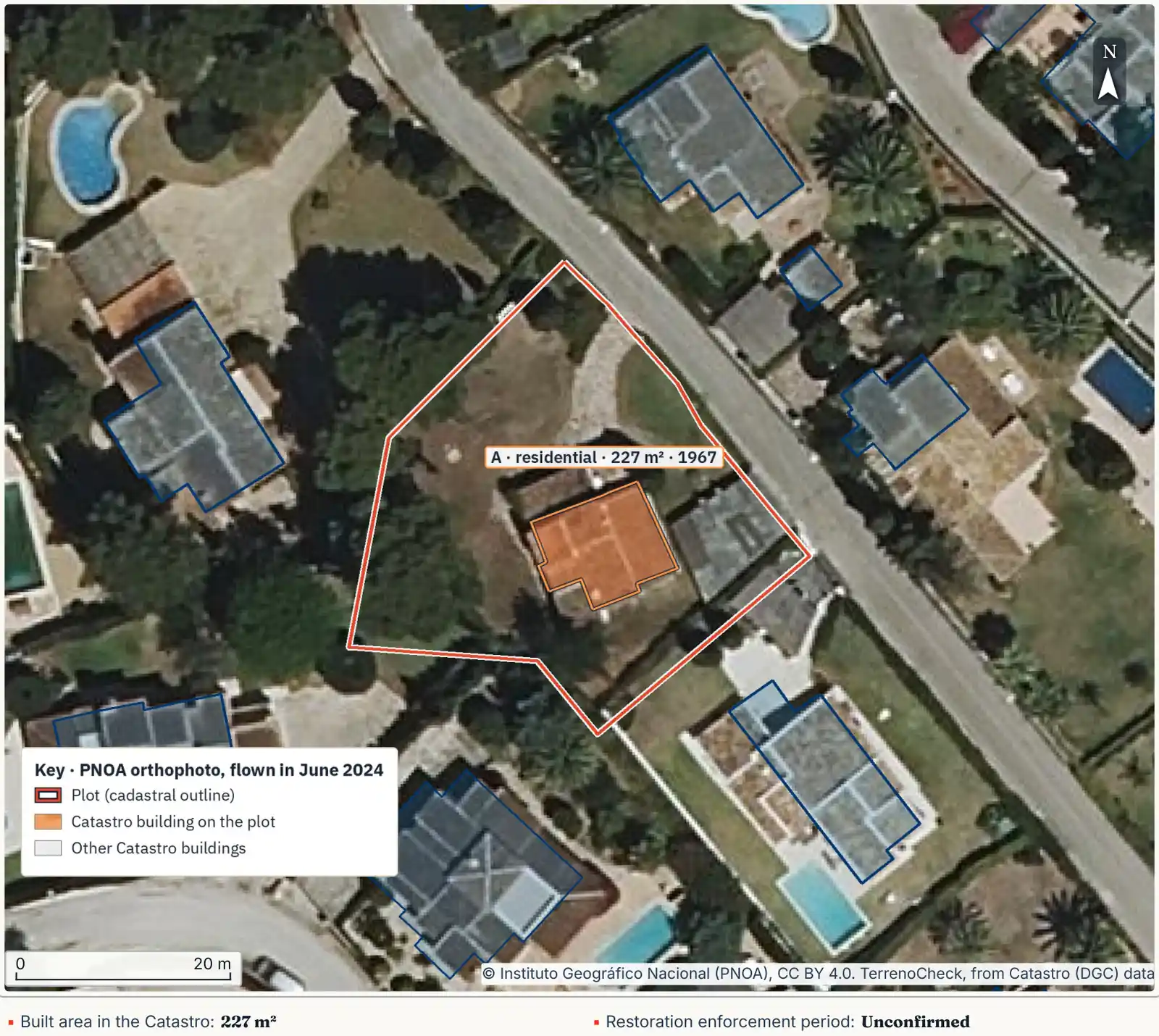
The report compares the Catastro’s buildings with the plot outline and tells you which cadastral parcel each belongs to. That tells you which plots you need a nota simple for. Owner, charges and coordination stay open until you read the nota.
Three hypothetical scenarios
These are invented examples to show the method, not real plots.
1. Bare ownership with a mother holding the life interest
The son is registered as bare owner and his mother holds the usufruct. If only the son signs, you buy property you cannot use while the usufruct lasts. The mother must take part, or the usufruct must end, before completion.
2. A mortgage “already paid”
The seller says the loan was paid off years ago, but the nota still shows the mortgage. Ask for the zero-debt certificate and agree in writing that the cancellation deed is signed and registered before the purchase or at the same appointment.
3. A marginal note about a charges certificate
The nota shows the certificate of title and charges was issued for a mortgage enforcement. The plot is in a debt-recovery procedure. Pay nothing until your lawyer has seen the state of the procedure and how it will be lifted.
When to hold the deposit
What to write into the arras contract
Have the contract identify each plot by its registry details and CRU, list the charges to be cancelled and those that stay, and name the pending documents: cancellation deeds, consents, inheritance papers or debt certificates. Set the deadline, who pays each step and the full refund of what you paid if the terms are not met. Finding a problem later does not by itself guarantee the deposit comes back. More in the guide to the arras contract.
Ordering a nota does not reserve priority. For completion, agree with the notary an updated registry check and electronic filing of the deed straight after signing.
The buyer’s order of steps before the deposit
- Identify every registry plot and ask for each CRU.
- Order a recent nota simple for each plot and keep the PDF with its date.
- Compare the description with the deed, the cadastral plan and the visit.
- Check owners, rights and shares, and who must sign.
- Go through every charge, marginal note and pending filing with your lawyer.
- Outside the Registry, get the planning information and the IBI and community certificates.
- Sign the arras only with the open conditions in writing.
- Before completion, have the notary check the Registry again.
Questions to send before you pay
- Which registry plots does the sale include, and what is each CRU?
- Who signs, and with what right? Is there a usufructuary, co-owner or spouse who must consent?
- Which charges will be cancelled, with what money and by what document?
- Are any documents filed at the Registry still pending?
- Which transaction does each tax note refer to, and was its self-assessment paid?
- Are all the buildings I saw registered, and do they have licences?
- Will you provide the IBI and community debt certificates?
The nota simple tells you what is registered today. Read all of it, compare it with the deed and the land, and have every issue settled or covered in the contract before you pay.
Common questions
Can I order a nota simple without being the owner?
Yes, if you show an interest the registrar accepts as legitimate (Mortgage Regulations, article 332.3). Explain that you are considering the purchase and identify the plot.
Is a nota simple from a few months ago still useful?
It shows what was registered when it was issued; it does not guarantee nothing has changed and it reserves no priority. Get a recent one before you pay and another check before completion.
Does a tax note mean the seller owes that amount?
Not necessarily. The usual ITP/AJD note states what the self-assessment already paid and warns of a possible extra assessment; it lapses five years after it was entered (Regulations, article 122.4).
Can a registered house still have planning problems?
Yes. Registration does not replace permits or confirm the permitted use. Ask the town hall about the building’s status and compare the papers with what stands on site.
Does the report include a nota simple?
No. The report identifies the parcel and its buildings from the Catastro but does not read the Registry: owner, charges and coordination are for the nota simple.
Keep reading
Check this on your own plot
Pin the plot on the map and confirm the cadastral reference: the report gathers the public data and official maps for it, each with its source and date. It does not replace the land registry extract, the notary or a tax adviser. €29 VAT included.