Pillar: Planning and buildings
Can you rebuild a ruined house on rural land in Spain?

On this page
A registered house may now be a shell, and a shell may have no right to become a home. Establish the building's planning status and get a written answer on your actual works before paying a deposit.
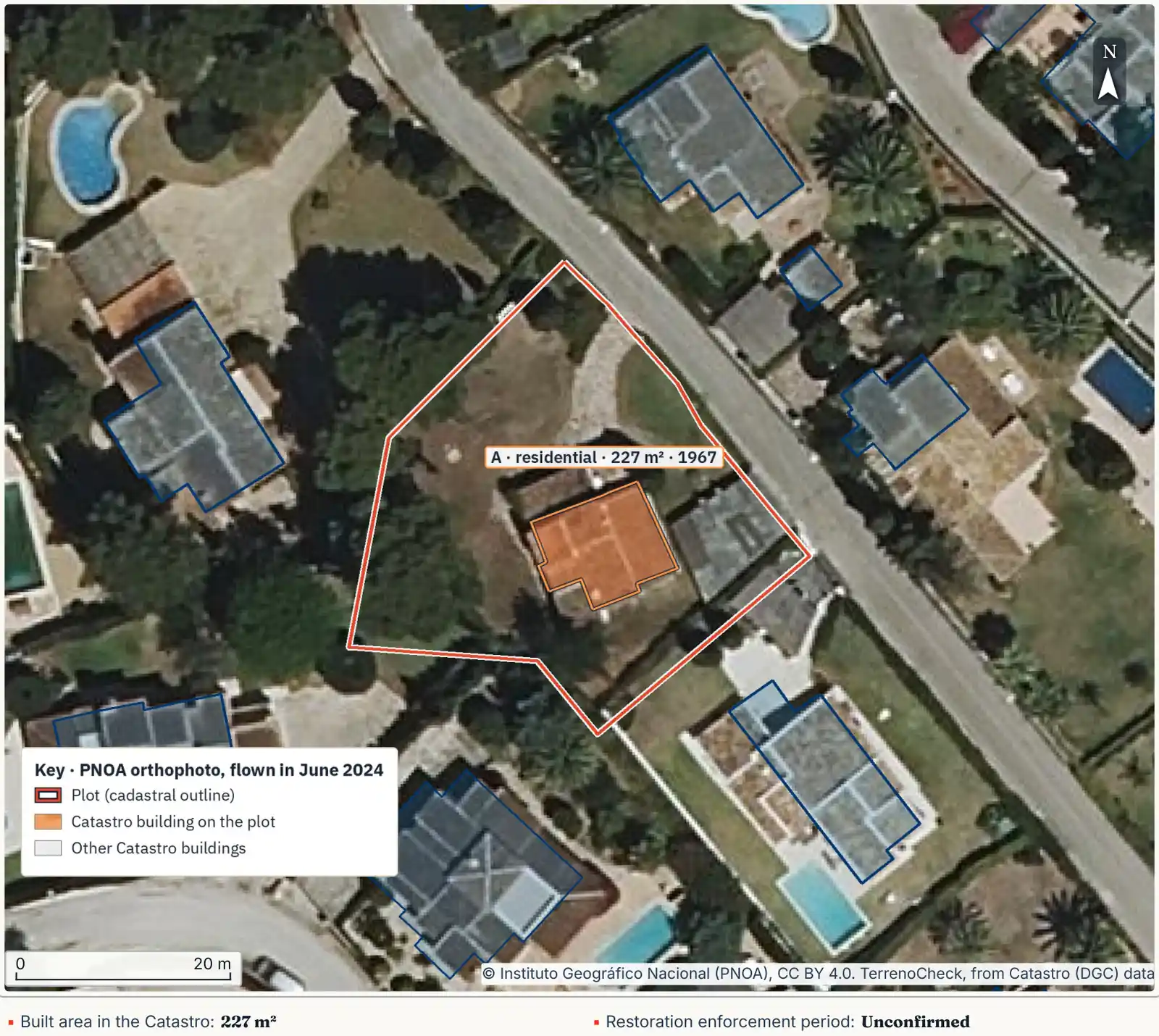
Have a specific plot in mind? The report gathers the public data and official maps for it, with source and date, for €29 VAT included. Pin it on the map →
Sometimes you can, but a ruin does not on its own give a right to rebuild a home. Being on the Catastro, registered by age or recognised as AFO is not a rebuild licence. Before you pay a deposit (arras), have an architect record the remains and ask the town hall for a written answer on the specific works and on residential use.
What to confirm before valuing a ruin as a house
The useful question is not whether you can “renovate something”. It is whether you can carry out the project that makes you want to buy: bring a home back, convert a store or pull down one building and put up another. These are different things. Every building job needs the administrative approval that fits it, and silence gives no rights against the plan (TRLSRU, article 11.3).
Have the architect describe which elements remain and which would have to be replaced. Then have the town hall name the route that applies and the use it allows. If it only allows repair and the project needs a structural rebuild, the purchase does not serve you, however much the listing sells it as a house to restore.
If you do not yet know what kind of land you are buying, start with the guide to rustic and urban land. On rural land, uses and works stay within the limits of the law and the plan, and an existing building does not let you ignore the protection of the place (TRLSRU, article 13.1). In Galicia, many village houses sit on rural nucleus land rather than rustic land; how to tell is in the guide to rural nucleus land in Galicia.
What the Catastro, the Land Registry and age prove
The Catastro describes the property: location, area, use and other features (Catastro Act, article 3). That description is not a licence. A building drawn as a home may not match what was authorised, or the remains you find on your visit.
| What you are shown | What it means | What it does not prove | First step |
|---|---|---|---|
| Drawn as a home on the Catastro | The Catastro describes it that way. | That a home was licensed, or that what is left matches the drawing. | Compare it with the licence and with the walls you saw. |
| Works registered by age | Demolition could no longer be ordered when it was registered (TRLSRU, article 28.4). | That you may rebuild the volume described. | Ask for the deed and the documents it was registered with. |
| Certificate of age | It dates what was built. | That every part has the same status, or that residential use is allowed. | Date each addition separately. |
| Old rebuild licence | Someone once had permission for a project. | That it is still valid or covers today’s remains. | Ask the town hall in writing about validity, scope and change of developer. |
Silence from the authorities gives no rights against the plan (TRLSRU, article 11.3). Source: BOE, TRLSRU, articles 11.3 and 28.4. Accessed 30 October 2026.
The Land Registry does something else. The TRLSRU allows some old works to be registered once demolition can no longer be ordered (article 28.4), but that entry does not give permission to rebuild the volume it describes. A certificate of age dates what was built; it does not prove every part has the same status or that residential use is authorised. On some land time protects nothing: in Andalusia, LISTA article 153 includes, among others, public domain, its easements and land at definite risk.
Clear up any mismatch before you pay, for instance a deed describing a house and a licence for a store.
Is keeping the walls enough to count as restoration?
No State rule lets you rebuild any house because one wall survives. Ask for a survey covering walls, floors, roof and damage, and a proposal saying what is kept, what is taken down and what is replaced. The surveyor should also check whether the remains can prove the original shape and volume.
With that document, ask the town hall whether it sees the works as repair, consolidation, rehabilitation, reconstruction or replacement. Calling the project a “roof renovation” does not help if carrying it out means replacing the whole load-bearing structure. Use needs its own answer: restoring a hay barn does not make it a home, and permission for a home does not cover holiday letting.
Andalusia: outside the plan, AFO and pre-1975 houses
The LISTA separates a lawful building that no longer fits a new plan (article 84) from asimilado a fuera de ordenación, the AFO status of finished unlawful buildings (articles 173 and 174). For the first, check which works the plan allows and, if it is silent, the law’s fallback rules.
An AFO does not make the building lawful. After recognition, conservation and renovation works are possible with a licence, including consolidation with no extra footprint or volume, save ancillary elements a sectoral rule requires, and compatible changes of use (article 174.7). Before recognition no works or basic services are allowed, except safety and health works the town hall orders (article 173.3). Nor is it granted if the building lacks minimum safety and health conditions (article 173.4): do not assume four roofless walls can get one. The town hall has six months and silence means refusal (article 173.2).
Transitional provision 5 (DT 5ª) treats some buildings finished before Law 19/1975, with no licence for their location on non-developable land, as if they held a building and occupancy licence. It is limited to the use they had then, does not cover later unlicensed works and does not apply on coastal public domain or its easements. Ask for the town hall certificate; it does not by itself give a right to rebuild.
Source: BOE, Andalusian LISTA, articles 84, 153, 173 and 174 and DT 5ª. Accessed 30 October 2026.
Valencia: is there a route for traditional buildings?
The TRLOTUP separates buildings outside the plan, limited to maintenance, from those that do not fully fit it and fall under its transitional rules: on those, renovations may not worsen the mismatch or fully rebuild the non-conforming elements (article 206). The end of the enforcement period does not make unlicensed work lawful or allow it to be renovated, extended or consolidated (article 256).
Article 231 bis opens a route for traditional clusters or isolated vernacular buildings older than Law 19/1975. A territorial or planning instrument must identify and regulate them, state the uses allowed and set the restoration conditions, and the works need a licence. Ask for that instrument and your building’s entry in it: the age on the Catastro is no substitute.
Source: BOE, Valencian TRLOTUP, articles 206, 231 bis and 256. Accessed 30 October 2026.
Murcia: outside the plan or fuera de norma
In a building outside the plan, works that add volume, modernise or raise its expropriation value are barred, though repairs to keep a lawfully established activity going are allowed (LOTURM, article 112.3). The plan sets the cases and tolerances.
Fuera de norma (out of line with a rule) is different: uses and works of extension, improvement and reform that do not worsen the mismatch may be allowed through the relevant procedure (article 112.5). Ask the town hall to classify the building and apply that category to your project. The more flexible category gives no right to replace the whole building.
Source: BOE, Murcian LOTURM, article 112. Accessed 30 October 2026.
Catalonia: is it in the catalogue of masías and rural houses?
The TRLU allows masías and rural houses that need preserving to be rebuilt and restored, provided the plan lists them in its catalogue; residential use is open to masías and rural houses (articles 47.3 and 47.3 bis). Not every old store qualifies.
Works must respect the earlier built volume and original massing. For masías and rural houses, partial replacement or extra volume is possible if needed for an allowed use, if it clearly improves the building’s preservation and if the original volume kept remains the main one (article 50 bis.1). If the plan does not set out those works in enough detail, a report from the territorial planning committee is required, and an unfavourable one is binding (article 50.3).
Where the municipality has no catalogue yet, transitional provision 15 lets these works be authorised through the article 48 procedure with a specific justification. Do not confuse a missing catalogue with an approved one that leaves your building out. If the building is outside the plan, article 108 bars consolidation and extra volume, save repairs for health, safety and upkeep. The uses the catalogue allows, division into units and who decides each licence are in the guide to masías on non-developable land in Catalonia.
Source: BOE, Catalan TRLU, articles 47, 48, 50, 50 bis and 108 and DT 15ª. Accessed 30 October 2026.
Balearics: inadecuada, outside the plan or legalisable
The LUIB separates inadecuada buildings, lawful but out of line with a later plan, from those outside the plan (article 129). For inadecuadas, works of hygiene, safety, reform, consolidation, rehabilitation and improvement are allowed as a minimum. For buildings put up without a licence that can no longer be demolished, only repairs for health, safety or hygiene are allowed, and if built after 1 March 1987 they cannot contract power, water or sewerage (article 129.2.b).
Law 7/2024 opens an extraordinary legalisation by project and licence once restoration measures can no longer be required. It covers every irregular work and use on the same property, legalising them or demolishing what must go, and excludes among others public domain and flood zones (DA 7ª.2 and 7ª.5). The project must include waste-water treatment that fits the Water Plan, and the town council may require measures or exclude uses (DA 7ª.2). The levy is 10, 12.5 or 15% of the construction cost of what is legalised depending on the year of application, with income-based reductions for Spanish income-tax payers (DA 7ª.3 and 7ª.4). It must be requested within three years of publication of each island council’s agreement. The property cannot be split while the activity lasts, unless it exceeds the minimum and is first released from the link (DA 7ª.7), and a home licence bans holiday letting, entered in the Land Registry within three months (DA 7ª.8), save the DT 4ª exception. More in the guide to unlicensed houses on rustic land.
Sources: BOE, Balearic LUIB, article 129; BOE, Balearic Law 7/2024, DA 7ª and DT 4ª. Accessed 30 October 2026.
Canaries: does the ruin have ethnographic value?
The LSENPC separates legal consolidation of lawful buildings out of line with a later plan (articles 159 and 160) from the outside-the-plan status of irregular buildings (article 362), where only repair and upkeep for habitability, accessibility and appearance are allowed, with no extra volume or height.
Article 161 allows special authorisation for buildings with ethnographic value due to their age that are in manifest ruin or whose restoration needs more than 50% of the structural elements demolished first. The project must prove it and keep the original materials, type and appearance. Ask your architect to justify the fit; “traditional house” in a listing proves nothing.
Source: BOE, Canary LSENPC, articles 159–162. Accessed 30 October 2026.
| Region | Status to ask about | The widest route, if it applies | Law |
|---|---|---|---|
| Andalusia | Lawful but outside a new plan (art. 84); AFO for unlawful buildings (arts. 173–174); pre-1975 houses (DT 5ª) | AFO: renovate and consolidate with no extra footprint or volume | LISTA |
| Valencia | Outside the plan or partly out of line (art. 206); vernacular buildings before 1975 (art. 231 bis) | Vernacular route only if a planning instrument identifies and regulates the building | TRLOTUP |
| Murcia | Outside the plan or fuera de norma (art. 112) | Fuera de norma: improvement, reform or extension that does not worsen the mismatch | LOTURM |
| Catalonia | Masías and rural houses in the catalogue (arts. 47, 50, 50 bis) | Rebuild within the earlier volume; partial replacement or more volume under conditions | TRLU |
| Balearics | Inadecuada, outside the plan, or extraordinary legalisation (art. 129; Law 7/2024) | Inadecuada: reform, consolidation and rehabilitation at least | LUIB |
| Canaries | Legal consolidation (arts. 159–160); outside the plan (art. 362); ethnographic (art. 161) | Ethnographic: authorisation even in manifest ruin or with over 50% structural demolition | LSENPC |
Ask for the exact category and its article, not a verbal assurance that it is “time-barred”. Sources: BOE, Andalusian LISTA; BOE, Valencian TRLOTUP; BOE, Murcian LOTURM; BOE, Catalan TRLU; BOE, Balearic LUIB; BOE, Canary LSENPC. Accessed 30 October 2026.
What a ruin declaration means
Tell the physical remains apart from a municipal ruin file. Ask for the decision and check what it orders, who was notified and what is outstanding: urgent safety duties may change your budget.
A declaration gives no right to rebuild. In Andalusia, if the building’s status does not allow restoration, demolition is ordered (LISTA, article 146). In Catalonia the owner chooses to restore or demolish unless the plan does not allow restoration, and for a listed building the competent authority decides (TRLU, article 198.3 and 198.4). Do not treat a ruin declaration as permission to demolish a protected building. The buyer takes on the property’s outstanding planning duties (TRLSRU, article 27.1).
Sources: BOE, Andalusian LISTA, article 146; BOE, Catalan TRLU, article 198; BOE, TRLSRU, article 27. Accessed 30 October 2026.
Four hypothetical scenarios
These are invented teaching examples, not real properties or the outcome of any file.
1. A farmhouse registered as a home, with no roof
Imagine an Andalusian property with a “120 m² home” registered by age and four walls with no roof. The entry does not allow rebuilding it, and without minimum safety conditions there is no AFO. Before the deposit: a survey, a question to the town hall and a price for land with a ruin, not for a house.
2. A listed masía
Imagine a masía in the municipal catalogue whose entry allows a home. You want to add volume for the kitchen. If the plan does not detail that increase, the licence needs a report from the territorial committee, and an unfavourable one binds. Tie the deposit to that report.
3. A Valencian barn with no listing
Imagine a stone barn older than 1975 in a municipality with no instrument identifying vernacular buildings. The article 231 bis route is not open for it, and age is not enough. Do not pay a house price.
4. A ruin with a town hall declaration
Imagine a house declared a ruin with a demolition order whose deadline has passed. Buying the property means taking on that order and its cost. Have your lawyer get the whole file and deduct the cost of compliance from the price.
When the deposit should wait
The list does not replace your lawyer. It tells you whether you can pay now or which document is still missing.
What to ask the town hall in writing
File the cadastral reference, the registry details and the architect’s plan at the town hall’s registry or e-office. You can adapt this request (send it in Spanish):
The answer must deal with the building and the elements you want to replace; one limited to the land is not enough. The works will still need their licence. Ask for fees in stages: diagnosis and enquiry before commissioning the full project, with items for safety, access, rubble, structure and services. There is no national rate for pricing a restoration from the look of the walls.
What to write into the arras contract
The parties may agree any terms that are lawful (Civil Code, article 1255). State which outcome the purchase depends on: a sufficient report or a licence, the use, the plan and the works. Agree what happens if the answer is negative, incomplete or late, how the date is extended and when money paid is returned, agency payments included.
A refund does not follow automatically because the rebuild turns out impossible. With arras penitenciales, a buyer who withdraws loses the deposit and a seller who withdraws returns it doubled (article 1454). The planning condition needs its own wording.
More in the guide to the arras contract.
The buyer’s sequence before the deposit
- Compare title deed, registry details, Catastro and the licences for each building, with your own lawyer.
- Have an independent architect survey the remains and say what can be kept and what must be replaced.
- Ask the town hall for the status, residential use and route for the works, on the plan.
- Check AFO, catalogue, vernacular or ethnographic listing, legalisation, ruin and pending orders, depending on the region.
- Check access, water, sewerage and power for the project; see the guide to utilities on rustic land.
- Agree the required outcome, the deadline and the refund of the reservation fee or deposit.
- A TerrenoCheck report sets out what the Catastro and aerial photos show, but it does not replace these documents or your lawyer.
Questions to send before money moves
- What licence, registry entry or decision covers each building, and for what use?
- What is the building’s planning status: outside the plan, AFO, inadecuada, listed?
- Is there a ruin declaration, or a pending safety or demolition order?
- Is there a valid rebuild licence? Does it need a change of developer?
- Which works does the regime allow: repair, consolidate, restore, rebuild?
- Is residential use allowed, or only the earlier use?
- Is there heritage protection or an archaeological site or any sectoral restriction on the property?
- What happens to each payment if the project licence does not arrive by the agreed date?
A cheap ruin is only a bargain if you know what work you will be allowed to do. Gather the survey, the town hall’s written answer and the deposit condition before you pay a house price.
Common questions
Can a ruin entered in the Land Registry be rebuilt?
The entry describes a right and a building, but does not authorise rebuilding it. Check how it was registered, its planning status and the permit the project needs.
With an AFO, can I demolish and build the same house again?
In Andalusia an AFO neither legalises the building nor allows it to be replaced. Conservation, renovation and consolidation are possible with a licence, without extra footprint or volume. Get a specific answer on demolition and replacement before acting.
If the roof is gone, can it no longer be restored?
A missing roof is not enough to rule it out. The architect must record the remains and the town hall apply regional and local rules. Some routes, such as the Canary ethnographic one or the Catalan catalogue, allow rebuilding buildings that meet their conditions.
Can I turn a farm ruin into my home?
Only if the rules and the permit allow that use and those works. Use as a farm store does not authorise living in it. Make sure the town hall’s answer refers to residential use.
Does a ruin declaration allow a protected building to be demolished?
No. For a listed building the competent authority decides the effects of the declaration, and the owner must keep it safe (TRLU, article 198.4, in Catalonia). Check the protection with the town hall and the heritage authority.
Keep reading
Check this on your own plot
Pin the plot on the map and confirm the cadastral reference: the report gathers the public data and official maps for it, each with its source and date. It does not replace the land registry extract, the notary or a tax adviser. €29 VAT included.