Pillar: Hazards and constraints
Can you build on Natura 2000 land or in a Spanish natural park?

On this page
Check the site's designation, its management zone and your actual proposal. A house outside the protected boundary can still affect the site and need environmental assessment.
Have a specific plot in mind? The report gathers the public data and official maps for it, with source and date, for €29 VAT included. Pin it on the map →
Natura 2000 status does not always prevent building, but it gives you no right to build either. The answer depends on the planning rules, the site’s own rules and the effects of your specific project, including access and services. A plot outside the boundary can still affect the site and need environmental assessment. This page sets out what to check, in this order, before you pay a reservation fee or a deposit (arras): which sites and which plan cover the plot, which zone each work falls in, whether the project needs environmental assessment and whether the region holds a pre-emption right.
How to check whether the plot is protected
Start with MITECO’s directory of map viewers, which links to the Nature Data Bank viewer. Do not look only for parks: compare Natura 2000 with protected natural areas (espacios naturales protegidos), which are separate sets and can overlap.
- Mark the whole plot, the house and every planned work on a plan with coordinates. Include the access road and service lines, even where they leave the plot.
- Check the Natura map and the protected-areas map. Note the name and code of every site involved and keep the map with its date.
- Go to the regional portal: designation act, published boundary and the management instrument in force. Check its zoning, because being inside the same park does not tell you which rule applies at each spot.
- Compare the works plan with those zones. If the boundary runs near the house or the maps disagree, have a surveyor check and ask the managing authority to confirm.
- Ask the town hall for planning information on the plot and the project. The environmental map does not say how much you can build or what use the building may have.
| Result on the map | What it means | What it does not prove | First step |
|---|---|---|---|
| Inside a ZEC or ZEPA | A Natura 2000 protected site, with the scope its rules and plan set (article 42.2). | It neither always bans building nor allows it. | Ask for the management plan and the zone of each work. |
| Inside a natural park or other protected area | Its designation act, the PORN and, for parks, the PRUG apply. | The park line does not tell you which rule applies in each zone. | Find the zoning and the section on the use you need. |
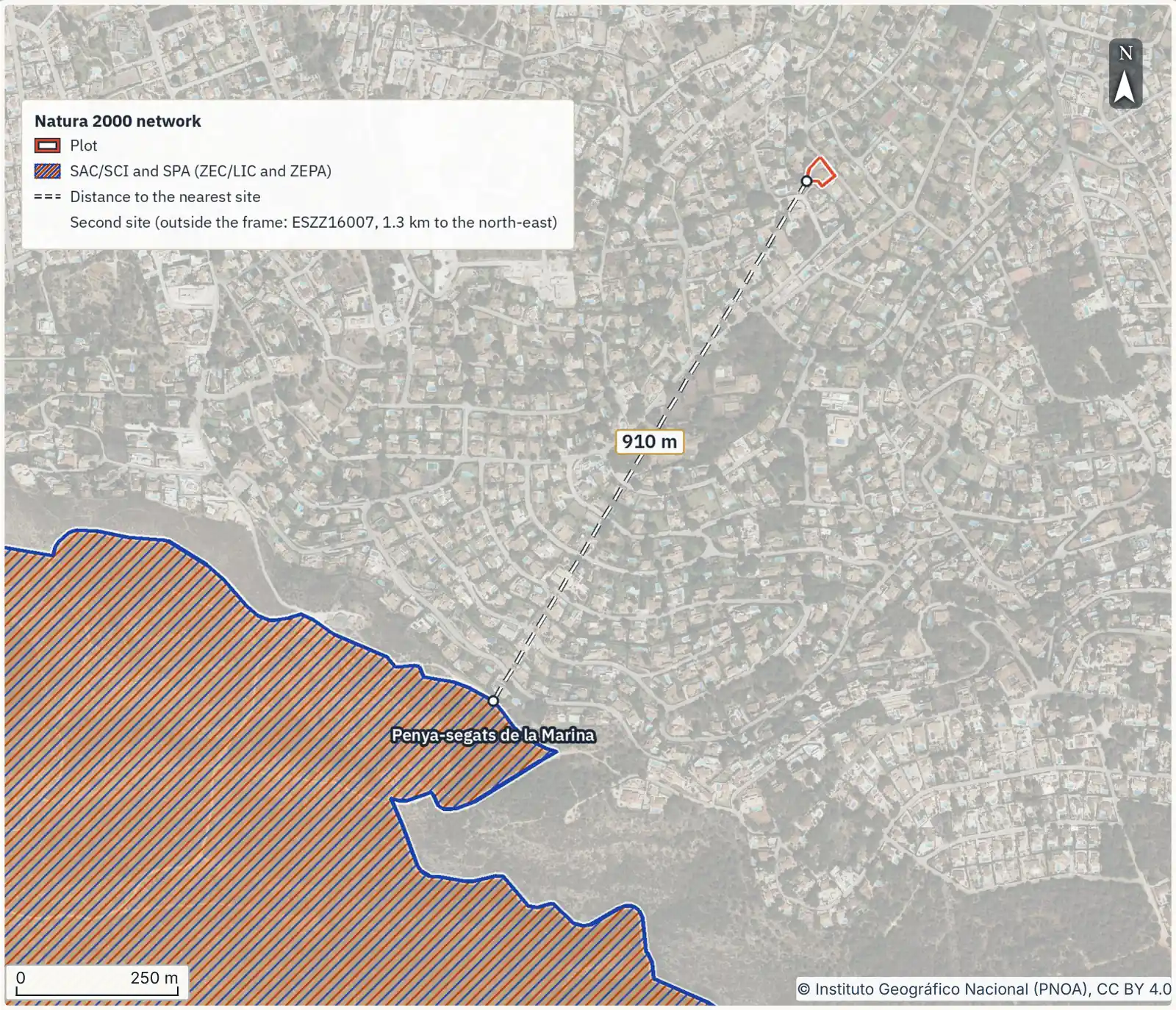
| Outside, but close | The plot is not inside the published polygon. | A project outside can still need assessment (article 46.4; Law 21/2013, article 7.2.b). | Describe access, service lines and wastewater and ask the managing authority. |
| Proposed LIC or PORN in progress | Preventive or interim protection applies before designation (articles 23 and 43.2). | A layer of designated sites may not show it. | Ask for the published decisions and their boundaries. |
| Marine site | As a rule the State carries out the law’s functions at sea (article 6.1). | The region may not be the one that answers, unless the site continues a protected area on land. | Ask the Ministry as well. |
| Nothing on the viewer | No published site at that scale or in that layer. | It does not rule out buffer zones, protected species or regional layers. | Check the regional portal. |
Note each site’s name and code and keep the map with its date. Sources: BOE, Natural Heritage Law 42/2007, article 42; BOE, Natural Heritage Law 42/2007, article 46; BOE, Natural Heritage Law 42/2007, article 6. Accessed 30 October 2026. Law 42/2007, articles 6, 23, 42, 43 and 46.
If the viewer does not load, MITECO offers downloads of Natura 2000 and of protected natural areas, including GeoJSON and KMZ, which a surveyor can compare with the plan. The ministry itself advises checking the regional websites, since much of its data comes from them. Keep the version you used: a screenshot without the site’s name does not settle a purchase.
Is a ZEPA the same as a natural park?
No. Law 42/2007 separates protected natural areas, including parks and reserves, from Natura 2000 sites. A park can coincide with a ZEC and a ZEPA; you need to check every regime, even when one document coordinates them.
LICs protect habitats and species of Community interest and become ZECs. ZEPAs protect birds. A LIC on the list approved by the European Commission is already subject to the assessment rule in article 46.4: protection does not wait for its designation as a ZEC (article 46.8). National parks are also governed by their own specific legislation (article 31.2).
Do not decide by the label. Ask for the site’s code, which habitats or species justify its protection and which rule governs your exact location. An answer about “the park” may be too general for a plot that crosses several zones.
What the PORN, the PRUG and the management plan decide
The PORN (natural resources plan) sets its own area and limits uses and activities. Check that area on your own plan, without assuming it ends at the park boundary. Where it contradicts town planning, the planning has to adapt and the PORN prevails meanwhile (Law 42/2007, article 19.2).
The PRUG (park use and management plan) sets the park’s general rules of use and management and also prevails over town planning (article 31.6). For Natura sites, the management plan or instrument sets conservation objectives and measures; it may be part of another plan (article 46.1.a).
Find the section on the use you need, its zone and its conditions. A permitted farming use does not settle a house or tourist accommodation. If you cannot find the plan, ask the managing authority.
To check the planning class and housing options separately, read the guide to rustic, urban and developable land. If the plan places the plot in specially protected land, the guide to the categories of non-developable land explains where that category comes from and where to read it. In the Balearic Islands, the regional planning guidelines ban new houses in ANEI areas: see rustic land in the Balearic Islands.
Building, extending or changing the use
Law 42/2007 gives no building allowance common to every ZEC and sets no national minimum plot size for a house in one. Planning rules and the site’s restrictions have to be read together. On rural land with protected values, only the changes the protection rules expressly authorise are possible (Land Law, article 13.1).
Give a description that separates what you want to buy from what you want to do:
| Project | What to describe | What to ask |
|---|---|---|
| New house or extension | Position, floor area, footprint and earthworks. | Ask first whether the use and the works are allowed at all. |
| Renovation or rebuilding | What is kept, what is demolished and the final use. | A licence for upkeep does not show that other work is viable. |
| Pool, fence or new track | Route and associated works. | Ask about the plan’s conditions and the effects on habitats and wildlife. |
| Services | Route of power and water lines, drainage and where wastewater goes. | An acceptable house does not settle these works automatically. |
| Farming or tourism use | Authorised use and planned change, with the installations needed. | Do not treat a change of activity as simple upkeep. |
Ask for the answer to name the rule and the consents for each part. Source: BOE, Land Law, article 13.1. Accessed 30 October 2026.
If the answer is “in principle it is possible”, ask what remains outstanding before the project can go ahead.
If the house exists and you only want to keep it
Compare the existing licences and authorisations with the real building and its use. Check which environmental conditions were imposed and whether the works you need are covered. Ask the seller for access to the files and check whether any enforcement or restoration proceedings are open.
Check whether the works needed environmental assessment and whether it was done before they were carried out. If it was skipped when required, do not buy assuming a study can simply be filed now: the impact assessment in Title II of Law 21/2013 is not carried out for article 7 projects already built, in whole or in part, without prior assessment (article 9.1). Your lawyer must work out the consequences and the legal route before you commit.
Also check whether the decisions you are shown for pending works are still valid. For a DIA, unless specific rules say otherwise, works start when, with every authorisation obtained, building or assembly has physically begun and the authority has a record of it; the developer must tell the environmental authority the start date (article 43.1). A photo of earthworks does not prove it on its own.
The age of the house does not show you can extend it, rebuild it or let it to tourists, and a neighbour’s permission does not decide what happens on your plot. For legality problems with the building, read the guide to unlicensed houses on rustic land.
When environmental assessment is required
Separate the strategic assessment of a plan or programme from the impact assessment of a project. The Natura assessment looks at the effects on the site against its conservation objectives and is carried out within those procedures.
The rule in article 46.4 of Law 42/2007 covers plans, programmes and projects not directly connected with or needed for the site’s management that could appreciably affect its species or habitats, alone or together with others. Being inside does not always mean an ordinary assessment, and being outside does not rule one out.
| Route | When | How it ends |
|---|---|---|
| Ordinary impact assessment | Annex I projects and the other cases in article 7.1. | An environmental impact statement (DIA). It lapses if works have not started within four years of publication (article 43.1). |
| Simplified assessment | Annex II projects, and projects in neither annex that could appreciably affect a Natura 2000 site, directly or indirectly (article 7.2.b). | An environmental impact report (IIA): it may call for ordinary assessment, find no significant adverse effects on the conditions it sets, or close the file for lack of information (article 47.2). A favourable one lapses if the project is not authorised within four years (article 47.4). |
| No Natura assessment (seventh additional provision) | The management plan expressly lists the activity as allowed, or the site’s managing authority reports that it will cause no appreciable adverse effects. | Ask for that plan section or report in writing; another reason for assessment may still apply. |
The DIA and the IIA can be extended once by two years if asked for before they expire (articles 43 and 47). Sources: BOE, Environmental Assessment Law 21/2013, article 7; BOE, Environmental Assessment Law 21/2013, article 43; BOE, Environmental Assessment Law 21/2013, article 47; BOE, Environmental Assessment Law 21/2013, seventh additional provision. Accessed 30 October 2026.
Where assessment is required, the developer (whoever is promoting the project) files the documents with the body that handles its authorisation. In the simplified route, the environmental document must include a specific section on Natura effects where the project could affect a site (article 45.1). Hire a professional who knows the site. If you are not yet the owner, agree in writing with the seller on access for surveys, inspection of files, their cooperation or authority to act where needed, and who pays for the documents if the purchase does not go ahead. Being a future buyer does not by itself make you the developer of an existing file.
After assessment, the authority may only approve if it is sure there will be no harm to the site’s integrity (article 46.4). Exceptions for overriding reasons of public interest need a law or a government decision for each case, plus compensatory measures (article 46.5): do not count on offsetting the harm of a private project to get a permit.
Any required assessment comes before authorisation or, where relevant, before a declaration of compliance, and an authorisation given without it is invalid (Law 21/2013, article 9). The authority’s silence never counts as a favourable assessment (article 10).
Where to check in each region
- Andalusia: the REDIAM planning page links each PORN and PRUG with its rules, annexes and zoning.
- Valencia region: use the regional government’s map viewer and ask the managing authority for the site’s rules.
- Region of Murcia: SITMurcia, Natural Heritage gathers access to the sites and Natura planning.
- Catalonia: the Generalitat’s list of map applications links to the protected natural areas viewer. Compare Natura with the PEIN (plan of areas of natural interest) and special protection designations, as the viewer manual explains.
- Balearic Islands: the official Natura mapping links to IDEIB. Check protected natural areas and their zoning too.
- Canary Islands: the planning system directory gives access to the mapping and documents for protected areas. Check the island plan as well.
What to ask in writing, and what it costs
Send the town hall and the regional nature authority a query identifying the plot, with a plan and a description of the work. You can write: “Please state the sites and plans that apply, the zone, whether the described use and works are compatible, and which reports, consents and assessment they need.” Ask them to say who handles each question: the site’s managing authority and the environmental assessment authority need not be the same body.
There is no single budget. Ask your surveyor and lawyer for fees and a timetable, and the authority for the fees of the specific procedure. Ask whether site visits or species surveys are needed at particular times of year before you set the deposit.
In Murcia, procedure 482 for authorisations and reports charges no fee to start, has a 3-month decision period and silence means refusal. That is not the timescale of every environmental assessment or of the building licence.
Pre-emption in protected areas
Designating a protected natural area gives the region pre-emption and buy-back rights (tanteo and retracto) over sales and other paid transactions on property inside it (Law 42/2007, article 40). The seller must give formal notice of the price and main terms, and regional law sets the time limits. Registrars will not register the transfer without proof of that notice.
Your lawyer should check the notice, that it matches the deal being made, and the waiver or the expiry of the applicable period. Proof of notice does not by itself show the right has ended. Check the site’s regime: the law ties these rights to protected natural areas, not to every plot just because it is in Natura.
Three hypothetical scenarios
These are invented examples to show the method, not real plots or results from any viewer.
1. A farmhouse outside the ZEPA with its track inside
Imagine a house 300 metres from a ZEPA whose only access crosses the site, and which you want to widen and surface. The house is outside, but the track works could appreciably affect the birds. Ask the managing authority whether simplified assessment is needed or whether the management plan expressly allows that work, before paying for a house you might not reach the way you plan.
2. A farm building turned into a home inside a park
Imagine a farm building inside a natural park, in a PRUG zone that allows farming uses. The listing sells it as a “house with potential”. The PRUG prevails over town planning, and a permitted farming use does not settle a home. Without a written answer from the managing authority and the town hall on the change of use, the price should be that of a farm building.
3. An extension with an old environmental report
Imagine the seller holds a favourable environmental impact report for extending the house, published five years ago, and the licence was never applied for. Unless it was extended, the report lapses four years after publication without the project being authorised. Expect to repeat the procedure, and do not pay for the extension as if it were granted.
When to stop
The list does not replace a lawyer. It tells you whether you can pay now or whether a specific document is still missing.
What to write into the arras contract
If answers are still missing, agree with your lawyer a condition tied to the project and an attached plan. Identify the plot by its cadastral reference and registry details and describe the planned work and use. Name the answers or consents that must arrive: sites and plans that apply, compatibility of the use and works, whether assessment is needed and, for a protected natural area, the pre-emption notice and its outcome. Set the deadline and a refund of every amount if they are refused or do not arrive, and say who refunds each payment, including the agency’s reservation fee.
This is protection you negotiate: there is no automatic refund for being in Natura. Provide for a partial result too, such as an acceptable house whose access needs assessment, and write down whether you may withdraw, renegotiate or go ahead. More in the guide to the arras contract.
The buyer’s sequence before the deposit
- Get the plot’s exact cadastral reference and registry details.
- Place the plot, house, access and service lines on the MITECO viewer and keep the capture with names, codes and date.
- Find the designation act, the plan in force and the zoning on the regional portal.
- Ask the town hall for written planning information on the plot and the intended use.
- Send the managing authority your query with the plan and description of the work.
- Confirm with the environmental authority whether the project needs assessment and by which route.
- Ask the seller for the house’s licences, authorisations and environmental decisions, with their dates.
- For a protected natural area, check the pre-emption notice with your lawyer.
- Only then compare the price with what you can really do with the plot. A TerrenoCheck report organises the public checks in its protected nature chapter, but it does not replace these answers or your lawyer.
Questions to send before money moves
- Which Natura 2000 sites and protected natural areas cover the plot, and with which codes?
- Which plan applies to each part of the plot, and which zone does each work fall in?
- Is a PORN being prepared, or a LIC proposed, that affects the area?
- Are the use and works I describe compatible with the plan?
- Does the project need environmental assessment? Ordinary, simplified or none, and why?
- Do the access, service lines or wastewater affect any site?
- Which licences and environmental decisions does the house have, and are they still valid?
- Are any enforcement or restoration proceedings open?
- Does the region hold a pre-emption right? Has notice been given?
- What happens to each payment if an answer does not arrive by the agreed date?
A map of protected areas is useful because it tells you what to ask next. Keep the capture, the plan and the answers together with their dates, and let the managing authority, the town hall and your lawyer confirm whether the purchase you have in mind still makes sense.
Common questions
Can you buy property within Natura 2000?
Yes. The designation alone does not prevent a sale. Check the restrictions on the use you need and whether any pre-emption right applies. Being able to buy it does not show you can build.
Can land outside a natural park need assessment?
Yes, if the project could appreciably affect a Natura site, even indirectly (Law 21/2013, article 7.2.b). Check too for a peripheral protection zone and the PORN’s area. The park line does not settle every effect.
Does every renovation in a ZEC need ordinary impact assessment?
Not because of the location alone. It depends on the project, its effects, the legal cases and the rules that apply. Ask for the specific procedure to be justified; a renovation can need other consents even without ordinary assessment.
Does a favourable environmental report replace the building licence?
No. Check its conditions and obtain the consents the project needs. A preliminary answer on compatibility is not a licence either, and it does not cover works other than those you asked about.
Can existing farming continue without checking the rules?
Review the management measures and the conditions of existing consents. Ask about any change you plan, such as new infrastructure or reshaping the land, even if the farming predates the protection.
Does the report include protected areas?
Partly. The protected nature chapter places the plot against Natura 2000 and protected natural areas, with the distance and what to ask. It does not replace the management plan, the managing authority’s answer or an environmental assessment.
Keep reading
Check this on your own plot
Pin the plot on the map and confirm the cadastral reference: the report gathers the public data and official maps for it, each with its source and date. It does not replace the land registry extract, the notary or a tax adviser. €29 VAT included.