Pillar: Planning and buildings
Which occupancy licence or habitability certificate does a home need?

On this page
An electricity bill is no substitute for permission to live in a house. Establish which document the region requires, whether it covers the home you viewed and what is missing before paying a deposit.
Have a specific plot in mind? The report gathers the public data and official maps for it, with source and date, for €29 VAT included. Pin it on the map →
An electricity bill does not prove that a house may lawfully be lived in. Before you pay a reservation fee or a deposit (arras), ask for the title that allows that home to be occupied: a town hall licence, a cédula de habitabilidad (habitability certificate) or a declaración responsable or prior notice filed with its documents. The region and the state of the building decide which. This page sets out what to ask for in Andalusia, the Valencia region, Murcia, Catalonia, the Balearic Islands and the Canary Islands, how to check that the paper covers the house you visited, and what to write into the contract if it is missing.
For the completion date, see the evidence for a building age certificate.
Licence, cédula and declaration: what each one is
A first-occupation licence (licencia de primera ocupación) checks, where it is required, that what was built matches the permit and may be used. A cédula de habitabilidad shows the technical conditions for using a property as a home. The names are not interchangeable across Spain, and “second occupation” does not mean the process is repeated whenever the owner changes.
A declaración responsable is signed by the applicant: they state that they meet the requirements and hold the documents that prove it. The entry stamp is not a town hall approval. The town hall keeps its power to check, and an essential inaccuracy, falsehood or omission can stop occupation (Law 39/2015, article 69).
| What you are shown | What it means | What it does not prove | First step |
|---|---|---|---|
| Electricity or water bill | There is a supply contract in someone’s name. | That the use or the extensions were authorised, or that the supply is not a temporary works supply. | Ask each company in writing what it needs for your case. |
| Stamped declaration | The declaration was filed on that date. | That the town hall approved it: it keeps its power to check, and a false or missing essential item can stop occupation (Law 39/2015, article 69). | Ask for the annexes and any later letters from the town hall. |
| Cédula with a date | The home met the technical conditions when it was issued. | That it is still in force, that it covers later works or that the home is lawful under planning rules. | Read the date and regime; ask a technician to compare plans and reality. |
| House in the deed or nota simple | The building is described in the Registry. | That it may be lived in lawfully. | Ask for the planning file and the occupancy title. |
| Catastro entry | The Catastro records a building of that size. | Anything about licences or occupation. | Use it to ask which licence covers each building. |
Neither utilities nor a Registry entry settle whether the house is lawful. Sources: BOE, Law 39/2015, article 69; BOE, Land Act, article 28. Accessed 30 October 2026.
What to ask for in each region
Look the document up by where the house is. For another region, ask the town hall which regime applies; do not carry over the periods or requirements on this page.
Andalusia: a declaration for occupation
The LISTA (Law 7/2021) makes the occupation of finished buildings covered by a licence or works declaration, built as permitted and used as the rules allow, subject to a declaración responsable (article 138.1.d). New works add the final works certificate; existing buildings, a descriptive and graphic certificate (article 138.3). Any prior sector authorisations must already be in hand (article 138.4).
With the required documents, the declaration takes effect on the day it is filed, subject to later checks (article 138.5). There is also a route for existing buildings in urban land not under redevelopment that comply with the plan or are lawfully outside it and have had no works (article 138.1.e). That route is not a general way in for any unlicensed rural house.
If you are offered a house with AFO status (asimilado a fuera de ordenación, an irregular building that can no longer be demolished), ask for the full decision. AFO status does not legalise the building (article 174.1). Access to basic services can be authorised as long as only the connection works to existing networks are needed, and the companies confirm the connection is feasible (article 174.3). Do not assume it allows an extension or a change of use. When the time limit for ordering demolition runs out in each region is explained in the guide to planning-offence time limits. An irregular cave under an AFO also has its own minimum standards for ventilation and openings: see buying a cave house.
A change of holder of a licence or declaration must be notified to the town hall. Without that notice, buyer and seller are jointly liable for what is done under the title (article 138.6.a). Agree before the deposit who will file it and hand you the receipt. It is not a repeat of first occupation.
Source: BOE, Andalusian LISTA, articles 138, 142 and 174. Accessed 30 October 2026.
Valencia region: first and second occupation
First occupation and the second and later occupation of homes are subject to a declaración responsable (TRLOTUP, article 233.1.f). Decree 12/2021 sets the documents and effects, and the declaration goes to the town hall where the home is.
| Region | Period | When it matters | Basis |
|---|---|---|---|
| Valencia region | 10 years from the first occupation title | On a second or later sale of the property, or a new water, gas or electricity contract. A change of supplier by the same holder is not a new contract. | Law 3/2004, article 33; Decree 12/2021 |
| Valencia region, building never titled | No 10-year wait | The same two events require the title. | Law 3/2004, article 33.3 |
| Catalonia | 25 years (first occupation of a new build); 15 years (second occupation, renovation) | Read the date and regime of the cédula you are given; do not apply these periods to an old cédula automatically. | Generalitat |
| Balearic Islands, new regime | 10 years from the occupancy licence | A renewal cédula is applied for. | Law 7/2024, article 53.3 |
| Balearic Islands, older cédula | Expires 10 years after issue, whoever owns it | Counted from issue, not from the licence. Check the island’s regime. | Decree 145/1997, article 13 |
There is no national ten-year expiry. Sources: BOE, Valencian Law 3/2004, articles 32 and 33; DOGV, Valencian Decree 12/2021; Generalitat, first-occupation cédula; BOE, Balearic Law 7/2024, article 53; BOE, Balearic housing code (Decree 145/1997). Accessed 30 October 2026.
Significant works or a change of use need a new title whatever the age of the previous one (Law 3/2004, article 33.4). Do not treat a store turned into a house as a simple second occupation. For a new subsidised home, the final classification replaces the occupancy licence on the first sale; later sales follow the general rules (article 33.5).
Before relying on a declaration, check whether the town hall had opened a planning enforcement file: occupation declarations filed in those circumstances have no validity or effect (Decree 12/2021, article 2.5). The technical certificate filed with a second-occupation declaration is valid for three months from signature; that is not how long the title lasts. A town hall request to correct the file suspends the declaration’s effects.
Sources: BOE, Valencian TRLOTUP, article 233.1.f; BOE, Valencian Law 3/2004, articles 32 and 33; DOGV, Valencian Decree 12/2021. Accessed 30 October 2026.
Murcia: first and later occupation
Law 13/2015 makes first occupation of new buildings and later occupations of existing ones subject to a declaración responsable (article 264.2.f). That letter was amended by Decree-law 3/2026 of 3 July. Do not rely on an old form without checking the current one.
Ask for the filed document, the location plan, the supporting documents and proof that the fees were paid (article 264.4). The declaration takes effect from the day all the required documents are filed with the town hall’s register (article 266.4), and the town hall may ask for more within the next fifteen working days. Check whether anything was left pending.
Source: BOE, Murcian Law 13/2015, articles 264 and 266. Accessed 30 October 2026.
Catalonia: a valid cédula on every sale
A home may only be occupied once it has a cédula de habitabilidad or, for subsidised housing, the final classification. Any sale, lease or transfer of use, including second and later ones, requires the valid cédula to be handed over or made available, save for the exemptions in article 132.a (Law 18/2007, article 26.1–2). Power, water and gas companies require it to connect (article 26.3).
For a used home, the buyer may expressly release the seller where the house will be renovated or demolished, where both parties state it will not be used as a home, or in other cases set by regulation. Renovation needs a technician’s report showing that a cédula can be obtained after the works (article 132.a). Do not sign a general waiver.
The cédula does not make the residential use lawful under planning rules; if the process shows that the use may not be lawful, the cédula must say so and the notary must warn the buyer (article 26.5 bis). Losing the minimum habitability conditions revokes it (article 26.6). For a new build, the Generalitat issues the cédula after the town hall’s first-occupation notice: they are separate documents.
Sources: BOE, Catalan Law 18/2007, articles 26 and 132; Generalitat, first-occupation cédula; Generalitat, second-occupation cédula. Accessed 30 October 2026.
Balearic Islands: occupancy licence and renewal cédula
Law 7/2024 replaced the first-occupation cédula with the occupancy or first-use licence on all the islands, subject to what each island council decides, and ten years after the licence a renewal cédula is applied for (article 53). The reform does not on its own invalidate an earlier cédula, but that cédula expires ten years after it was issued (Decree 145/1997, article 13).
If a house finished before 1 March 1987 never had a cédula, ask the island council whether a cédula de carencia applies (Decree 145/1997, article 8.c). The age of the house is not enough and does not legalise its works.
Every sale must include a copy of the title in force; if there is none, that must be stated expressly in the private contract or the deed (Law 5/2018, article 16.4). Recording that it is missing does not allow occupation, and companies require the title in force for a permanent supply (article 16.3). For subsidised housing, the final classification replaces the cédula on first occupation (article 16.2). Losing the minimum conditions revokes the cédula (article 16.5).
Sources: BOE, Balearic Law 7/2024, article 53; BOE, Balearic Law 5/2018, article 16; BOE, Balearic housing code (Decree 145/1997). Accessed 30 October 2026.
Canary Islands: prior notice and a one-month wait
Law 4/2017 makes first occupation subject to a prior notice (comunicación previa, article 332.1.c). Decree 182/2018 replaced references to the cédula de habitabilidad with that notice, together with the matching habitability certificate.
For buildings put up under a permit, the notice comes with that permit and the final works certificate (Regulation, article 33.1). The house may only be occupied one month after the complete notice is filed, or after the required correction (article 33.2). A receipt from yesterday does not let you move in today. Buildings outside the plan have their own route, which requires proof of structural safety and habitability (article 34).
Sources: BOE, Canary Law 4/2017, article 332; BOC, Canary Decree 182/2018. Accessed 30 October 2026.
Power and water: why the companies ask for the title
Several regional laws tie the supply contract to the occupancy title. In Andalusia a temporary works supply lasts as long as the works permit; a permanent one needs the occupancy licence, the declaration or the AFO decision (LISTA, article 142). Catalonia and the Balearic Islands require the cédula or an equivalent title, and in the Valencia region a new contract can trigger the renewal.
Ask each company in writing whether your case is a change of holder of a live supply, the reconnection of a closed one or a new connection. An occupancy title is not a connection quote. More in the guide on power, water and sewage on rustic land.
What the notary checks
For a deed declaring a finished new building, the notary requires the technician’s completion certificate and the authorisations showing the building is fit for its use; where the region uses a declaration or notice, its filing and the expiry of the waiting period are shown instead, with no blocking decision in the Land Registry. The registrar requires the same to register it (Land Act, article 28.1–2).
That is not the same as requiring one licence for every resale. Catalonia has its cédula and exemption rules; the Balearic Islands require the title to be attached or its absence stated. Send the file to the notary before fixing the signing date and ask which document they will require. A house described in the deed or the nota simple is not proof that it may be lived in.
If the document is missing: fees, technician and works
Tell three cases apart: a lost copy, an expired title and no title from the start. In the first, ask the seller to obtain the record; in the second, have a technician check the renewal; in the third, the problem may lie in the use or the works, not in printing another certificate.
Split the quote into the town hall fee, the technician’s work and any works. A declaración responsable may carry a fee: it is not free. The amount depends on the local bylaw, and there is no single Spanish price or timescale that can be promised without reading the file.
Four hypothetical scenarios
These are invented examples to show the method, not real cases.
1. A house in Alicante with a 2009 first-occupation title
Imagine a home whose first-occupation title dates from 2009 and which is now being sold for the second time. More than ten years have passed, so the sale requires the title to be renewed with a second-occupation declaration and its technical certificate. Agree who files it and by when.
2. An annexe turned into a bedroom in Andalusia
Imagine a house with a 2015 occupation declaration and a store the seller turned into a bedroom in 2020 without a licence. The declaration covers the permitted house, not the store. The price should start from what is covered, and the bedroom needs its own review.
3. A house in Mallorca with a 2012 cédula
Imagine a cédula issued in 2012 under the old regime. It expired ten years after issue. The sale must include the title in force or state that it is missing, and without it the company will not give a permanent contract. Ask for the renewal before completion.
4. A new build in Tenerife with yesterday’s receipt
Imagine the seller filed the complete prior notice yesterday. The house cannot be occupied until a month has passed. If the keys are due earlier, agree what happens if a request to correct the file arrives.
When to hold the deposit
The list does not replace your lawyer or the technician. It tells you whether you can pay now or whether a specific document is still missing.
What to write into the arras contract
Ask your lawyer to set out what the seller must deliver: the occupancy title the region requires, with its annexes and receipts, the works file and, if a renewal is due, the filed declaration. Fix who pays for the checks, the deadline and a full refund of the reservation fee and the deposit if the condition fails. If the fix involves works, write down their scope and which document will show the problem is solved. In Catalonia, any release from the cédula must name the legal ground. More in the guide to the arras contract.
The buyer’s sequence before the deposit
- Identify the region and ask the town hall which title this home needs and whether it needs renewing.
- Ask the seller for the full title, its annexes and any later requests or decisions.
- Check with the town hall whether any planning enforcement file is open.
- Have an independent technician compare plans and house, annexes included, and its current habitability.
- Confirm validity and corrections and, in the Canary Islands, that the month since the complete notice has passed.
- Ask the companies in writing what they need for your supply.
- Send the file to the notary and ask which document the deed will need.
- Agree in the arras contract on delivery, a deadline and a refund if the condition fails.
Questions to send before money moves
- Which occupancy title does the home have, and from what date?
- Does it cover the house as it is today, with its annexes and extensions?
- Does it need renewing with this sale or with a new supply contract?
- Was a correction requested after it was filed? How was it resolved?
- Is any planning enforcement file open on the property?
- Are the supplies permanent, temporary works supplies or disconnected?
- If the house has AFO status, can I see the full decision?
- Who will notify the town hall of the change of holder of the title?
- What happens to my payment if the title does not arrive by the agreed date?
An occupancy title is for one house on one date. Keep the title, the plans and the town hall’s answer together, and let your technician and lawyer confirm that they match what you are buying.
Common questions
Can I buy a house without a first-occupation licence?
There is no single answer for all of Spain. Another title may apply, a documented exception may exist or its absence may have to be stated. Being able to sign the sale does not show that you may move in or connect utilities. Settle it before the deposit.
Does a cédula de habitabilidad legalise a rural house?
No. Catalan law says so expressly: the cédula does not make the residential use lawful. Compare the use and the works with the town hall file even if there is a cédula, utilities and a Registry description.
Is a stamped declaración responsable the same as a granted licence?
No. It shows that it was filed, with effects that depend on the legal requirements and a complete file. Ask for the annexes and later letters. The authorities can act if requirements are missing or the statement is untrue.
Do all licences expire after ten years?
It is not a national rule. The Valencia region requires renewal after ten years on a sale or a new supply; the Balearic Islands require a renewal cédula ten years after the licence; Catalonia has its own periods. Check the actual document.
Is it enough that the house has water and electricity?
No. Check the occupancy title and ask the companies what they need for your case. A temporary works supply does not replace a permanent home supply.
Does the TerrenoCheck report check the occupancy licence?
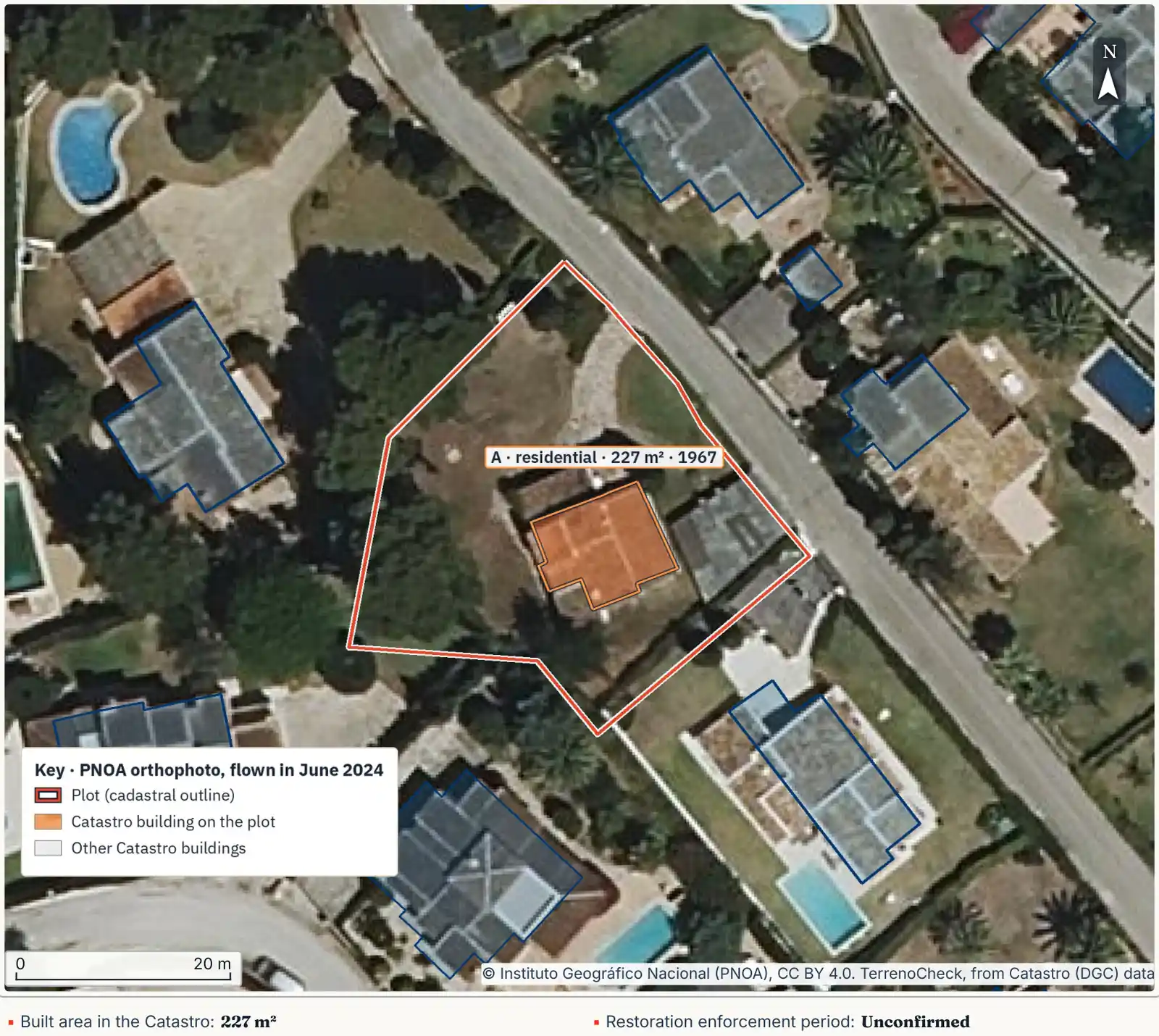
No. The report compares what the Catastro records with what aerial photos show and helps you ask which licence covers each building. It does not obtain the title or confirm that it is valid.
Keep reading
Check this on your own plot
Pin the plot on the map and confirm the cadastral reference: the report gathers the public data and official maps for it, each with its source and date. It does not replace the land registry extract, the notary or a tax adviser. €29 VAT included.