Can I legally offer holiday lets in the Spanish home I want to buy?

On this page
An existing holiday listing does not establish your right to operate after buying. Check local planning, the regional tourism file and any owners' association, with a separate review for rural accommodation.
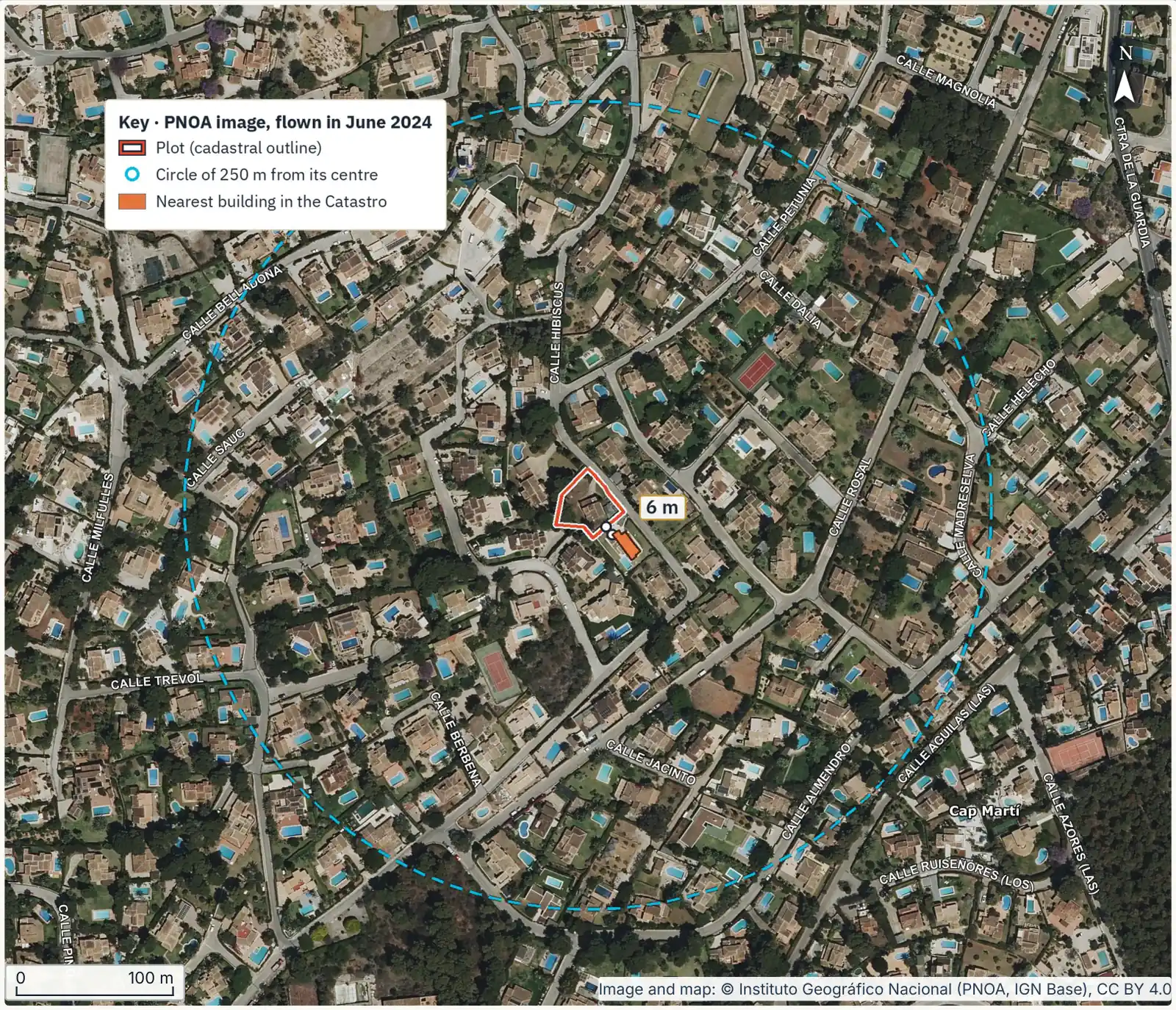
Have a specific plot in mind? The report gathers the public data and official maps for it, with source and date, for €29 VAT included. Pin it on the map →
A live listing does not show that you could keep letting to tourists after you buy. Four things have to fit: local planning must allow the use, the regional tourism requirements must be met, the owners’ community must have approved it where that is needed, and the building must be authorised. This page sets out what to check, in that order, before you pay a reservation fee or a deposit (arras), and what changed in 2026 with the state register.
What permission are you actually buying?
There is no national tourist licence. The vivienda de uso turístico (VUT), a tourist home, is a category set by each region, and a casa rural is rural accommodation with its own rules, not a way to advertise any country house. Send the town hall and the tourism authority the cadastral reference, the Land Registry details and a plan, and describe the operation: whole home or rooms, guest capacity, seasons and planned works. Ask which category and which permissions you would need as the new owner.
A declaración responsable is a signed statement that you meet the requirements, hold the documents that prove it and will keep complying (Law 39/2015, article 69). It does not prove that an official has checked everything. Ask the town hall for a written view of tourist use at that address, with any suspensions or files affecting the property. If you plan works, check what the town plan allows too.
The 2025 state register, annulled in 2026
RD 1312/2024 created a state registration number, requested from the Land Registry or the Movable Property Registry, to advertise tourist and short-term lets on platforms. It never replaced regional tourism permission.
The Supreme Court judgment of 19 May 2026, published in the BOE, annulled the provisions on the single rental registration procedure and the duty to register. The decree’s consolidated text records this and notes a second judgment, of 1 June 2026, to the same effect. The Ventanilla Única Digital de Arrendamientos, the digital gateway for exchanging data with platforms, is still defined in the decree.
| What you are shown | What it means | What it does not prove | First step |
|---|---|---|---|
| Live listing with reviews | The home has been let to guests. | That the letting is lawful, or that you could continue it after buying. | Ask for the tourism file and the town hall’s position for the address. |
| Old NRA or NRUA number | The seller applied under the 2025 state scheme. | Anything after the 2026 annulment; it is not a transferable licence. | Ask the regional authority which identifier applies to this unit now. |
| Regional tourism registration | A declaration was filed under the regional rules. | That an inspector approved everything, that the community agreed or that the works were authorised. | Ask for the full file, any inspection and what changes on a sale. |
| Statutes silent on tourist letting | There is no express ban in the statutes. | Approval: since 3 April 2025 the community must approve it expressly (LPH). | Ask for a certificate of the resolution with the votes and shares. |
| Cadastral entry or power supply | The building exists and has a supply. | That tourist use, or the building itself, is authorised. | An architect compares what stands with the licences. |
Each paper opens only one of the keys. Sources: BOE, Horizontal Property Law, article 7.3; BOE, RD 1312/2024 (consolidated text with the annulments). Accessed 30 October 2026.
Can the owners’ community stop tourist letting?
Since 3 April 2025, in communities governed by the state Horizontal Property Law, an owner who wants to start tourist letting must first obtain the community’s express approval (LPH, article 7.3). Statutes that say nothing are not approval, and neither is another flat in the building already hosting guests.
Approving, limiting, conditioning or banning the activity needs the votes of three fifths of all owners who also hold three fifths of the shares (article 17.12). The same majority can set special charges or raise that home’s share of common costs by up to 20%, with no retroactive effect. It is not an automatic surcharge or a percentage of booking income.
| Situation | What applies | Majority or check |
|---|---|---|
| Starting tourist letting in a flat (state LPH) | Express prior approval of the community (article 7.3) | Three fifths of all owners who also hold three fifths of the shares (article 17.12) |
| Limiting, conditioning or banning the activity | A resolution of the meeting; it binds you as buyer subject to legal review | The same double three-fifths majority |
| Extra charges on the tourist flat | Up to a 20% increase in its share of common costs; no retroactive effect | The same majority (article 17.12) |
| Owner already letting before 3 April 2025 | May continue on the conditions and terms of the tourism rules (second additional provision) | Lawyer checks whether the seller qualifies and what the sale changes |
| Catalonia | Its own Civil Code: changes to the title or statutes need four fifths (article 553-26.2.a) | Four fifths of owners entitled to vote and four fifths of the shares |
Count all owners and all shares, not just those at the meeting. Sources: BOE, Horizontal Property Law, articles 7.3 and 17.12; BOE, Catalan Civil Code, article 553-26. Accessed 30 October 2026.
An owner already letting before 3 April 2025 under the tourism rules may continue on their conditions and terms (LPH, second additional provision). An old registration date alone does not prove it, and your lawyer must check whether the sale changes anything. Catalonia follows its own Civil Code: changing the title or statutes needs four fifths of owners entitled to vote and four fifths of the shares (article 553-26.2.a).
What changes from region to region
Andalusia: tourist home or rural accommodation?
Decree 28/2016 on tourist homes leaves out homes in the medio rural, the rural setting, which follow Decree 20/2002 on rural tourism, subject to its article 9.3. Ask the tourism authority whether the building counts as vivienda turística de alojamiento rural, casa rural or VUT. The same decree excludes homes recognised as asimilado a fuera de ordenación (AFO), a status for certain irregular buildings, unless the town hall gives express prior authorisation for the change of activity. That authorisation does not legalise works. Read the guide to irregular houses on rustic land first.
Source: BOJA, Decree 28/2016, article 1 (consolidated text). Accessed 30 October 2026.
Valencia: whole home and ten days
A VUT is a whole property let for tourist purposes for up to 10 consecutive days to the same guest, with a favourable municipal planning-compatibility report or equivalent and any municipal permits required. Letting rooms to tourists is banned, and registration in the tourism register lasts five years, with the exceptions in the law (Law 15/2018, article 65). Ask the tourism authority what you must file as the new owner before assuming you inherit the seller’s position.
Source: BOE, Valencian Law 15/2018, article 65. Accessed 30 October 2026.
Catalonia: prior planning licence
In the towns listed in the annex to Decreto-ley 3/2023, using a home for tourists requires a prior planning licence lasting five years. Homes already authorised in those towns have five years to obtain the licence or stop, with a single possible extension on the decree’s terms. Ask the town hall which regime applies to the address and the file; the transition does not guarantee renewal.
Source: BOE, Catalan Decreto-ley 3/2023. Accessed 30 October 2026.
Balearics and Canaries
In the Balearics, the DRIAT, the declaration that starts a tourist activity, does not replace a suitable zone or tourism places. A final sanction for a serious or very serious planning breach prevents marketing until planning legality is restored, and a home with a final sanction cannot change holder in the tourism register until the debt to the tourism authority is paid (Law 8/2012, article 50.4). Ask for the receipt.
In the Canaries, Law 6/2025 separates residential use from tourist use: for a new declaration, residential zoning alone is not enough. What matters most to a buyer is consolidated use: it lapses when the property is transferred by any title, with an exception for inheritance. For certain earlier declarations with no prior notice of activity to the town hall, Law 7/2026 allows that notice before 31 July 2027, with the documents it requires.
| Case | Rule | Duration or limit |
|---|---|---|
| Balearics, flat in horizontal property | No new start-of-activity declarations, except terraced and semi-detached homes and principal-home letting (Decreto-ley 4/2025) | Existing files run for five years by default and are extended only if every requirement is still met |
| Balearics, principal home | Letting the owner’s main residence, up to 60 days a year in whole months, in a zone declared suitable | Five years by default; renewal needs proof it is still the main home |
| Balearics, new activity | Minimum building age, five years by default, with private residential use in that period | No new activity on protected rustic land unless island planning provides otherwise |
| Canaries, new declaration | Planning must allow tourist use; the home must be ten years old, or five on El Hierro, La Gomera, La Palma and demographic-challenge towns | The declaration runs five years, or ten in those places (article 10) |
| Canaries, consolidated use | Lapses when the property is transferred by any title, with an exception for inheritance (Law 7/2026) | Ask the town hall and cabildo what you could continue after buying |
The islands have the strictest rules: check the specific file. Sources: BOE, Balearic Law 8/2012, article 50; BOE, Balearic Decreto-ley 4/2025; BOE, Canarian Law 6/2025; BOC, Canarian Law 7/2026. Accessed 30 October 2026.
Seasonal lets are not a way round
Since 8 October 2026, a temporary housing lease must state a real, provable reason for the tenant’s temporary move, and the landlord bears the burden of proof. Without that reason, the contract falls under the rules for a main-home tenancy from the day it was signed (LAU, articles 2.3 and 7.2). The tourist letting described in article 5.e cannot exceed 31 days, and the region may set less. Renaming the contract does not avoid these rules.
Source: BOE, Urban Leases Act, articles 2.3, 5.e and 7.2. Accessed 30 October 2026.
Rustic land: registration does not authorise works
A tourism registration does not authorise a new house, rebuilding a ruin or turning a farm store into bedrooms. Ask an architect to compare the house, annexes and pool with what was authorised. If the pool is not in the licence, read the guide to pools on rustic land. A cadastral entry, a power contract or past guests do not prove authorised tourist use. In the Balearics, new activity on protected rustic land is also banned unless island planning provides otherwise with reasons (article 50.18).
Three hypothetical scenarios
These are invented examples to show the method, not real homes.
1. A flat with a listing and no community resolution
Imagine a coastal flat advertised since 2023 with good reviews. The statutes say nothing and the meeting has never voted. Unless the seller proves they were already letting under the tourism rules before 3 April 2025, you would need express approval by three fifths. Before the deposit: a certificate of the resolution, or a condition that lets you withdraw.
2. A farmhouse with a store turned into bedrooms
Imagine a house on non-developable land with an old licence and a store converted into three bedrooms without one. The tourism register counts the beds but does not legalise the store. The price should start from the house with only its authorised places, and the tourism authority confirms the rural category.
3. A Canary Islands holiday home with consolidated use
Imagine the seller lets the home under a consolidated-use declaration. The transfer of ownership makes it lapse. If your plan depends on letting, ask the town hall and the cabildo in writing what you could do, and value the property as a home.
When the deposit should wait
The list does not replace your lawyer. It tells you whether you can pay now or whether a specific document is still missing.
What to write into the arras contract
If tourist income is essential, negotiate an express condition in both the reservation and the deposit agreement. Parties may agree the conditions they see fit within the law (Civil Code, article 1255), but writing “tourist licence” does not by itself give you a right to a refund. Identify the property, whether it will be let whole or by rooms, and the guest capacity. List the documents and approvals you, or the operator you appoint, need to operate after the sale. Set the deadline, a full refund if approval is refused or documents do not arrive, and the repayment period. Deal expressly with the reservation fee and agency fees. The clause cannot force an authority or the neighbours to approve anything. More in the guide to the arras contract.
Source: BOE, Civil Code, article 1255. Accessed 30 October 2026.
The buyer’s sequence before the deposit
- Get the cadastral reference, the Registry details and the complete tourism file.
- Ask the town hall for a written view of tourist use at the address and any suspensions in force.
- Ask the tourism authority which category applies and what you must file as the new owner.
- If it is horizontal property, ask for the title, statutes and a certificate of any resolution on tourist letting.
- Have an architect compare what stands with the licences and the tourism requirements.
- In the Balearics and Canaries, check places, zone, building age, sanctions and whether the use depends on the seller personally.
- Work out income with insurance, tax and running costs, without assuming the permission continues.
- Only then negotiate the price. A TerrenoCheck report places the plot and prepares questions for the town hall, but it does not replace these documents or your lawyer.
Questions to send before money moves
- Which tourism category does the home hold, with what number and date?
- Does planning allow tourist use at this address? Is any suspension in force?
- What must a new owner file to continue the activity?
- Are there inspections, notices or sanctions on the file?
- Did the community expressly approve the activity? With what votes and shares?
- Is there any resolution limiting, conditioning or banning tourist letting?
- Which parts of the house and annexes have a licence?
- Does the permission depend on the seller’s personal status?
- How many guest places are authorised, and until when?
- What happens to the reservation fee and the deposit if an approval does not arrive by the agreed date?
A listing with reviews tells you what happened, not what you will be allowed to do. Gather the town hall’s answer, the tourism file and the community resolution before you put a price on the income.
Common questions
Does the seller’s tourism number pass to me automatically?
Do not assume it does. Ask for the file and what the tourism authority requires for a change of holder. In the Canaries, consolidated use lapses on transfer; in the Balearics, a sanctioned home cannot change holder until the tourism debt is paid.
Can the community ban letting even if it is registered with tourism?
Yes. Under the state LPH, approving, limiting, conditioning or banning the activity needs three fifths of owners and of shares, and a tourism registration does not replace that approval. Activity started before 3 April 2025 is assessed separately, and Catalonia follows its own Civil Code.
Should I apply now for the NRA number under RD 1312/2024?
The Supreme Court annulled the provisions imposing that state register in 2026. Do not follow old instructions as if they were current law. Ask the tourism authority and the platform which identifier applies. The annulment does not remove regional requirements or municipal controls.
Can I avoid tourism rules by calling bookings seasonal lets?
No. Since 8 October 2026, a temporary lease must state a real, provable reason, with the burden of proof on the landlord; without it, main-home tenancy rules apply from signing (LAU, articles 2.3 and 7.2).
Can an irregular house be registered as a casa rural?
A tourism registration does not legalise the building. Confirm the rural category and the licences for the house, annexes and intended use. A declaration of compliance does not erase breaches or prevent a later inspection.
Keep reading
Check this on your own plot
Pin the plot on the map and confirm the cadastral reference: the report gathers the public data and official maps for it, each with its source and date. It does not replace the land registry extract, the notary or a tax adviser. €29 VAT included.