Buying in Spain: which community debts and costs follow the home?

On this page
Before paying a deposit, check the owners’ association account and future extra charges. A detached house can have shared estate costs too, including a separate obligation to maintain public infrastructure.
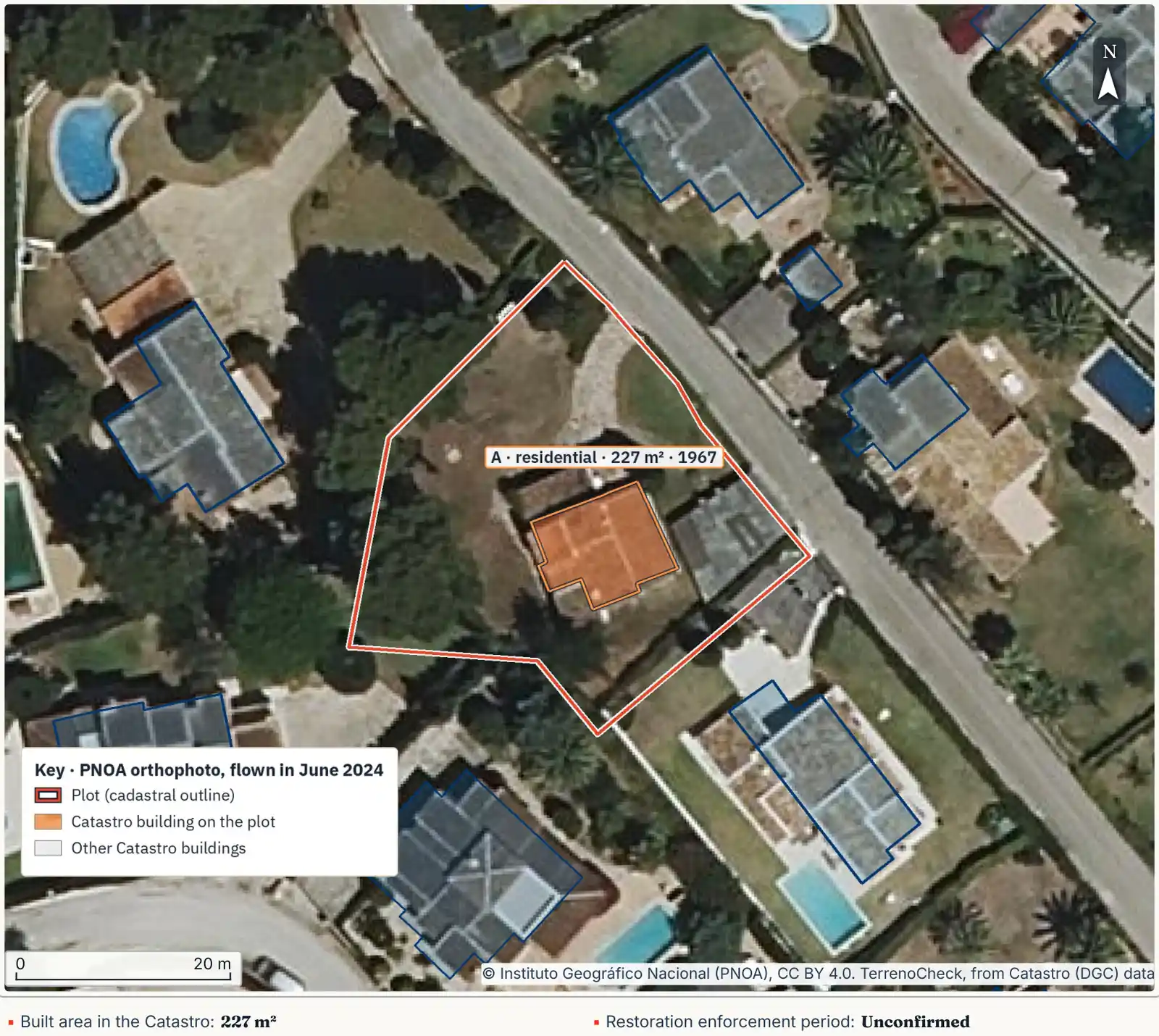
Have a specific plot in mind? The report gathers the public data and official maps for it, with source and date, for €29 VAT included. Pin it on the map →
When you buy a flat, a house on an estate or even a plot, part of what the seller owes the owners’ community can stay with the property. This page sets out which debts follow the home, which certificate the seller must provide, who pays an extra levy approved before completion and why an estate conservation entity is checked separately. All of it before you pay a reservation fee or a deposit (arras).
Can a detached house or a plot pay community fees?
Yes. A comunidad de propietarios, the owners’ community, manages the shared parts and costs of a building, but also of an estate of houses. Separate plots that co-own roads, facilities or services form a private complex covered by the Horizontal Property Law (LPH, article 24). A private garden and your own front door do not prove there are no shared costs.
Ask for the título constitutivo, the document that creates the community and describes its properties, and the estatutos, its rules. The cuota de participación is the property’s percentage share of costs; check whether any expense is split differently. There may be a community for the building or phase and an agrupación de comunidades, a group of communities, for the whole estate (article 24.2.b). The building’s certificate does not settle the estate account.
Having no professional administrator proves nothing: the president can perform that role. And sharing a rural track does not by itself create horizontal property. Your lawyer should identify the real arrangement rather than infer it from the way neighbours collect money.
How much of the seller’s debt can reach the property
The buyer of a home or unit under horizontal property, even with a title registered in the Land Registry, answers with the property itself for general expenses that earlier owners left unpaid, up to the amounts attributable to the elapsed part of the purchase year and the three previous calendar years (LPH, article 9.1.e). This is afección real, a liability attached to the property: the community can pursue the home within that limit, but the seller’s debts do not become your personal debts.
For a purchase on 19 October 2026, the state window covers amounts already due in 2026 and those attributable to 2023, 2024 and 2025. Do not count back from completion as if it were a rolling period. What falls due after you buy is your own obligation as owner.
An older debt outside the window has not thereby been extinguished against the seller. A registered attachment, a pending claim or a clause in which you take on debt needs separate review. Order the nota simple alongside the certificate: the Registry and the community account answer different questions.
The debt certificate
At the deed, the seller declares whether community expenses are paid or states what is owed, and provides a certificate of the debt position that matches the declaration. Whoever acts as secretary issues it, with the president’s approval, within seven calendar days of the request (article 9.1.e). That deadline is for issuing it; it is not an expiry date for the document.
Ask for it while you investigate, before the deposit, and for an update for the deed. Check that it names the right property and seller, carries a date and signatures, and what it covers if a garage, a storeroom or another community has a separate account.
| Document or claim | What it shows | What it does not prove | First step |
|---|---|---|---|
| Debt certificate showing zero | No general expenses are owed on that account on its date. | That no levies are approved, that no works are coming, or that the estate account is clear. | Ask for the approved levies not yet due, the minutes and the budget. |
| Bank receipt or direct-debit slip | That payment was made. | The whole account, interest or claimed recovery costs. | Ask for the formal certificate and reconcile the receipts with it. |
| Clean nota simple | No charge on the property is registered. | That nothing is owed: the community’s claim attaches to the property even against a registered buyer. | Obtain the community certificate as well. |
| “There is no administrator” | Nobody is paid to manage the community. | That there is no community: the president can act as administrator. | Ask the lawyer to read the title and statutes. |
| Roads taken over by the town hall | The council has formally received some works. | That owners no longer have conservation duties. | Ask for the reception documents and what remains payable. |
Each document answers a different question. Sources: BOE, Horizontal Property Law, article 9.1.e; BOE, Land and Urban Rehabilitation Law, article 27.1. Accessed 30 October 2026.
If the certificate shows debt, agree a verifiable payment first: for example, a payment to the community out of the price, or a retention with clear release terms. Ask for a statement that separates principal, interest and claimed recovery costs, and write down who receives the money and which document proves it was paid. A certificate showing debt does not create an automatic holdback.
Derramas: who pays what was approved before completion
A derrama is an extra contribution to pay for works or costs outside the ordinary budget. What matters is what it is for, what the meeting approved and when each amount falls due. The meeting date alone does not put every instalment on the seller.
Levies to pay for improvements fall on whoever owns the property when the amounts become payable (article 17.11). An improvement approved before you buy can leave you with the later instalments. Works needed to keep the building in repair are a different matter: they are compulsory and need no prior vote of the meeting (article 10.1.a). Ask your lawyer to classify the work before you treat an extraordinary bill as an optional upgrade.
| Situation | Who pays | What to ask for |
|---|---|---|
| Improvement approved before completion | Whoever owns the property when each amount falls due (article 17.11). | Due dates of every instalment; any exemption the seller claimed. |
| Non-required improvement costing more than three monthly fees | A dissenting owner may be exempt, subject to article 17.4. | Minutes, vote and proof of the dissent. |
| Necessary conservation works | Compulsory for all owners, with no prior vote needed (article 10.1.a). | The resolution, budget and the property’s share. |
| Resolution under court challenge | It is still carried out unless a judge suspends it (article 18.4). | The court order, if the seller says nothing is payable. |
| Catalonia | Its own rules: the certificate lists approved amounts not yet due (553-5). | The Catalan certificate and the lawyer’s reading under book five. |
The meeting date alone does not split the instalments between seller and buyer. Sources: BOE, Horizontal Property Law, articles 10, 17 and 18; BOE, Catalan Civil Code, book five, article 553-5. Accessed 30 October 2026.
You can agree that the seller will bear a specific levy, including future instalments. Parties may agree the terms they see fit within the law (Civil Code, article 1255), but a contract binds only its parties (article 1257): it does not change whom the community can claim from. Name the works, the instalments included and how payment is made. “The seller pays the derrama” leaves too much room.
Source: BOE, Civil Code, articles 1255 and 1257. Accessed 30 October 2026.
A zero certificate is not a budget
A balance with no arrears describes the account, not the state of the building or what will be spent. Ask expressly for levies approved but not yet due, the current budget, the latest approved accounts, minutes about pending works and any financing commitments. Ask about litigation: challenging a resolution does not suspend it unless a judge orders an interim suspension (article 18.4).
Not using the pool or visiting only a few weeks a year does not by itself exempt an owner from common expenses. Other owners’ arrears can strain the community’s cash, but they are not passed on to you. The seller should provide the documents or authorise the administrator: a prospective buyer has no free access to the community’s records.
What is different in Catalonia
Catalonia regulates horizontal property in its own Civil Code. The property answers for ordinary and extraordinary common expenses and reserve-fund contributions for the elapsed part of the current year and the four previous years, counted January to December (article 553-5.1). In the October 2026 example, that adds 2022 to the window. The seller still answers for whatever they owe at the transfer.
The Catalan certificate must also list expenses and contributions approved but not yet due (article 553-5.2). The secretary issues it, and the president’s approval is not needed when a professional manages the community and acts as secretary (article 553-5.3). The article does not set the LPH’s seven days: agree a delivery date. The budget must put at least 5% of common expenses into the reserve fund, and the seller cannot ask for their share back on sale (article 553-6).
| Point | State LPH | Catalonia (book five) |
|---|---|---|
| Years covered by the property | Amounts due in the purchase year so far and the three previous calendar years | Ordinary and extraordinary expenses and reserve contributions, current year so far and four previous years |
| Certificate | Secretary with the president’s approval, within seven calendar days of the request | Secretary; no presidential approval when a professional manager acts as secretary; no fixed deadline in 553-5 |
| Future amounts on the certificate | Not required by the text: ask for them expressly | Approved ordinary and extraordinary expenses and reserve contributions not yet due |
| Reserve fund | At least 10% of the latest ordinary budget | At least 5% of common expenses; the seller cannot ask for it back on sale |
Andalusia, Valencia, Murcia, the Balearics and the Canaries apply the state LPH on this point. Sources: BOE, Horizontal Property Law, article 9.1.e–f; BOE, Catalan Civil Code, book five, articles 553-5 and 553-6. Accessed 30 October 2026.
Estate conservation entities
An entidad urbanística de conservación is an administrative body that maintains a development’s infrastructure (Urban Planning Management Regulations, article 26). It is not an optional residents’ club: membership is compulsory where the plan, the programme’s terms or a legal rule puts conservation on the owners (articles 25.3 and 68). Each owner’s share follows their participation (article 69), and the town hall can collect arrears through apremio, the public debt-recovery procedure (article 70). These state rules are read with each region’s planning law and the development’s actual file.
On a sale, the new owner steps into the previous owner’s planning duties (Land Law, article 27.1). A finished-looking street does not prove those duties are settled. The LPH applies to these entities only where their statutes say so (article 2.e), so do not assume the three-year window applies.
Sources: BOE, Urban Planning Management Regulations, articles 25 and 67–70; BOE, Land and Urban Rehabilitation Law, article 27.1; BOE, Horizontal Property Law, article 2.e. Accessed 30 October 2026.
Ask the ayuntamiento, the town hall, to confirm whether the plot lies within a conservation entity and which infrastructure the owners maintain. Ask for the approved statutes, the boundary plan, the plot’s share, the budget and an account statement with arrears, approved payments and claims. The council taking over the roads does not by itself answer whether a conservation duty remains: ask for the formal reception record. If the costs involve networks or connections, check the plot’s utility supplies too.
Three hypothetical scenarios
These are invented examples to show the method, not real properties.
1. A flat with a lift levy under way
Imagine the meeting approved a new lift in May, payable in ten quarterly instalments. The September certificate says “up to date” because only two have fallen due. If you buy in November, the later instalments can be yours. Before the deposit: minutes, the instalment schedule and a written agreement on who pays each one.
2. An estate house with two accounts
Imagine a house with a clean certificate from its phase, inside an estate whose conservation entity is chasing arrears for roads and street lighting. The phase certificate does not cover that account. Ask for the entity’s statement and statutes, and hold the deposit until you have them.
3. A seller who suggests skipping the certificate
Imagine the agent says the secretary is away and proposes signing without the certificate. The waiver lets the notary authorise the deed, but the property still answers for debt within the legal window. Ask for a new date or an agreed retention paid to the community.
When the deposit should wait
The list does not replace your lawyer. It tells you whether you can pay now or whether a specific document is still missing.
What to write into the arras contract
Ask your lawyer to draft the condition. Name the documents that must arrive: a debt certificate from each community and, where there is one, the conservation entity; approved levies with amounts and dates; the last year’s minutes; the title and statutes. Set the deadline, who pays each outstanding levy and how any debt is cleared: amount, payee, retention and the document that releases it. Provide for a full refund of everything paid, the reservation fee included, if a document does not arrive or discloses a debt or works you do not accept. More in the guide to the arras contract.
The buyer’s sequence before the deposit
- Ask the seller how many communities, groups or entities charge the property.
- Ask for the título constitutivo, the statutes and the ownership share.
- Ask for each debt certificate and the list of approved levies with their dates.
- Read the minutes, budget and accounts; note works, lawsuits and challenges.
- Ask the town hall whether the plot is in a conservation entity and what remains outstanding.
- Order the nota simple and compare it with the above.
- If the building raises doubts, commission an independent technical survey.
- Agree debt payment and the split of each levy in writing before paying. A TerrenoCheck report shows the plot and its surroundings, but it does not replace these documents or your lawyer.
When the deed is prepared, refresh the accounts. Under the LPH, the seller must notify the secretary of the change of owner in a way that leaves a record; if not, the seller remains jointly liable with you for later debts (article 9.1.i). Changing the direct debit is not enough.
Questions to send before money moves
- Which communities, groups or conservation entities charge this property?
- What is the ownership share, and is any expense split differently?
- Can you send a dated debt certificate from each one?
- Are there approved levies not yet due? For how much and on what dates?
- Have necessary works been identified without an approved budget?
- Are there lawsuits or challenged resolutions?
- What is the current ordinary fee and what does it include?
- Is any debt being claimed in court, or is there an attachment?
- Who will pay each outstanding instalment after completion?
- What happens to the reservation fee and the deposit if a document does not arrive by the agreed date?
A debt certificate is useful because it fixes a figure on a date. Keep it with the minutes and the levy schedule, and let your lawyer turn whatever is missing into conditions in the contract.
Common questions
Is a clean nota simple enough to rule out community debt?
No. The statutory liability reaches even a buyer with a registered title (LPH, article 9.1.e). Use the nota simple for what is registered and obtain the community certificate and the list of pending levies separately.
Must the seller pay every levy approved before the sale?
Not necessarily. Levies for improvements fall on whoever owns the property when each amount becomes payable (article 17.11). Necessary works have their own rules and Catalonia has its own. Put the split you agree with the seller in writing.
Can I buy if the seller owes community fees?
Yes, with a verifiable payment arrangement: a payment to the community out of the price or an agreed retention with its release document. A promise to pay after completion leaves the debt open.
Does a debt-free certificate guarantee there will be no levies?
No. Approved payments may not have fallen due yet, and necessary works may still await a budget. In Catalonia the certificate must list approved amounts not yet due; under the state LPH, ask for them expressly.
Do conservation charges stop when the town hall takes over the roads?
That alone does not prove it. The duty depends on the plan, the entity’s statutes and the applicable law. Ask for the reception record and a written explanation of what remains payable by owners.
Keep reading
Check this on your own plot
Pin the plot on the map and confirm the cadastral reference: the report gathers the public data and official maps for it, each with its source and date. It does not replace the land registry extract, the notary or a tax adviser. €29 VAT included.