Pillar: Planning and buildings
When must a Spanish seller give you the energy certificate?

On this page
Ask for the registered certificate and its label before committing to a house purchase. Bare land is different; a ruin or planned renovation needs a specific explanation and supporting documents.
Have a specific plot in mind? The report gathers the public data and official maps for it, with source and date, for €29 VAT included. Pin it on the map →
If you buy an existing home in Spain and no exclusion applies, the seller must annex to the sale contract a copy of the registered energy performance certificate (certificado de eficiencia energética) and its label. This page sets out what to ask for before you pay a reservation fee or a deposit (arras): the full certificate, proof that it is in the regional register and its expiry date or, if you are told the house is excluded, the specific legal ground. Land with no building needs no certificate. Calling a house a “ruin” does not exclude it on its own.
When the seller must hand it over
Royal Decree 390/2021 applies to existing buildings, or parts of them, that are sold (article 3.1.b). The owner commissions the certificate and keeps the papers; if a valid certificate already exists, a new one is not needed just because the buyer changes (article 6.1).
The duty starts before completion. The label must appear in every offer, promotion and advert for the sale (article 15.2), and whoever publishes the listing, including the agency or the portal, must include the energy rating (article 17.3). For the sale, article 17.2 requires a copy of the duly registered certificate and the label to be annexed to the contract.
The rules set no deadline called “before the deposit”. Your lawyer should check whether the document you are asked to sign is already a binding sale. Ask for both before any money moves, so you can review the house and price the upgrades.
Which document are you holding?
Several papers in a purchase look alike and are not. The label is a summary; the full certificate identifies the house, describes its energy features and lists the rating and improvement recommendations (article 8). Without an entry in the regional register, the certificate has no legal validity (article 6.6).
| Document you receive | What it means | What it does not prove | First step |
|---|---|---|---|
| Label in the listing | The seller or agent has published the energy rating, as the law requires. | That a certificate exists for this house, is registered or is still valid. | Ask for the full certificate and the register number. |
| Signed certificate | A competent technician assessed the building and signed the result. | That it is registered: without registration it has no legal validity (article 6.6). | Check the register entry with the regional body. |
| XML file or technician’s invoice | The certificate was produced and, perhaps, filed. | That the regional register accepted it or that nothing is pending. | Ask for the register number or receipt and any request to correct. |
| “Certificate in progress” | The seller has not finished the process. | It does not replace the energy information required in advertising (articles 15 and 17.3). | Ask for the certificate before paying anything. |
| Certificate for another house | A representative building was assessed (articles 6.2 and 6.3). | That it covers your house unless the technician shows the match. | Ask the technician to explain the basis and how your home is covered. |
| Owner’s declaration for demolition or works | The owner relies on the article 3.2.e exclusion. | That the works are lawful or that you may rebuild (article 6.4). | Copy, filing receipt and your technician’s reading of the works. |
Each paper answers a different question. Sources: BOE, RD 390/2021, article 6; BOE, RD 390/2021, article 15; BOE, RD 390/2021, article 17. Accessed 30 October 2026.
A plot, a house or a building to demolish?
The listing’s wording does not decide. Work out which buildings exist and what you are buying them for.
A truly empty plot. Under RD 390/2021 a building is a roofed construction with walls in which energy is used to condition the indoor climate (article 2.h). Land with no building is outside it. Needing no certificate says nothing about whether you may build: check the guide on what you can build.
A plot with a house. The certificate covers the building or the certified part, not the land. “It is a rustic estate” is not an exclusion. Identify the house and check whether other buildings have a different use.
Remains of a building. A structure without a roof needs an assessment against the legal definition of a building. “Ruin”, “house to renovate” or “no utilities” are not exclusions under article 3.2. Ask the technician to explain what exists and which ground applies; if in doubt, ask the regional energy certification body.
The demolition or major-works exclusion
Article 3.2.e excludes from the existing-building certificate a building bought to be demolished or for the works defined in article 3.1.d. Planning to paint, fit a new kitchen or repair damage is not enough.
Since 23 July 2026, to rely on this exclusion the owner must file a declaración responsable (a formal declaration of compliance) with the regional body in charge of energy certification, which may set a stricter procedure (article 3.2.e as worded by RD 659/2025). A sentence from the buyer in the contract does not replace that filing, and it is not a notice of works to the town hall.
| Kind of works (art. 3.1.d) | Threshold | What to ask for |
|---|---|---|
| Heating or cooling systems | Replacing, installing or renewing them in a way that needs a thermal installations project to be drawn up or changed. | The technician’s note naming the project required. |
| Building envelope | Work on more than 25 % of the total area of the final thermal envelope. | Envelope area and the share affected, in square metres. |
| Extension | More than 10 % more floor area or volume in the units affected, and more than 50 m² of useful area added. Both conditions apply; MITECO says the 50 m² is the added part only. | A calculation of the added useful area, not the gross built area. |
Painting, a new kitchen or repairs fit none of these. Sources: BOE, RD 390/2021, article 3.1.d; MITECO, FAQ on RD 390/2021. Accessed 30 October 2026.
Being excluded from the existing-building certificate does not remove the project and completed-works certificates of article 9 when the works go ahead. Ask for a copy of what was filed, the filing receipt and confirmation that it refers to this property and these works.
Other exclusions for a rural house
The size exclusion needs a detached building, not touching any other, with a total useful area below 50 m² (article 3.2.d). A house of exactly 50 m² does not qualify. A small flat or a terraced house is not excluded for being small, and the plot size does not count.
Do not rely on the listing’s floor area. Useful area has its own definition (article 2.t): among other rules it includes half of any covered private outdoor space. A porch can change the answer; ask the technician for the calculation.
Non-residential farm buildings with low energy demand can be excluded (article 3.2.c). A shed and the house you live in need not be treated the same way. For officially protected buildings, the exclusion needs any upgrade to alter their character or appearance unacceptably, and the authority that granted the protection decides which elements cannot change (article 3.2.a). Being old or having stone walls is not enough.
Use for less than four months a year no longer excludes a home: RD 390/2021 removed that exclusion, according to MITECO. Nor is there a general waiver for an empty house, one without a boiler or one off the grid.
How to read the certificate and the label
Compare the address, the cadastral reference and the certified part of the building with the house you visited (article 8.2.a). If the property has several buildings, check which one the document covers. A label for another home is no use because the address is similar.
A home’s certificate can rest on one for the whole building or on representative homes with the same energy features (article 6.2). For a detached house, article 6.3 allows the assessment of another representative building of similar design and size if the technician can guarantee the match. Ask the technician to justify that basis.
The scale runs from A, the most efficient, to G. Read separately the non-renewable primary energy use, in kWh/m² a year, and the emissions, in kg CO2/m² a year: the two letters can differ. The assessment uses standard operating and occupancy conditions (article 2.i), so do not turn it into your future bill.
A poor letter does not oblige the seller, under this decree, to carry out the recommendations before selling. It is a reason to get quotes before you set your offer. The certificate does not replace a survey of the structure, damp or habitability.
New recognised documents and label models have been in force since 30 September 2026, according to MITECO. For a new certificate, check that the technician uses the current procedure; an older certificate does not lapse because it looks different. Article 9.4 lets a completed-works certificate use the same version of the recognised document as the project so the two can be compared; it is not a waiver for new certificates on existing homes.
Sources: MITECO, recognised documents; MITECO, label model for existing buildings. Accessed 30 October 2026.
The register and the expiry date
The owner, or someone they authorise, files the certificate and the XML report with the regional body. The deadline is the one the region sets; if it sets none, one month from issue (article 6.6). This register is not the Land Registry.
Ask for the register number or document and check it against the regional search or with the competent body. You can start from MITECO’s list of regional bodies and then confirm the body’s current e-office. Send the register number and the cadastral reference and ask: “Is this certificate registered, when does it expire and is any correction pending?”
| Certificate | Maximum validity | What to check |
|---|---|---|
| A to F, any date | Up to 10 years | Read the expiry date printed on the certificate and in the register. |
| G registered before 3 June 2021 | Keeps the earlier 10 years | MITECO: the five-year limit does not apply backwards. |
| G in energy use or emissions, registered since 3 June 2021 | Up to 5 years | Check both indicators, not just the headline letter. |
| Installations or features changed later | The owner renews or updates under regional rules | Ask whether the boiler, windows or insulation changed after the visit. |
Article 13 sets the validity; MITECO explains the 2021 cut-off. Sources: BOE, RD 390/2021, article 13; MITECO, FAQ on RD 390/2021. Accessed 30 October 2026.
Who orders it, how long it takes and what if it is missing
In a resale, the selling owner commissions the certificate when it is required. Ask for a quote that separates the visit, the certificate and the filing, and states tax, travel, any fee and corrections. RD 390/2021 sets no national price and no single timescale.
The technician must visit the property at least once, no more than three months before issuing the certificate (article 6.5). Be wary of an offer based only on photos. Those three months are not the certificate’s validity.
Articles 4 bis, 4 ter and 4 quáter set the technician’s requirements and professional declaration, which allows them to work anywhere in Spain. Technicians already listed in regional registers move to the national register under additional provision one of RD 659/2025. That declaration by the technician is not the owner’s declaration to exclude a building.
If you buy before a new build or a certifiable renovation is finished, the seller provides the project label and, once the works are finished and it is issued, the completed-works certificate (article 17.1).
Four hypothetical scenarios
These are invented examples to show the method, not real cases.
1. “It is a ruin, no certificate needed”
Imagine a stone house with part of its roof and a kitchen in use. If it has a roof and walls and energy is used inside, it can be a building for the decree. Ask the technician to explain what exists and which ground applies; if nobody can, ask for the certificate.
2. A 48 m² house with a porch
Imagine a detached house listed at 48 m² with a 10 m² covered porch. Adding half the covered porch brings the useful area to 53 m², and the size exclusion no longer works. The listing’s figure is not enough.
3. A G certificate from 2022
Imagine a certificate registered in 2022 with G for emissions and E for energy use. According to MITECO it lasts five years at most, because a G in either indicator is enough. If the register confirms it has expired, the seller must renew it before the contract.
4. Buying to extend and renovate
Imagine you plan to add 40 m² of useful area to a 120 m² house. That is more than 10 % but less than 50 m² added, so the extension alone does not fit article 3.1.d. Without another ground, the seller must provide the certificate.
When to hold the deposit
The list does not replace your lawyer or your technician. It tells you whether you can pay now or whether a specific document is still missing.
What to write into the arras contract
Ask your lawyer to draft the condition. Identify the home by its cadastral reference and name the documents that must arrive: the full certificate, the label, the regional register number and the expiry date or, if an exclusion is claimed, its ground and the declaration the owner filed. Set a deadline, who pays for each step and a full refund if the documents do not arrive or the exclusion does not hold. A refund does not follow automatically from any flaw in the certificate: it has to be agreed. More in the guide to the arras contract.
The buyer’s sequence before the deposit
- Work out which buildings stand on the plot and which one is the home you are buying.
- Ask the seller for the full certificate, the label and the register number.
- Compare the cadastral reference and the certified part with the house you visited.
- Check the entry, the expiry date and any pending correction with the regional body.
- If you hear of an exclusion, ask for the legal ground and, for demolition or works, the owner’s declaration.
- Have your technician read the indicators and price the upgrades you care about.
- Agree in the contract on delivery, a deadline and a refund if the condition fails.
- Check separately that the house and the works you plan are lawful; the certificate does not prove it.
Questions to send before money moves
- Does the home have a registered energy certificate? With what number and in which region?
- When does it expire, and what are its letters for energy use and for emissions?
- Which building or part of the building does it cover? Does the cadastral reference match?
- Did the technician visit this house? On what date?
- Have the heating, windows or insulation changed since then?
- If an exclusion is claimed, which one, on what reasoning and with what document?
- If it is for demolition or works, has the owner filed the declaration? Can I see the receipt?
- What happens to my payment if the certificate does not arrive by the agreed date?
Keep the certificate, the register check and the listing together. The letter helps you negotiate; the register and the date tell you whether the document is valid; whether the house is lawful is checked elsewhere.
Common questions
Does a plot with no buildings need an energy certificate?
No existing-building certificate is needed if only land with no building is sold. If there is a house or the remains of one, identify them before accepting that answer. Needing no certificate says nothing about whether you may build.
Is a ruin always exempt?
No. What exists must be assessed against the definition of a building and the ground that applies. For the exclusion for a purchase for demolition or major works, since 23 July 2026 the owner must file a declaration with the regional body, which may require a stricter procedure.
Is “certificate in progress” in the listing enough?
No. Adverts must include the energy rating, and for the sale the seller must annex the registered certificate and the label to the contract when they are required. Ask for them before committing money.
Does a G certificate always expire after five years?
No. MITECO applies that limit to certificates registered since 3 June 2021 with G for energy use or emissions. Earlier ones keep the ten-year validity. Check the actual expiry date and whether the house has changed.
Does the certificate show that the house is lawful and habitable?
No. Article 6.4 of RD 390/2021 says it proves no other requirement for the building. The licence, the planning position and the occupancy document are checked separately, even with a good label.
Does the TerrenoCheck report include the energy certificate?
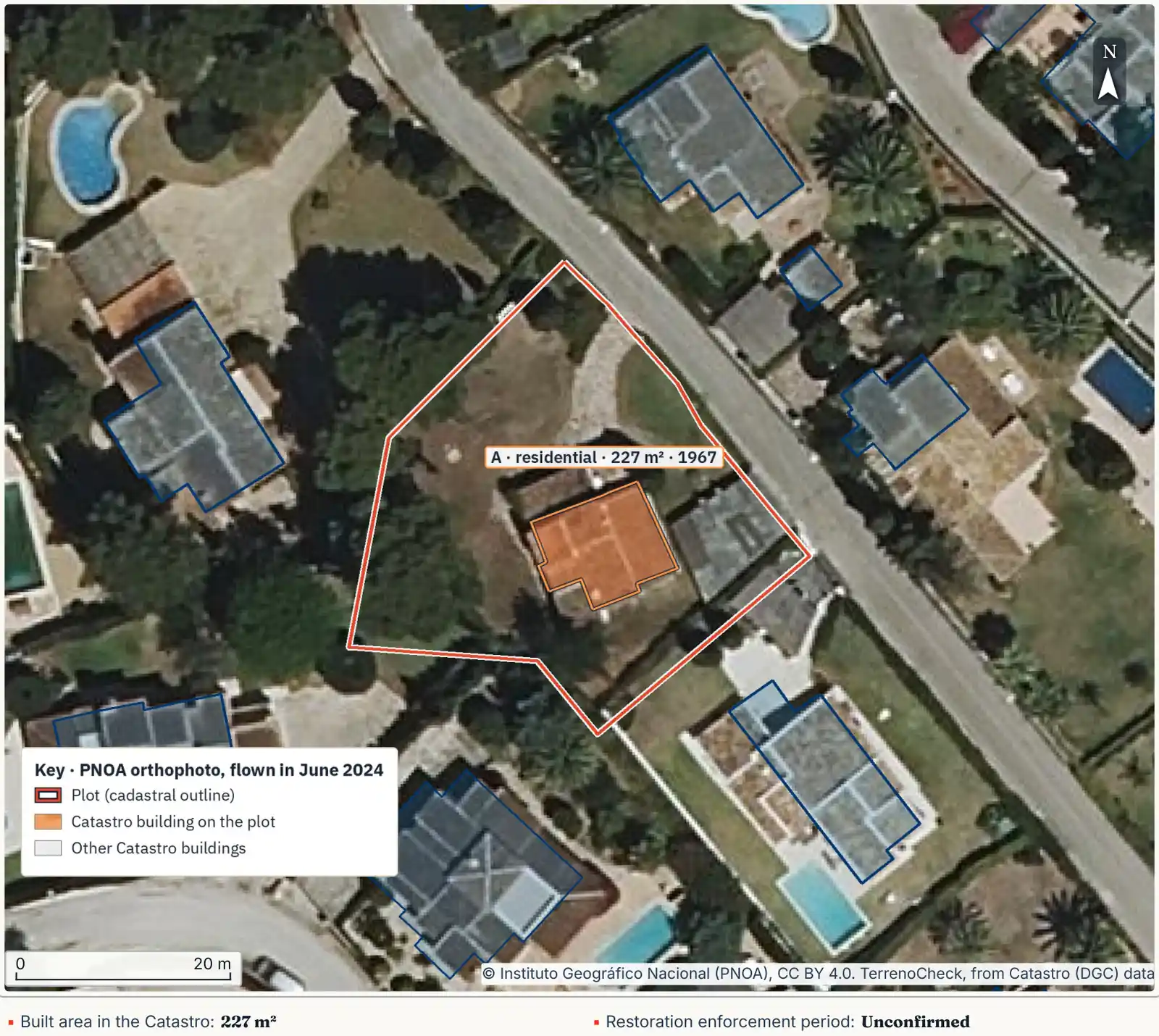
No. The report shows the buildings the Catastro records and those visible in aerial photos, which helps you ask which building the certificate covers. It gives no letter, does not check the regional register and does not assess exclusions.
Keep reading
Check this on your own plot
Pin the plot on the map and confirm the cadastral reference: the report gathers the public data and official maps for it, each with its source and date. It does not replace the land registry extract, the notary or a tax adviser. €29 VAT included.