Pillar: Land, rights and services
Can I buy or split farmland in Spain, and can a neighbour claim it?

On this page
A small existing property and a piece to be split from a larger farm are different purchases. Establish which you are buying, which regional minimum applies and whether a neighbour could replace you as buyer.
Have a specific plot in mind? The report gathers the public data and official maps for it, with source and date, for €29 VAT included. Pin it on the map →
You can buy a small farm plot that already lawfully exists. Creating one by splitting it off is another matter: the minimum farming unit (UMC) must be checked for every resulting plot, along with the plan. A neighbour or a tenant may also have the right to take your place as buyer. The civil law that applies, the area and who the neighbour is decide which right you need to check.
Are you buying an existing plot, a piece or a share?
Have the seller identify what is sold in the contract. Buying a whole registered plot, a piece that still belongs to a larger one or an undivided share has different consequences.
The UMC limits the division of rustic land: acts that create plots below that minimum are void, save the exceptions that apply (Law 19/1995, article 24). It does not ban the sale of a small plot that was lawfully created. If the one on offer is small, have your lawyer check its origin and the deed that created it; if it came from a split, ask for that deed too, its date and any administrative permit it needed.
In a split, what the seller keeps must be measured too: your piece reaching the minimum is not enough if the remainder falls below it. Dividing an inheritance does not get round this rule either (article 24.3). An undivided share is a stake in the whole property; sold with exclusive use of one part, it faces the same requirements as a split (TRLSRU, article 26.2). To decode a listing’s numbers, see the guide to the cadastral reference.
Sources: BOE, Law 19/1995, article 24; BOE, TRLSRU, article 26.2. Accessed 30 October 2026.
Which minimum farming unit applies to your land?
Each region sets the minimum for dry and irrigated land by municipality, zone or district (Law 19/1995, article 23). It is a farming measure meant to stop holdings being broken up. It is not the minimum plot for building a house; that is checked in the plan (see the guide to rustic and urban land).
| Region | Dry / irrigated | What to check |
|---|---|---|
| Andalusia | Whole province of Almería: 3 / 0.25 ha | Resolution of 4 November 1996, municipal annex. Do not extend Almería’s figure; Granada’s annex separates intensive (0.25 ha) and extensive (0.50 ha) irrigated land. |
| Valencia | 2.5 / 0.5 ha | Decree 217/1999, single article. Irrigated land needs actual cultivation and a proven right to irrigate, checked by the agriculture department. |
| Murcia | Group 1: 2.5 / 0.20 ha. Group 2: 2 / 0.20 ha | Decree 40/1997, single article. Jumilla and Yecla are in group 1; Murcia, Cartagena and Lorca in group 2. Check the full list. |
| Catalonia | By municipality | Decret 169/1983, annex I. There is no single figure for Catalonia; look up your municipality. |
| Balearics | Dry: Ibiza and Formentera 1.5; Menorca 3; Mallorca 2.5 or 3.5 ha by municipality. Irrigated: Formentera 0.35; other islands 0.5 ha | Law 3/2019, article 108. Artà, Capdepera and the northern-range municipalities listed in the law have 3.5 ha dry. |
| Canaries | 1 ha as the general rule | Decree 58/1994, article 1. Plots under twice the minimum are indivisible (article 2). It is not a residential minimum. |
The table helps you find the rule; it does not replace checking your municipality. Sources: Junta de Andalucía, Resolution of 4.11.1996; DOGV, Decree 217/1999; BORM, Decree 40/1997; BOE, Balearic Law 3/2019, article 108; Canary Government, Decree 58/1994. Accessed 30 October 2026.
If the land mixes uses, the municipality has changed its boundaries or it is woodland, do not pick the lowest figure yourself. Have your surveyor identify the case and ask the agriculture department for written confirmation. In Valencia a hose pipe or the word “irrigated” in a listing does not meet the decree’s test.
Is reaching the minimum enough to split?
No. Every resulting plot must meet the rules of law and of the territorial and urban plan, and notaries and registrars require the administrative permit that applies (TRLSRU, article 26.2). Ask the town hall which approval or licence your case needs.
To register a split or division, a georeferenced graphic representation of the plot is required (Mortgage Act, article 9.b). Drawing a boundary on a screenshot is not that document. The registrar also sends the papers for any division below the minimum to the agriculture authority; if there is no answer in four months, the entry goes ahead (RD 1093/1997, article 80). Town planning approval does not by itself settle a farming objection.
Sources: BOE, Mortgage Act, article 9; BOE, RD 1093/1997, article 80. Accessed 30 October 2026.
What if the seller relies on an exception?
Article 25 of Law 19/1995 allows division below the minimum in these cases, among others:
- In favour of a neighbour: neither the plot left nor the neighbour’s plot after the deal may fall below the minimum.
- Non-farm use: within a year the piece is used for a permanent industrial building or other non-farm purpose, with a licence and later proof of completion within the licence period.
- Access to ownership under farm-tenancy law, or compulsory purchase.
The second exception does not on its own allow a house, and “a licence will be applied for later” leaves exactly the key condition unproven. Have your lawyer pin down the rule that applies and the proof of the exception, regional rules included.
Source: BOE, Law 19/1995, article 25. Accessed 30 October 2026.
Can a neighbour take the plot after you buy?
A right of redemption (retracto) lets its holder step into the buyer’s place on the same terms. They do not pick a lower price: they must repay the price, contract costs and lawful payments for the sale, and necessary and useful spending on the property (Civil Code, articles 1518 and 1525). Do not count on recovering any spending you choose to make after buying.
Civil Code article 1523. Where this regime applies, the owner of adjoining land can redeem the sale of a rustic plot of one hectare or less. The neighbour need not hold a priority farm holding. Land separated by streams, irrigation channels, ravines, roads or other visible easements serving other plots is excluded; if the seller points to a track, your lawyer must check what it really is, not a line on a map viewer. With several neighbours, the owner of the smallest adjoining plot comes first and, with equal areas, whoever asks first.
Deadline. The neighbour has nine calendar days from entry in the Land Registry or, failing that, from when the claimant learned of the sale (article 1524). In civil reckoning non-working days count and the count starts on the day after registration (article 5). Under the case law cited by the Directorate General for Legal Certainty and Public Faith, proven earlier full knowledge of the sale and its terms can bring the start forward. Do not confuse registration with signing or with lodging the deed. If the plot lies in a land consolidation zone, check first what that zone's law says about this right.
Sources: BOE, Civil Code, articles 5, 1518 and 1521–1525; BOE, DGSJFP decision of 10 March 2021. Accessed 30 October 2026.
The farming redemption right in Law 19/1995
Article 27 covers another case: the neighbour holds a priority farm holding and the plot sold is under twice the UMC. Being a farmer or working the next plot does not by itself prove that legal status.
So being over one hectare does not remove the risk. A 3 ha dry plot in Valencia is above the article 1523 limit but below 5 ha, twice the 2.5 ha UMC: it may fall under article 27 if its other conditions are met. Exactly 5 ha is not “under twice”. If the sale is formally notified to the neighbours before registration, the period is sixty days from notice; otherwise one year from registration. It is the completed sale that is notified, not an intention to sell. Whoever acquires through this right may not resell for six years (article 27.5).
Source: BOE, Law 19/1995, article 27. Accessed 30 October 2026.
Do the rules change in Catalonia, the Balearics or with a tenant?
Yes. Articles 24 to 28 of Law 19/1995 apply only where regional civil law has no rule of its own (second additional provision). Do not add every right together or apply the common Civil Code everywhere.
- Catalonia: the neighbour must be an owner who farms in person, in sales or transfers in payment of rustic plots below the UMC to someone who is not a neighbour. It does not apply if lawful buildings are worth more than two thirds of the plot’s value. Two months from learning of the sale and its terms, or from registration (Catalan Civil Code, articles 568-17 to 568-19).
- Balearics: there is a right of redemption on sales of rustic plots under one hectare or under the UMC, plus the priority-holding right (Law 3/2019, article 109.2 and 109.3). Do not rule it out because the plot is over one hectare.
- Canaries: plots under twice the UMC are indivisible (Decree 58/1994, article 2).
- A share: where a share in jointly owned land is sold, the co-owners’ right ranks ahead of the neighbours’ (Civil Code, articles 1522 and 1524).
Tenant. Buying does not end a farm lease: the buyer takes the landlord’s place (Law 49/2003, article 22.1). If the tenant has a right to acquire, the seller must first notify the intention to sell and its terms, and the tenant has sixty working days to buy on them (article 22.2). The deed must then be notified to the tenant, and that notice proven to register the sale (article 22.3 and 22.4). If both the plot and the neighbour’s land are one hectare or less, the article 1523 right prevails (article 22.6). How long the lease runs and which tenants hold that right are covered in the guide to buying a farm with a tenant.
Sources: BOE, Law 19/1995, DA 2ª; BOE, Catalan Civil Code, Book Five; BOE, Balearic Law 3/2019, article 109; BOE, Law 49/2003, article 22; Canary Government, Decree 58/1994. Accessed 30 October 2026.
What SIGPAC, the Catastro and the Land Registry prove
SIGPAC identifies areas for managing and checking CAP farm subsidies; its enclosures mark out farm uses within a plot (RD 1047/2022, articles 18 and 19). A separate enclosure is not a plot you can simply buy. Nor does it prove ownership or grant a licence.
| Document | What it means | What it does not prove | First step |
|---|---|---|---|
| SIGPAC enclosure | A farm-use area for managing CAP subsidies. | Ownership, a separate plot or a right to irrigate. | Save the full IDs and the date; compare use and area with the Catastro. |
| Catastro | Location, area, use and graphic outline; presumed true unless proven otherwise. | Who owns it in law: the Land Registry prevails. | Get the descriptive and graphic certificate. |
| Nota simple | Owners and rights entered in the Land Registry. | That the land on the ground matches the description. | Read it with the seller’s deed and a surveyor’s plan. |
| Georeferenced plan | The outline of what is sold and of what is left. | That the split is allowed. | Your surveyor and notary decide which representation the Registry needs. |
Correcting a map is no substitute for permission to split. Sources: BOE, RD 1047/2022, articles 18–21; BOE, Catastro Act, article 3; BOE, Mortgage Act, article 9. Accessed 30 October 2026.
Open the SIGPAC viewer and look up the enclosure. Keep the full IDs and the date, and compare use, area and irrigation with the cadastral certificate and the surveyor’s plan. The irrigation attribute creates no water right: subsidy claimants must check that irrigation is lawful under their water-use rights (article 20). If a SIGPAC entry is wrong, the region corrects it, or the Catastro if it concerns the cadastral parcel (article 21). The Catastro is presumed true unless proven otherwise, but the Land Registry prevails (Catastro Act, article 3). If you will claim subsidies, the enclosure's average slope also decides how the land may be ploughed; see the guide to soil erosion on a plot.
Four hypothetical scenarios
These are invented teaching examples, not real plots or the outcome of any file.
1. A dry piece in Valencia
Imagine being offered 3 ha out of a 5 ha dry plot in Valencia. Your piece is over 2.5 ha, but the seller’s remaining 2 ha fall below it. Without a proven article 25 exception the split is void. Do not pay a deposit without the administrative permit.
2. A 0.8 ha plot beside a neighbour
Imagine an existing 0.8 ha rustic plot in a common-law region. The neighbour can redeem within nine days of registration, unless a track or other visible easement separates them. Have your lawyer check the boundary and agree what happens to your money if the neighbour steps in.
3. A share with a fenced garden
Imagine being sold 20% of a plot with exclusive use of a fenced vegetable garden. That share is treated as a split and must meet its requirements. The other co-owners can also redeem it. It is not a plot of your own.
4. A leased plot in Murcia
Imagine an irrigated plot farmed by a tenant. Without prior notice to the tenant and their sixty working days, the sale is exposed. Ask for the lease and proof of notice before the deposit.
When the deposit should wait
The list does not replace your lawyer. It tells you whether you can pay now or which document is still missing.
What to write into the arras contract
Have the contract identify the parent plot, the piece and the remainder on an annexed plan. If you buy subject to a split, set which approvals are needed, a deadline and what happens if they are missing, refused or describe a different area. Agree the refund of what you paid and who owes it, including any reservation fee taken by the agency. The parties may agree such terms within the law (Civil Code, article 1255); with arras penitenciales, a buyer who withdraws loses the deposit and a seller who withdraws returns it doubled (article 1454).
More in the guide to the arras contract.
The buyer’s sequence before the deposit
- Identify plot, piece or share and check title, charges and leases with an independent lawyer.
- Have a surveyor confirm areas, coordinates, the remainder and whether it is dry or irrigated.
- Confirm the minimum with the agriculture department and document any exception relied on.
- Get the town hall’s administrative permit for the split.
- Check redemption rights, notices and possible suspensions, with a calendar for this sale.
- Compare SIGPAC, Catastro, nota simple and plan; see the guide to boundaries, Catastro and Land Registry.
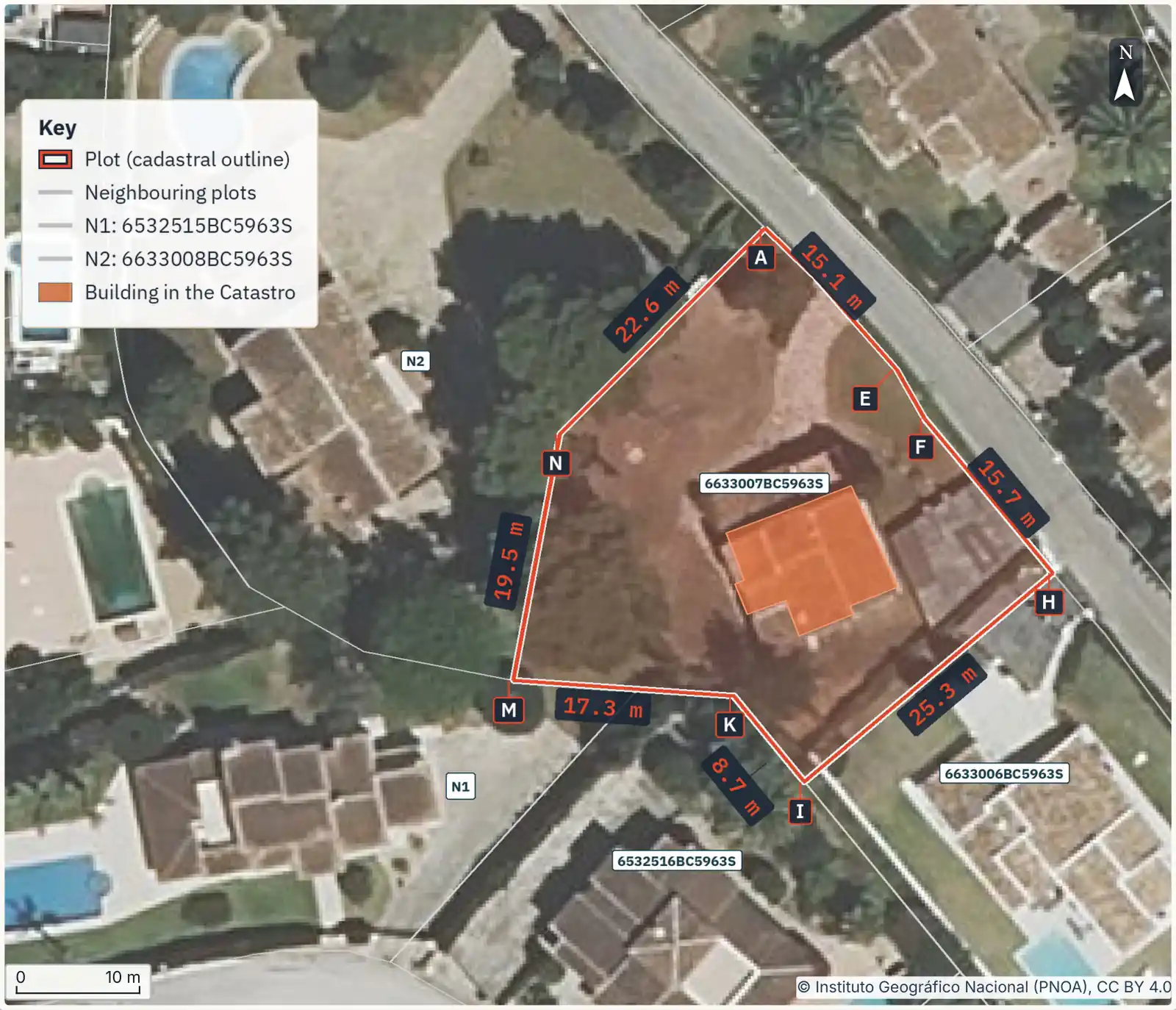
- A TerrenoCheck report gives the cadastral area and shape, but it does not replace these documents or your lawyer.
Questions to send before money moves
- Am I buying a whole registered plot, a piece to be split off or a share?
- How and when was the plot created, and with what administrative permit?
- What dry and irrigated UMC applies in the municipality? Has the agriculture department confirmed it?
- If irrigated, what water right proves it?
- What area does the seller keep after the split?
- Who owns the adjoining land, and does any of them hold a priority farm holding?
- Is there a tenant? Have they been notified of the sale?
- What happens to each payment if a neighbour or the tenant exercises their right?
A small farm plot is a safe buy if it already exists and nobody can take your place. Confirm both in writing before you pay.
Common questions
Is it illegal to buy a plot smaller than the minimum farming unit?
Not for that reason alone. The ban in article 24 of Law 19/1995 is on splitting land into plots below the minimum. Check that the existing plot was lawfully created and review the other requirements of the sale.
Can I split if my piece is above the minimum?
Every resulting plot must be checked, the seller’s remainder included, as well as the plan and the administrative permit required. If any falls below, an applicable exception must exist and be proven.
Does a plot of exactly one hectare carry the neighbours’ right?
It can under Civil Code article 1523, which includes that area. The farming right and regional regimes have different thresholds; the answer depends on where the plot is and which rule applies.
Should I wait nine days after signing before starting work?
That wait guarantees nothing. Article 1524 counts from registration, not signing, and another right with another period, of up to a year, may apply. The works also need their own permits.
Does an irrigated SIGPAC entry prove I can irrigate?
No. Check the water-use right. Article 20 of RD 1047/2022 requires subsidy claimants to verify that irrigation is lawful; the map does not grant it.
Keep reading
Check this on your own plot
Pin the plot on the map and confirm the cadastral reference: the report gathers the public data and official maps for it, each with its source and date. It does not replace the land registry extract, the notary or a tax adviser. €29 VAT included.