Pillar: Documents and contract
What does a Spanish notary check when you buy property?

On this page
Spain's notario checks the legal transaction and authenticates the deed. Arrange separate checks on the property and its permitted use before paying a deposit, then follow registration through to completion.
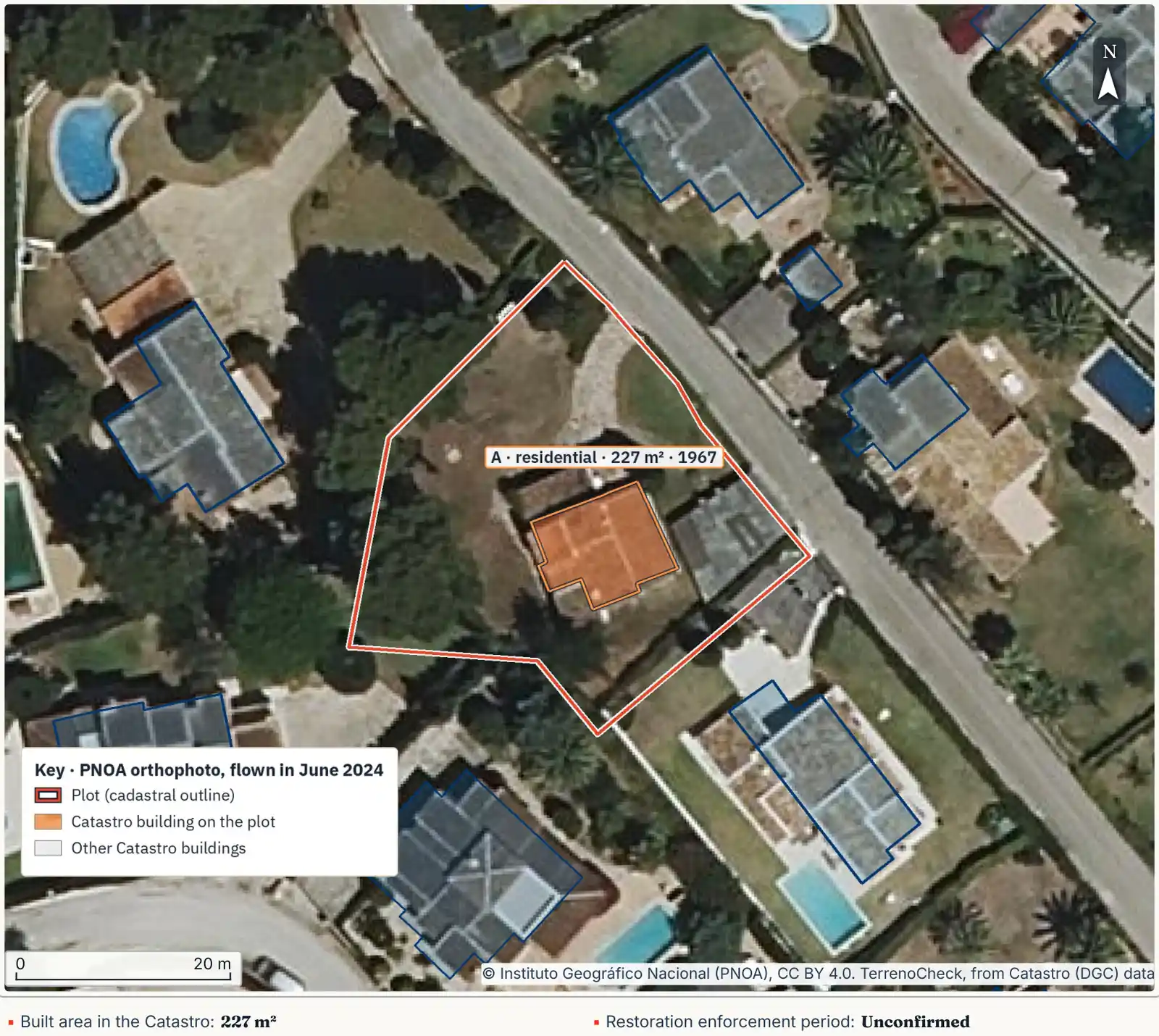
Have a specific plot in mind? The report gathers the public data and official maps for it, with source and date, for €29 VAT included. Pin it on the map →
The notary checks the legality of the deed. That is not the same as surveying the house or confirming you can extend it. This page separates what the notary’s office checks from what you must settle before paying the deposit, and explains what happens between signing and registration.
What the notary checks before signing
A Spanish notary is a public official who advises impartially: they do more than witness signatures, and they do not become your lawyer because you chose them. In a purchase of a registered property, they request the registry information on title and charges as close as possible to the signing (Notarial Regulations, article 175). The nota simple you ordered at the start helps you decide whether to go on; it does not replace that final check.
The notary needs to know who is selling and on what title. If an agent signs, the notary must be able to assess their authority. Send the family and representation details they ask for early: they can change who must consent. If you buy from abroad, confirm which NIE or tax number you need. If you will sign through an attorney yourself, the guide to buying from abroad with a power of attorney explains how to prepare that power. If you are not a national of an EU member state and the property lies in a restricted defence zone, the notary will ask for military authorisation before signing.
The deed records how the price was paid: whether before or at signing and by which means of payment, advance payments included (Notaries Act, article 24). Keep the receipts for the reservation and the deposit. What may be paid in cash, and what you may be asked about the source of the money, is covered in the guide to paying for a purchase in cash.
IBI and community debts, and the energy certificate
The notary must request information and warn in the deed about unpaid IBI (annual property tax) on the property, which stays liable for it on a secondary basis (Local Finance Act, article 64.1). Ask the town hall or its collection office for that information before the deposit: the last paid bill does not show whether older amounts remain.
In a building under the Horizontal Property Act, the seller declares they are up to date and provides a certificate; without it the deed cannot be signed unless you expressly waive it. The waiver does not remove the charge: the flat answers for what is due for the part of the year of purchase already passed and the three previous calendar years (article 9.1.e).
When an existing building is sold, a copy of the registered energy performance certificate and its label is attached to the contract (Royal Decree 390/2021, article 17.2). Do not confuse it with a survey of the house.
Sources: BOE, Local Finance Act, article 64; BOE, Horizontal Property Act, article 9; BOE, Royal Decree 390/2021, article 17. Accessed 30 October 2026.
What stays outside the notary’s office
The notary works with titles, registry information and statements. That is not a survey. For a rural house, have a surveyor examine its condition and compare what is built with the paperwork. The cadastral certificate helps identify the property but does not measure the boundaries or show that you can build.
The notary does have planning duties: in sales of land, the deed must state the planning situation in certain cases and any outstanding duties, and the notary may ask the authorities for information (TRLSRU, article 27.2 and 27.4). That is not a study of every permit on a plot. Ask the town hall for written information on the use and works you have in mind, a right under article 5.d of the TRLSRU, and read what you can build.
The deed and when ownership passes
The public deed (escritura) records the contract, the consents and the terms before a notary. The signed original, the matriz, stays in the notary’s protocol; you receive copies.
The deed is not the first moment you are bound. Under the common Civil Code, contracts bind whatever their form if they meet the conditions for validity, and a sale is complete once the property and price are agreed (articles 1278 and 1450). Check the arras contract terms before paying.
Ownership passes by contract plus delivery, and signing the deed counts as delivery unless the deed shows otherwise (articles 609 and 1462). Delivery and registration are different things.
From signing to registration
After signing, unless you say otherwise or there is a technical problem, the notary sends the electronic authorised copy to the Registry the same day or at the latest the next working day (Notarial Regulations, article 249). Ask for the filing receipt: it gives priority for sixty days (Mortgage Law, article 17), but it is not the registration. The registrar reviews the title on their own responsibility and may find defects (article 18).
The tax steps must also be met before registration. Decide who handles taxes, notices, defects and follow-up; if a gestoría does it, get the scope in writing. The steps that follow at the Registry and the Cadastre are in the guide to registry and cadastre updates after purchase.
The protection in article 34 of the Mortgage Law for a good-faith buyer for value from the registered owner requires your right to be registered. Do not leave the file with a simple copy in your inbox. If the seller had a mortgage, paying the bank does not remove it from the Registry: agree who prepares, pays for and files the cancellation, and add it to your pre-purchase checklist.
| Document | What it shows | What it does not prove | First step |
|---|---|---|---|
| Signed deed (escritura) | The notary has checked the parties, the title and the legality of the sale. | It does not prove the house is lawful, sound or extendable. | Get the town hall answer and a survey before the deposit. |
| Filing entry (asiento de presentación) | The deed has entered the Land Registry and gains priority. | It is not the registration: the registrar still reviews the title (articles 17 and 18). | Ask for the filing receipt and follow the file. |
| Simple copy (copia simple) | A copy to read what was signed. | It has no effect as an authorised copy and does not prove registration. | Ask which copy went to the Registry. |
| Authorised copy (copia autorizada) | A faithful copy of the original with the notary’s authentication. | On its own it does not show that registration is finished. | Keep the notary’s name, date and protocol number. |
| Nota simple | Registered owner, description and charges, for information. | It is not a copy of the deed or a planning permit (article 222.5). | Order a fresh one after registration. |
A copy does not change category because it arrives as a PDF or on paper. Sources: BOE, Mortgage Law, article 17; BOE, Mortgage Law, article 18; BOE, Mortgage Law, article 222.5. Accessed 30 October 2026.
Choosing the notary
Whoever asks for a notary’s services may choose the notary, within legal limits. In sales by habitual sellers, on standard terms or in bank contracts, the buyer or customer chooses, but cannot impose a notary with no reasonable connection to the deal. Otherwise the specific rules apply and, failing them, what was agreed (Notarial Regulations, article 126).
If you buy from a private seller, read the contract before accepting the notary the agency suggests. Pick an office that can answer your questions in the language you need; impartiality does not change because you pay the bill.
Reading the deed and the language
Ask for the draft in good time and compare it with what was agreed: properties, the right acquired, price, payments and handover. Put any differences in writing.
If you do not understand Spanish, say so when booking. If the notary knows your language they can translate the content orally; if not, an interpreter chosen by you takes part, translates and confirms the text (Notarial Regulations, article 150). An agent’s informal explanation does not replace that.
Source: BOE, Notarial Regulations, article 150. Accessed 30 October 2026.
Do not accept without explanation a clause saying you are satisfied with information you have not received. A warning in the deed records a risk; it does not remove it.
Costs and a mortgage
Notary fees follow a regulated tariff and depend on the value, length and copies. There is no single price: ask for an itemised quote and separate fees, taxes, Registry and gestoría. A payment on account is not the final invoice. For the whole budget, see the costs of buying.
| Deed | Who pays | Basis |
|---|---|---|
| Sale deed, between private parties | Seller pays the deed; buyer the first copy and later costs, unless agreed otherwise. | Civil Code, article 1455 |
| Home bought by a consumer from a business | Documentation and processing costs that by law fall on the business cannot be passed to the consumer. | Consumer law, article 89.3 |
| Mortgage deed under Law 5/2019 | The lender pays the notary for the mortgage deed; whoever asks for copies pays for them. | Law 5/2019, article 14.1.e |
| Pre-signing notarial record for the loan | No notarial fee. | Law 5/2019, article 15.8 |
Fees follow a regulated tariff; ask for an itemised quote. Sources: BOE, Civil Code, articles 1455; BOE, Law 5/2019; BOE, notaries’ tariff. Accessed 30 October 2026.
With a loan under Law 5/2019, the bank must give you the documents at least ten calendar days ahead (article 14.1), and you, or your representative, must appear before the notary of your choice for the pre-signing record no later than the day before the loan deed (article 15.3). Fit those appointments around the deposit deadline.
Four hypothetical scenarios
These are invented teaching examples, not real purchases.
1. “It is in the deeds, you can extend it”
Imagine a rural house registered on the basis of its age and an agent promising an extension. The deed declaring the building is not a licence, and the age route does not legalise the works. Before the deposit: a written town hall answer on that specific extension.
2. An urgency clause in the draft
Imagine the draft says you are satisfied with the title and the seller’s statements because time is short. Ask which registry information is not being requested and why. If there is no real reason, ask for it to be obtained.
3. A flat with special levies
Imagine the seller offers to “waive” the community certificate to save time. If you accept, the flat still answers for debts for the part of the year already passed and the three years before. Ask for the certificate and the minutes before the deposit.
4. Signed, but not registered
Imagine that months after signing you find the Registry suspended registration over a defect nobody fixed. No one followed the file. Give one person the follow-up and order a fresh nota simple after registration.
When the deposit should wait
The list does not replace your lawyer. It tells you whether you can pay now or which document is missing.
What to write into the arras contract
Ask your lawyer to write down the points the notary will later check: each property by cadastral reference and registry details, which charges will be cancelled and how, the community and IBI debt certificates, vacant handover and who chooses the notary. Add the deadline for the deed, who pays each item if it departs from article 1455, and a full refund if an agreed document does not arrive or contradicts the deal.
The buyer’s sequence before the deposit
- Ask for the seller’s title and a recent nota simple for each property.
- Get the cadastral certificate and compare it with the property you visited.
- Ask the town hall for a written answer on the use and works the purchase depends on.
- Commission a survey and check access and utilities.
- Request IBI debt information and, if there is a community, the certificate and minutes.
- Agree how charges will be cancelled and how possession will be handed over.
- Choose the notary and confirm documents, tax identification and any interpreter.
- Only then sign the deposit contract with your lawyer. A TerrenoCheck report organises the public checks on the plot, but it does not replace the notary or your lawyer.
Questions to send before money moves
- Who signs for the seller, and under what power?
- Which properties and which exact right are being sold?
- Which charges exist, and how will they be cancelled before or at signing?
- Are there IBI or community debts? On which certificate?
- Which licences cover what is built, and which works does the town hall allow?
- Who chooses the notary, and at which office will the deed be signed?
- Do I need an interpreter? Who appoints them?
- Who will file the deed with the Registry and follow it up?
- How are notary, Registry and gestoría costs shared?
- What happens to my payments if the deed cannot be signed on the agreed date?
The notary closes the deal with legal certainty. What is not in the papers they receive, such as the state of the house or what you can build, must be settled before.
Common questions
Can the notary advise me before I pay the deposit?
Yes. Bring the draft contract and the documents you have. To negotiate terms or investigate problems with the purchase, you can also hire your own lawyer.
If the house is in the deeds, can I extend it?
The deed does not grant that permission. Ask the town hall for a written answer on the specific extension and have a surveyor study it. If the building was registered on the basis of its age, registration is not a licence.
Do I need an authorised copy if I already have the simple copy?
The simple copy is enough to read what you signed. The Registry works with the authenticated title. Confirm which copy was sent to the Registry and which one you need.
How do I know the purchase has been registered?
Ask for proof of registration and a fresh nota simple. The filing receipt only shows the deed entered the Registry. Also check that the charges meant to disappear are shown as cancelled.
Does the notary the seller suggests act for the seller?
The notary advises both sides impartially. Being suggested by the seller does not make them the seller’s lawyer, just as choosing them does not make them yours. Check the rules on choice and hire your own adviser if you need one.
Keep reading
Check this on your own plot
Pin the plot on the map and confirm the cadastral reference: the report gathers the public data and official maps for it, each with its source and date. It does not replace the land registry extract, the notary or a tax adviser. €29 VAT included.