Pillar: Documents and contract
What should I check before buying inherited property in Spain?

On this page
Establish who can sell the property before paying a deposit. The inheritance documents, ownership shares and tax filings need to fit the purchase you intend to make.
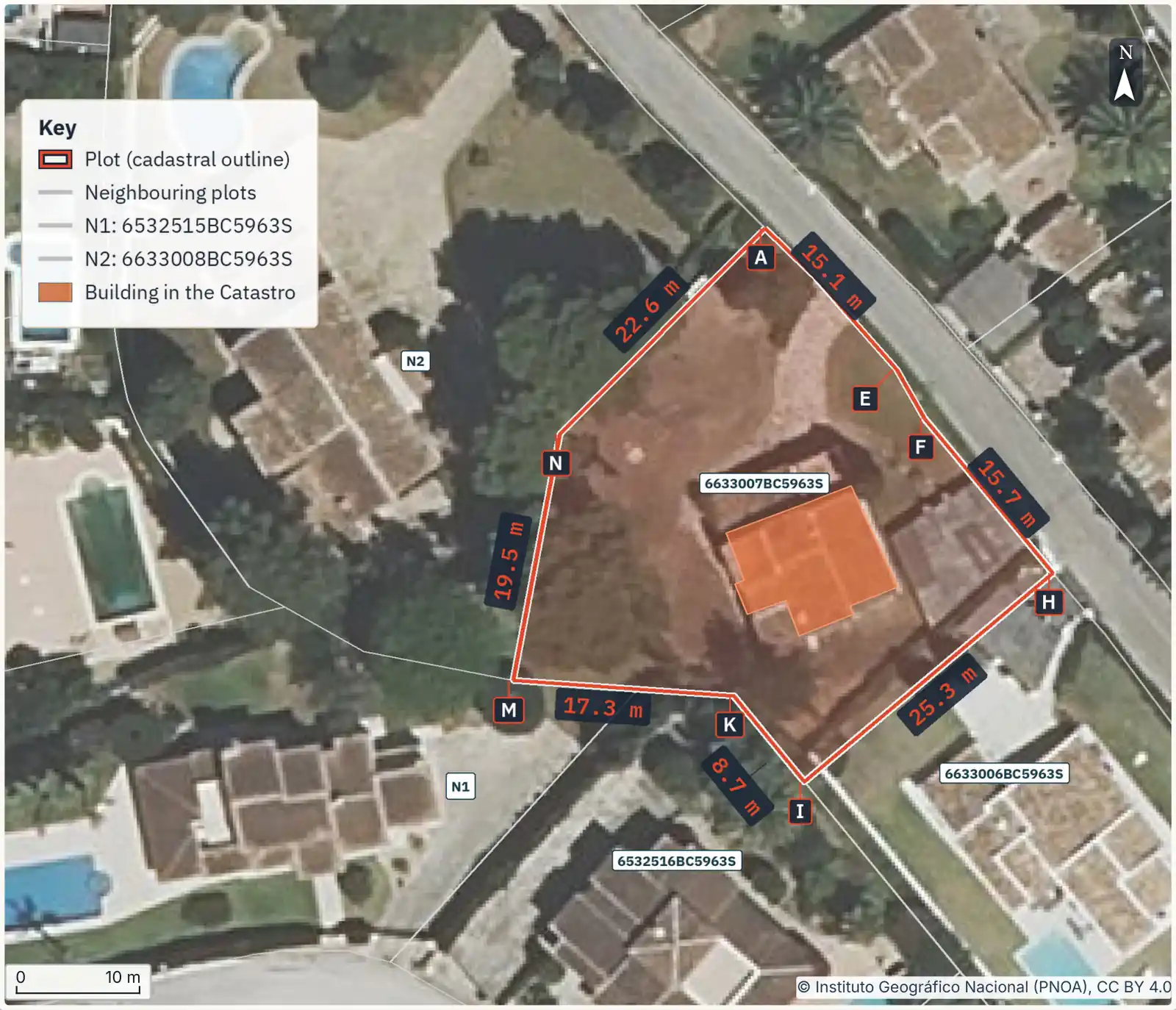
Have a specific plot in mind? The report gathers the public data and official maps for it, with source and date, for €29 VAT included. Pin it on the map →
Before you pay a reservation fee or a deposit (arras), find out who can transfer what you are buying and whether the purchase can be registered. The relative showing you around may have inherited a share, not the whole house. This page explains how to match the inheritance documents to the owners and their shares, which tax files to ask for on the inheritance and on the sale, and what to write into the contract if something is missing.
How to find out who owns the house
Keys and paid bills give no authority to sell. Your lawyer should trace ownership from the deceased to the people selling. Accepting an inheritance can be express or implied from acts that show the will to accept (Civil Code, article 999); acceptance does not always need a deed, but registration has its own requirements.
Partition (partición) divides the estate and allocation (adjudicación) assigns particular assets or shares. Adult heirs who manage their own affairs may divide the estate as they agree when the testator did not (article 1058). A valid partition gives each heir exclusive ownership of what they received (article 1068). If one heir received the whole house, the others need not sign the sale just because they were heirs. If it was allocated in shares, there are several owners.
If an heir died without accepting or rejecting, that right passes to their own heirs (article 1006). That branch of the family cannot be left out. This page follows Spain’s general Civil Code; regional civil law or a foreign law may govern the estate.
Sources: BOE, Civil Code, articles 999 and 1006; BOE, Civil Code, articles 1068, 1320 and 1346. Accessed 30 October 2026.
| What you are shown | What it means | What it does not prove | First step |
|---|---|---|---|
| Keys and paid bills | Someone looks after the house. | Authority to sell it. | Trace ownership from the deceased to the sellers. |
| The will | Who the deceased named as heirs. | As a rule, who received this particular house. | Ask for the partition or allocation deed. |
| Last-wills certificate | Whether the deceased made a will and where it is. | Who owns the house now. | Use it to locate the will, then ask for an authorised copy. |
| Partition deed | How the estate was divided and who received the house. | That the tax was filed or that the Registry has been updated. | Compare it with a recent nota simple. |
| Nota simple | Owners, shares, usufruct and charges in the Registry today. | That every tax is paid; it is an information extract. | Order a fresh one before the deposit and before completion. |
| Tax return receipts | That a return was filed for those heirs. | That this property was included, or that nothing is still owed. | Check that the house appears in the file. |
Accepting the estate or paying the tax does not cancel other charges on the property. Sources: BOE, Civil Code, articles 999 and 1006; BOE, Land Registry Act, articles 28 and 254. Accessed 30 October 2026.
Whose signatures a sale of the whole house needs
In an ordinary sale, each owner transfers their part in person or through a valid representative. A majority cannot sell the share of an owner who disagrees. Take two siblings with half each: to buy the whole house, both sign. If the contract offers one sibling’s half, photos of the entire house do not enlarge what you acquire.
A usufruct (usufructo) is a right to enjoy property that belongs to someone else (Civil Code, article 467); bare ownership (nuda propiedad) is ownership subject to that right. A bare owner cannot alone give you full ownership. The usufructuary must take part, or it must be shown that the usufruct has ended, and it must be cancelled in the Registry.
Inherited assets are the heir’s separate property (article 1346), but disposing of the family home needs both spouses’ consent or a court’s authorisation (article 1320). If the surviving spouse had community property (gananciales), separate its winding-up from the inheritance: the whole house may not have belonged to the deceased. Parents need court authorisation to sell property owned by their minor children (article 166). Settle this before fixing the date of the deed.
If someone signs for heirs who live abroad
If a sibling says they will sign for relatives abroad, ask for the power of attorney before you pay. A general power to manage assets does not on its own authorise a sale. Ask the notary to check that the powers cover the sale and, where needed, the inheritance steps still outstanding. A promise that absent owners will agree later leaves a gap in your purchase.
Estates of a foreign deceased
For deaths on or after 17 August 2015, the EU Succession Regulation generally applies the law of the deceased’s habitual residence at death, with exceptions, and allows a choice of the law of nationality (Regulation 650/2012, articles 21, 22 and 83). The house being in Spain does not decide who inherits or who can sell.
A European Certificate of Succession takes effect in every Member State without any special procedure (article 69) and can show who the heirs are or what an administrator may do. It is optional and does not replace the tax evidence. Documents issued in a Member State under the Regulation need no legalisation or similar formality (article 74). Send foreign documents to the notary before agreeing the deposit date and ask which translations they need.
Source: BOE, EU Regulation 650/2012. Accessed 30 October 2026.
If the Registry still names the deceased
When the Registry still shows the deceased, the inheritance has to be proved and the chain of title kept. The inheritance deed and the sale deed can be signed one after the other and filed with the Registry together, but the missing documents and tax filings are still needed. If you do not know which Registry holds the deceased’s property, request a “nota de localización” in their name. A seller whose title is already registered is easier to check. If you need a mortgage, get the bank to accept this order before fixing the deadline.
There is no longer a general two-year wait to sell inherited property: former article 28 of the Land Registry Act was removed with effect from 3 September 2021. That does not rule out a particular family dispute. A property that was never registered is a different case, first registration (inmatriculación), with its own requirements; an IBI receipt or a Catastro entry does not replace a registrable title.
Source: BOE, Land Registry Act, articles 28 and 254. Accessed 30 October 2026.
The inheritance tax the sellers should prove
Inheritance and gift tax (Impuesto sobre Sucesiones y Donaciones, ISD) is paid by the heir and falls due on the death. Accepting later does not restart the clock. Under the state rule the return is filed within six months of the death (inheritance-tax Regulation, article 67), with an extension of the same length if requested within the first five months; late-payment interest runs during the extension (article 68). It is a tax deadline, not a deadline to sell.
Ask for the returns of the people who received this property, their filing and payment receipts, or proof of a nil liability, an exemption or an expired limitation period. Check that the house appears in the file. “The children owed nothing” does not prove a return was filed. Each region’s rules change the calculation: ask for the actual figure for this estate instead of assuming a national family exemption. How the house’s cadastral reference value feeds into that figure is explained in a separate guide.
Municipal land-value tax: one file for the inheritance, another for the sale
The plusvalía municipal (IIVTNU) taxes the increase in value of urban land. The inheritance and the later sale are separate events: on the inheritance the heir pays; on the sale, the seller (Local Finance Act, article 106). The inheritance receipt is not the receipt for your purchase. The declaration period for the inheritance is six months, extendable to one year on request; for the sale, thirty working days (article 110.2).
Land treated as rustic for IBI purposes is outside this tax (article 104.2). An advert describing a country house does not decide how the land is treated. If the seller is a non-resident individual, the buyer is the substitute taxpayer (article 106.2): get a calculation and agree a retention from the price. As the acquirer you must also notify the town hall of the transfer (article 110.6.b). Keep the receipt.
Source: BOE, Local Finance Act, articles 104, 106 and 110. Accessed 30 October 2026. Your own purchase costs are in the guide on the cost of buying a home.
What an undivided share (proindiviso) really gives you
Buying 50% does not on its own give you exclusive ownership of certain rooms, an orchard or a separate plot. A family sketch dividing the use does not create an independent property. No co-owner has to stay in the co-ownership and any of them can ask for division (Civil Code, article 404); if the asset cannot be divided and nobody agrees to take it with compensation, it is sold and the price shared. Do not count on a quick exit.
A co-owner can sell their share, but the others can use the retracto de comuneros and take your place on the same terms. The period is nine calendar days counted from the day after registration in the Land Registry and, if the sale is not registered, from when the co-owner learned of it (article 1524). It can start earlier if full knowledge of the completed sale and its terms, including the price, is proven. A rumour is not enough. A later registration does not restart that period. Do not assume an informal letter before the sale removes every risk.
| What you buy | Period | Who can step in | Basis |
|---|---|---|---|
| An allocated share (proindiviso) | Nine calendar days from the day after registration; earlier if full knowledge of the sale and its terms is proven. | The other co-owners (retracto de comuneros). | Civil Code, articles 1522 and 1524 |
| Rights in an undivided estate | One month from being informed of the sale. | The other co-heirs. | Civil Code, article 1067 |
| A share in Catalonia | One month from formal notice (pre-emption); three months for substitution if notice was missing or the terms differed. | The other co-owners. | Catalan Civil Code, article 552-4 |
| A rented home | Thirty calendar days from formal notice of the decision to sell, the price and terms. | The tenant, depending on the lease date and its terms. | Urban Tenancies Act, article 25 |
Your lawyer should establish which event starts each period in your case. Sources: BOE, Civil Code, articles 404, 1067 and 1524; BOE, Catalan Civil Code, article 552-4; BOE, Urban Tenancies Act, article 25. Accessed 30 October 2026.
Buying rights in an estate before it is divided is different again: it does not guarantee you will be allocated the advertised house, and the co-heirs can take your place within one month of being informed of the sale (article 1067). Ask whether you are buying an allocated share of the property or a right in an estate still awaiting division. In Catalonia, the co-owners’ pre-emption right lasts one month from formal notice; if notice was missing or the sale was on different terms, the right of substitution lasts three months (Catalan Civil Code, article 552-4).
Three hypothetical scenarios
These are invented examples to show the method, not real cases.
1. Three siblings, one lives in Germany
Imagine a house allocated in thirds to three siblings. Two agree and the third, who lives abroad, “will sign later”. Without that signature or a sufficient power checked by the notary, nobody can sell you the whole house. The deposit should depend on that power, with a deadline and a refund.
2. The widowed mother keeps the usufruct
Imagine the children inherited the bare ownership and their mother the usufruct. If only the children sign, you would buy a house that someone else may use for life. The mother must take part, or it must be shown that the usufruct has ended.
3. Half a house at a lower price
Imagine one sibling sells you their half and the other does not want to sell. You would be a co-owner without a physical part of your own, and the other sibling could use the retracto. If you want a house to live in, that purchase does not serve you.
When to hold the deposit
Also find out who lives in the house and on what basis. Ask for any tenancy agreements and have your lawyer check, from the lease date, whether the tenant can buy ahead of you (Urban Tenancies Act, article 25). Even if every owner signs, the house may still be occupied.
What to write into the arras contract
What happens to a deposit depends on what was agreed. With arras penitenciales, agreed expressly, the buyer can withdraw by losing the deposit and the seller by returning double (Civil Code, article 1454). Agree separate refund conditions for unfinished inheritance steps. The contract should name the registered property, the right you are buying and who can bind the sellers, and list the evidence still due. If a partition, an authorisation or registration is pending, fix a deadline and a full refund if it is not met, including money paid to the agency. More in the guide to the arras contract.
The buyer’s sequence before the deposit
- Order a fresh nota simple and compare owners, shares, usufruct and charges with what you are offered.
- Ask for the death certificate, the last-wills certificate, a copy of the will or the declaration of heirs, and the partition deed.
- Identify every owner, usufructuary and representative, and who will sign in person.
- Ask for the powers of anyone signing for others and send them to the notary.
- Ask for the inheritance-tax and municipal-tax receipts for the inheritance and check that the property appears.
- If a seller is non-resident, work out the 3% withholding and the land-value tax on the sale.
- Find out who occupies the house and on what basis.
- Agree in the arras contract what must be delivered, by when, and the refund if it fails.
Questions to send before money moves
- Who are the registered owners today, and with what shares?
- Was the estate accepted and divided? Can I see the deed?
- Is there a usufruct, and who holds it?
- Will any seller sign under a power of attorney? Can I send it to the notary?
- Is it the family home of a married seller?
- Were the inheritance tax and the municipal tax on the inheritance filed? Does this property appear?
- Is any seller a non-resident for Spanish tax?
- Who lives in the house, and under what contract?
- What happens to my payment if a signature is missing on the agreed date?
With an inherited house, you buy what the people signing can transfer. Keep the nota simple, the partition deed and the tax receipts together, and let your lawyer and the notary confirm that they fit.
Common questions
Is being named in the will enough to sell the house?
No. The seller’s right and how this property was allocated must be shown. An heir is not necessarily the sole owner of the advertised house, and your purchase needs the title and tax evidence to be registered.
Can the inheritance and sale deeds be signed on the same day?
The notary can assess it once the file is complete. The inheritance, tax and registry requirements still apply. Do not treat the date as certain while owners, documents or authorisations are missing.
Can the house be sold if one sibling disagrees?
An ordinary sale of the whole house cannot transfer that sibling’s share without them or their representative. Selling the other shares or asking for division are different transactions.
Does the seller’s unpaid inheritance tax become mine?
The heir remains liable. The property being bound to the tax and the buyer’s registry protection are separate questions. A contract putting everything on the seller does not settle the legal position; have your lawyer review it.
Does a percentage let me occupy a particular part?
A share does not assign a space of your own. A use agreement needs separate review and does not create a separate property. If you want a house for yourself alone, buy a title that allows it.
Does the TerrenoCheck report say whether a plot is inherited?
No. The report draws the plot from the Catastro and helps you check it is the one in the documents. It does not review wills, partitions, powers or taxes.
Keep reading
Check this on your own plot
Pin the plot on the map and confirm the cadastral reference: the report gathers the public data and official maps for it, each with its source and date. It does not replace the land registry extract, the notary or a tax adviser. €29 VAT included.