Pillar: Documents and contract
Can I buy a Spanish property with a mortgage or other charges?

On this page
Check the registered charges and the debts that can affect the property without an entry. Before paying a deposit, agree who gets paid, what releases each charge and who finishes registration.
Have a specific plot in mind? The report gathers the public data and official maps for it, with source and date, for €29 VAT included. Pin it on the map →
You can buy a Spanish property that carries a mortgage, but paying the seller does not remove the mortgage or an attachment. Before you pay a deposit (arras), agree which charges are cancelled, with what money and by what document, and which ones you accept. The notary authorises the deed; the registrar records the cancellation. Check the IBI and community debts too: they can affect the property without appearing on the nota simple.
What it means when a property has charges
A mortgage secures a debt on the property even after it changes hands. An attachment (embargo) comes from a debt-recovery procedure. A noted claim warns that ownership or a property right is in dispute (Mortgage Law, article 42). Each is dealt with differently.
Start with the nota simple for every registry plot: plot, owner, right affected and creditor. The nota is for information only (Mortgage Law, article 222.5) and shows no balances or unpaid bills. To prove to a third party that the property is free of charges you need a Registry certificate, not a nota: see the difference between a nota simple, a certificate and a simple copy. Before signing, ask the notary about documents filed and still pending too: while a filing entry lasts, no conflicting title can be registered for sixty days (article 17).
| Entry on the nota | What it means | What it does not prove | First step |
|---|---|---|---|
| Mortgage with a registered amount | Principal and interest, or the maximum liability, secured on the plot (article 12). | The loan balance today. | Bank statement of the amount to pay on the signing date. |
| Mortgage over several plots | Each plot answers for its set share of the debt (article 119). | That paying part of the loan frees your plot. | Document from the bank naming the plot to be released. |
| Attachment (anotación de embargo) | A court or authority has attached the property in a debt case. | The current debt, interest or costs. | Case number, creditor, updated amount and the cancellation order. |
| Note of charges certificate (enforcement) | A mortgage enforcement has started. | That it can be cancelled by an ordinary deed while the note stands. | Your lawyer reads the case before any payment. |
| Tax note (afección fiscal) | Possible extra assessment of an earlier transfer tax. | That a tax is owed. | Earlier deed, self-assessment and receipt. |
The nota simple is for information only and does not certify the entries. Sources: BOE, Mortgage Law, article 12; BOE, Mortgage Law, article 119; BOE, Mortgage Law, article 222.5; BOE, ITP/AJD Regulations, article 122. Accessed 30 October 2026.
Paying off the mortgage does not cancel it
Paying the loan settles the debt; cancelling the registration removes the entry. On the ordinary route, a mortgage created by deed is cancelled by another deed in which the creditor consents, or by a final judgment (Mortgage Law, article 82). The zero-debt certificate does not replace that deed.
According to the Banco de España, the bank must issue the zero-debt certificate free of charge and may not charge for signing or for going to the notary. If you ask the bank to handle the steps, it may charge for that, telling you in advance. Source: Banco de España, registry cancellation. Accessed 30 October 2026.
If one mortgage covers several plots and you buy one, each plot answers for the share assigned to it (Mortgage Law, article 119). Insist that the papers name the plot to be released.
Taking over the loan is a different deal. To replace the borrower and release the seller, the creditor must consent (Mortgage Law, article 118; Civil Code, article 1205). Do not simply pay the instalments into the seller’s account. If instead you finance the purchase with a mortgage on rustic land, see how the bank values it in the guide to mortgages and valuation on rustic land. Sources: BOE, Mortgage Law, article 118; BOE, Civil Code, article 1205. Accessed 30 October 2026.
How it is paid and cancelled at signing
Prepare a payment schedule with your lawyer and the notary before fixing the appointment. If the mortgage is cleared from the price, agree that the amount needed goes straight to the bank, on verified instructions. The seller receives the rest after the agreed payments and holdbacks. Do not hand over everything trusting the seller to pay later.
The payoff figure must match the payment date: if the date moves, have it checked again. If the price does not cover what is needed, the seller must add the difference or reach a sufficient agreement with the bank.
A holdback (retención) is money from the price kept for an agreed purpose. Spell out who holds it, whom it may pay, which receipts release it and what happens to any surplus or shortfall. Holding money back does not cancel the charge.
Buying a property under attachment
A voluntary sale does not remove the entry: attached property may be sold, but without prejudice to the right of the person who obtained the entry (Mortgage Law, article 71). Taking the nota’s figure off the price does not free the property.
Find out who ordered the attachment, the case number, the creditor and the updated amount with interest and costs. An entry ordered by a court is only cancelled by a court order (Mortgage Law, article 83); in the administrative route, by an order from the competent body. Neither a private receipt nor a statement from the seller replaces that document.
Other charges that need another kind of check
A claim over ownership means studying the lawsuit; holding money back may not protect you. With a ban on disposal, find out whether you can buy and what permission or cancellation is needed.
Some rights may stay. A usufruct is the right to enjoy someone else’s property; an easement is a burden on one plot for the benefit of another (Civil Code, articles 467 and 530). Ask for the title: who may use the property, where and until when.
On plots and developments, the new owner steps into the previous owner’s planning duties (Land Law, article 27.1). Where a reparcelling (reparcelación) charges the plot with development costs, the plot answers for the balance of the final account; the amount registered belongs to the provisional account (Royal Decree 1093/1997, article 19). Ask the town hall and the development body for any unpaid contributions. Sources: BOE, Land Law, article 27; BOE, Royal Decree 1093/1997, article 19. Accessed 30 October 2026.
A tax note does not prove unpaid tax
The usual ITP/AJD marginal note warns of a possible extra assessment, even when the self-assessment was filed and paid, and states the amount already paid. It is cancelled when proof of payment of that assessment is filed and, in any case, five years after it was entered (ITP/AJD Regulations, article 122).
Do not ignore it: when the liability is expressly recorded in the Registry, the buyer is not protected as a good-faith third party (ITP/AJD Law, article 5.1). Ask for the earlier deed, the self-assessment and the receipt. And do not confuse the note lapsing with the tax limitation period, which the General Tax Law sets at four years with its own rules on start and interruption (article 66). Sources: BOE, ITP/AJD Regulations, article 122; BOE, ITP/AJD Law, article 5; BOE, General Tax Law, article 66. Accessed 30 October 2026.
IBI debts
When ownership changes, the property stays liable for the whole IBI (annual property tax) due, as secondary liability (Local Finance Law, article 64.1). The buyer answers with the property if the debt is not paid, once the tax claim is passed on (General Tax Law, article 79.1). The notary must request the information and warn about unpaid tax in the deed. A recent paid receipt does not prove that earlier years are clear.
The tax authority also ranks ahead of any buyer to collect the IBI for the year payment is demanded and the year before (General Tax Law, article 78). That is a separate rule from the liability and does not limit it to two years. Ask the town hall or the collecting body for the property’s debt information. Sources: BOE, Local Finance Law, article 64; BOE, General Tax Law, articles 78 and 79. Accessed 30 October 2026.
Community debts and levies
| Where | What the flat answers for | Certificate | Watch for |
|---|---|---|---|
| Horizontal Property Law (most regions) | The year of purchase already due and the three calendar years before, even with the buyer’s title registered. | Seller declares being up to date and provides a certificate from the secretary, approved by the president, within at most seven calendar days of the request; the buyer may waive it. | Improvement levies fall on whoever owns the flat when they become payable (article 17.11). |
| Catalonia (Civil Code, article 553-5) | The year to date and the four years before, ordinary and extraordinary costs and reserve fund. | The certificate must also show costs approved but not yet due; the deed cannot be signed without it unless the parties expressly waive it. | Do not carry over the seven-day rule from the national law. |
Waiving the certificate does not remove the legal liability. Sources: BOE, Horizontal Property Law, article 9.1.e; BOE, Horizontal Property Law, article 17.11; BOE, Catalan Civil Code, article 553-5. Accessed 30 October 2026.
Read the minutes and the schedule of future contributions: a certificate with no overdue debt can sit alongside approved works still to be charged. If the house is on a private estate, find out whether it belongs to a horizontal-property community or another kind of body. For the total budget, see the guide to buying costs.
What the TerrenoCheck report shows
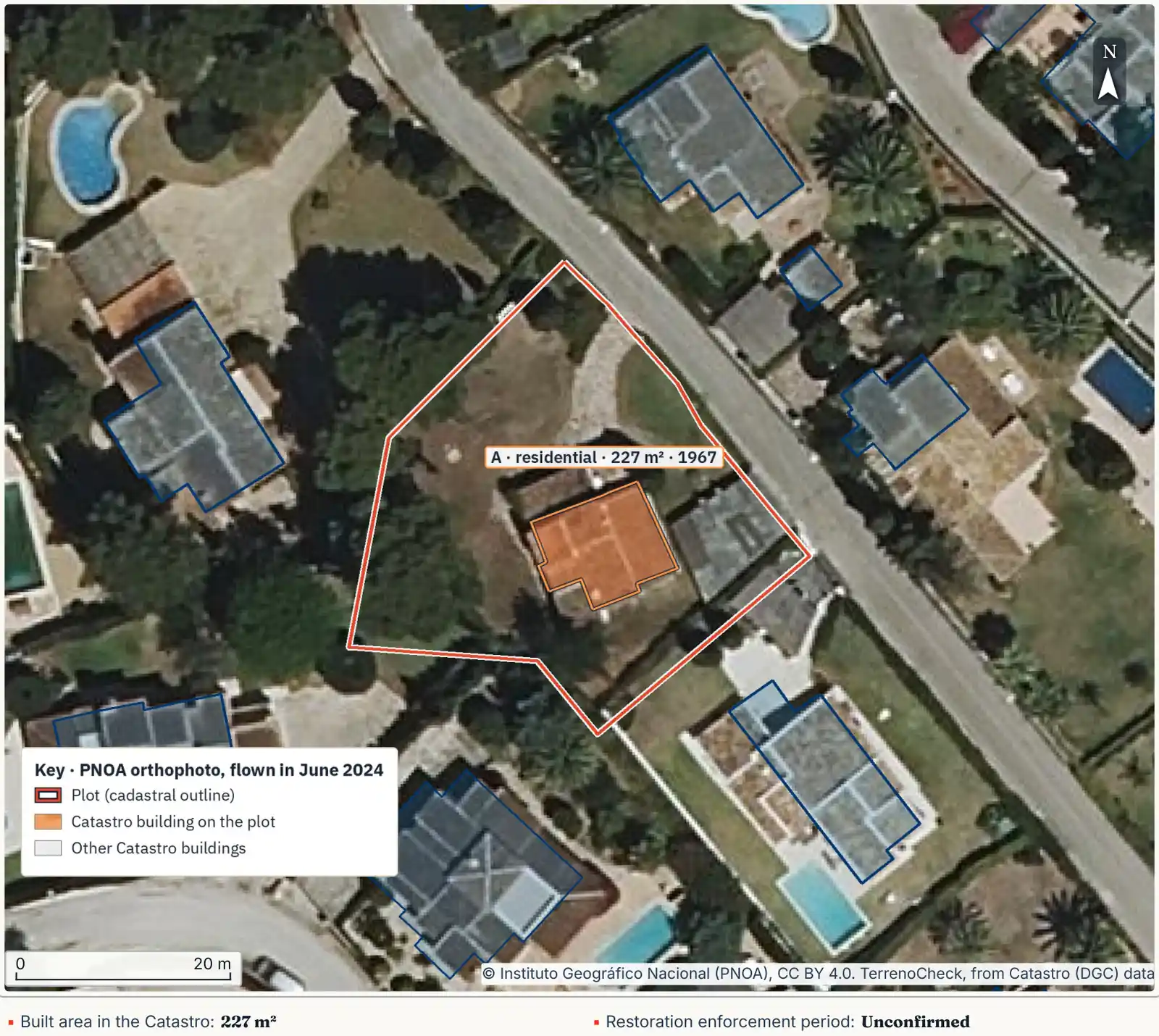
The report identifies the cadastral parcels and buildings of what you are being sold, so you know which plots need a nota simple and certificates. It does not read the Registry: it does not certify a property free of charges, loan balances or cancellations.
Three hypothetical scenarios
These are invented examples to show the method, not real properties.
1. The price does not cover the mortgage
Imagine an agreed price below the payoff the bank asks for. The seller promises to “negotiate later”. Without enough money or the bank’s agreement to release the property, the mortgage will still be registered after you buy. Do not sign the arras without that agreement in writing.
2. An attachment from five years ago
The nota shows an attachment noted five years ago. It looks lapsed, but it may have been extended by a later note, and even if the entry lapsed the case may continue. Your lawyer must check extensions and status before you pay.
3. A flat with a levy just approved
The community certificate shows no overdue debt, but last month’s minutes approved a levy for the façade to be collected in spring. Under the Horizontal Property Law, an improvement levy is paid by whoever owns the flat when it falls due. Agree who pays before the deposit.
When to hold the deposit
What to write into the arras contract
Attach to the contract the entries to be cancelled, the rights that stay and the documents still to come. Name the direct payments to creditors, the holdbacks and who covers costs and any shortfall. Set one date to show how cancellation will work and another to finish the steps. Your lawyer should write what happens if the court order is missing, the bank does not consent or new charges appear: postponement, a condition or refund of what you paid. A refund does not follow automatically from finding a charge.
Contracts only bind those who sign them (Civil Code, article 1257): the seller taking on a debt towards you does not stop the creditor enforcing its right over the property. More in the guide to the arras contract. Source: BOE, Civil Code, article 1257. Accessed 30 October 2026.
The buyer’s order of steps before the deposit
- Order a recent nota simple for each plot and the title of any unclear charge.
- Ask the bank for the balance on the signing date, or the zero-debt certificate if already paid.
- For an attachment, gather the case, creditor, updated amount and cancellation route.
- Ask the town hall or collecting body for the property’s IBI debt information.
- Ask for the community certificate, the minutes and the schedule of levies.
- Prepare the payment and holdback schedule with your lawyer and the notary.
- Sign the arras only with the cancellations, the deadline and the refund in writing.
- After completion, check on a new nota that the agreed charges are gone.
Before authorising the purchase, the notary checks ownership and charges (Notarial Regulations, article 175). To defend your terms before the deposit, have your own lawyer. Source: BOE, Notarial Regulations, article 175. Accessed 30 October 2026.
Questions to send before you pay
- Which charges does each plot carry, and which will be cancelled before or at signing?
- What is the mortgage balance on the planned date, and who certifies it?
- Are there attachments, claims or bans? What stage is each case at?
- Is the IBI paid for every year, and are the community fees paid?
- Are any levies approved or planned?
- Are any planning duties or contributions unpaid?
- Who pays for cancelling each charge, and who follows it through to registration?
- What happens to the deposit if a cancellation document is missing on the agreed date?
The purchase is finished when your ownership is registered and the agreed charges are gone from a new nota, not when you sign. Keep the receipts and check.
Common questions
Can I buy a mortgaged home and have it freed of that mortgage?
Yes, by coordinating payment and cancellation: enough money, a deed in which the creditor consents and registration (Mortgage Law, article 82). Taking the seller’s stated debt off the price is not enough.
Does the notary cancel an attachment when the sale is signed?
Not by authorising the sale. A court entry is cancelled by a court order (Mortgage Law, article 83) and an administrative one by an order from the competent body. If the entry has lapsed, the owner can apply to record that (article 86).
Does a five-year tax note show unpaid tax?
No. The usual ITP note warns of a possible extra assessment and states what was already paid. Ask for the receipts from the earlier transfer; while the note stands, registry good faith does not protect you against it.
Does waiving the community certificate avoid earlier debts?
No. Waiving lets you sign without the document, but the flat still answers within the legal period: the current year and three before under the Horizontal Property Law, four in Catalonia.
Is the last paid IBI receipt enough?
No. Ask the town hall or collecting body for the property’s debt information. A receipt proves its own payment; it does not rule out other years.
Keep reading
Check this on your own plot
Pin the plot on the map and confirm the cadastral reference: the report gathers the public data and official maps for it, each with its source and date. It does not replace the land registry extract, the notary or a tax adviser. €29 VAT included.