Pillar: Documents and contract
What does a foreign buyer need to buy a home in Spain?

On this page
Arrange your tax identification and payment route before committing a deposit. Have any power of attorney checked in Spain. Once you own the house, an annual tax return may be due even without rental income.
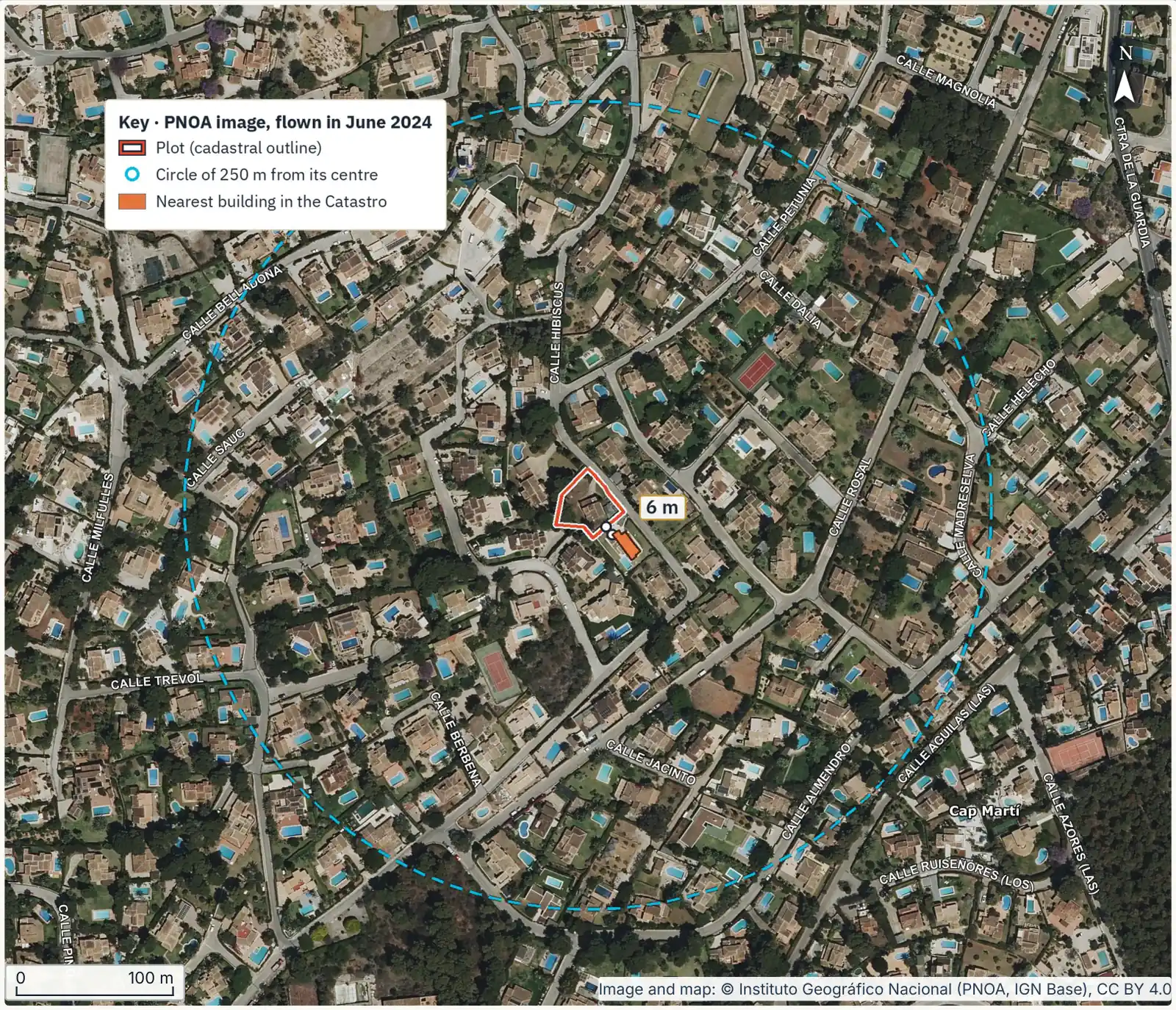
Have a specific plot in mind? The report gathers the public data and official maps for it, with source and date, for €29 VAT included. Pin it on the map →
Prepare an NIE for each buyer, the documents that explain where the money comes from and a record of every payment towards the price. A Spanish bank account is not a general legal requirement for buying. If someone signs for you, have the notary check their power first. And after completion, a house you keep for holidays can require a non-resident tax return even if it earns nothing.
What to organise before you pay a deposit
Before you pay a reservation fee or a deposit (arras), ask your lawyer to check whether each buyer can get an NIE and move the funds before the proposed signing date. If someone will sign for you, have that power checked too. Do this alongside the property checks and before accepting the seller’s deadline. A delay with the number or the transfer does not automatically entitle you to your deposit back.
The property checks are in the pre-purchase checklist.
The NIE: a tax number, not a residence permit
The NIE (número de identidad de extranjero) is the personal number given to a foreigner dealing with Spain. It is unique: if you have one from an earlier deal, tell your adviser. For a foreigner, the NIE is also their tax identification number (tax management Regulation, article 20). It gives no right to reside, and the certificate does not replace your passport or another photo ID.
Tell the notary your marital status and marital property regime even if you buy alone, and send any marriage agreement (Notarial Regulation, article 159). Who puts up the money does not on its own decide the shares to be registered. Each buyer needs their own number: your spouse’s NIE does not identify your part.
How to apply for the NIE and what it costs
In Spain you apply at the police or an immigration office (Extranjería); from abroad, at the Spanish consulate for where you live. The police procedure uses form EX-15 and fee form 790, code 012. You need your full valid passport or identity document, original and copy, the signed application and an explanation of the economic or other reason for applying. Applicants must not be in Spain irregularly.
The police fee for assigning an NIE on request is €9.84. That is not an agent’s price or what the consulate charges: ask there, and get a written quote if someone handles it for you. The fee can be paid at the listed banks without opening an account with them.
The published period to decide and notify is five working days from the application entering the competent office’s register. It does not include getting an appointment or collecting the result. If a representative applies for you, they need express authority to request the NIE; a power meant only for buying may not be enough.
Sources: National Police, NIE assignment; National Police, immigration fees. Accessed 30 October 2026.
Areas restricted to foreign buyers
If you are not an EU national, ask your lawyer to check whether the property lies in an area where foreign ownership is restricted. There, the purchase needs military authorisation (Law 8/1975, article 18). Individuals who are nationals of an EU Member State are exempt (additional provision). Which areas are covered, how to apply and how long it takes are set out in the guide to military authorisation in restricted zones.
If the purchase falls under that regime, also require proof of registration. The deed must be registered within eighteen months, extended to twenty-four if the tax assessment or another formality prevents it through no fault of the buyer; otherwise it is void (article 21). Your lawyer should track the deadline.
Source: BOE, Law 8/1975, articles 18 and 21. Accessed 30 October 2026.
Banks: you do not need a Spanish account
The rules on identifying purchase payments do not require a Spanish account. You can pay from abroad if the route is documented and the method agreed. For euro transfers and direct debits within the EU, a payer cannot be required to hold the account in a particular Member State (Regulation 260/2012, article 9). That says nothing about accounts outside the EU or every bank-cheque service.
Explain the source of funds to the bank with documents: the sale of a house, an inheritance or savings, and statements linking that source to the purchase money. Banks must carry out due-diligence checks and do not execute transactions when they cannot complete them (Law 10/2010, article 7.3). An open account does not confirm that your payment will go out: ask what is still missing and when you can pay, and get the charges in writing.
Sources: BOE, Regulation (EU) 260/2012, article 9; BOE, Law 10/2010, article 7. Accessed 30 October 2026.
What the deed must say about the money
The public deed (escritura) records payments made earlier and money handed over at signing (Notaries Act, article 24). A reservation fee or deposit credited to the price belongs in that record. Keep any agency fee separate from money paid on account of the house.
Give the notary a schedule that reconciles the price with each payment: date, amount, recipient and method, with the evidence. For transfers, the ordering party and the beneficiary, the sending and receiving banks and the debit and credit accounts. If the account codes are not available, the Notarial Regulation (article 177) treats a transfer as identified when the ordering party, beneficiary, date, amount and both banks appear. If you pay by bank cheque (cheque bancario), agree the payee’s exact details first.
If the payments are not identified, the deed cannot be registered even after signing (Land Registry Act, article 254). A line saying the seller has already received the money does not replace that identification. If new bank details arrive by email, confirm them through a known contact before paying.
Sources: BOE, Notaries Act, article 24; BOE, Notarial Regulation, articles 150, 159 and 177; BOE, Land Registry Act, article 254. Accessed 30 October 2026.
Signing through a power of attorney while you stay abroad
A notarial power of attorney (poder notarial) lets your representative act within its terms. Have the Spanish purchase notary review the wording before you sign it. A private letter to collect papers will not do for signing the deed. You can grant it before a Spanish notary or ask whether a Spanish consul acts as notary. If you sign it before a foreign notary, the Spanish notary will check its form, its scope and whether the foreign official performed a function equivalent to theirs; ask about the apostille and translation too.
Set limits that match your instructions: the property, the maximum price, the payments, signing and taxes. Add applying for the NIE or dealing with the bank if needed. A mandate can be revoked (Civil Code, article 1733); ask how to formalise it and tell those concerned. If you sign in person and do not understand the language well, ask for the notary’s oral translation or an interpreter (Notarial Regulation, article 150). The three ways to grant it without travelling, video call included, are compared in the guide to buying from abroad with a power of attorney.
A holiday home is taxed even when not let
Start with your tax residence. Owning a house, an NIE or an account does not decide it. You are resident if you spend more than 183 days of the calendar year in Spain or have your main centre of economic interests here, with a family presumption that can be rebutted (Income Tax Act, article 9). If two countries treat you as resident, the tax treaty decides.
If you stay non-resident, an urban home kept available to you or left empty produces imputed income: you pay non-resident income tax (IRNR) on a calculated amount even though no tenant pays you. Modelo 210 is the self-assessment form. IBI is a separate, local tax; paying it by direct debit does not file your return.
The base is the cadastral value on the IBI bill, not the purchase price or the reference value. For 2026 the general percentage is 2%, and 1.1% applies where the municipality has had a general collective valuation in force since 1 January 2012 (Income Tax Act, article 85 and additional provision fifty-five). The extension to 2026 comes from Royal Decree-law 29/2026 of 6 October, which Congress still has to ratify; the earlier decree-laws with this content were rejected. Ask your adviser to confirm it before filing. If on 31 December the property has no cadastral value or it has not been notified to you, 1.1% applies to 50% of the higher of the purchase price and the value checked by the tax authorities.
It is adjusted for the days you owned it and it was available, not just the days you visited, and for your share. No income is imputed on undeveloped land or on a home under construction or unusable for planning reasons; merely planning to renovate is not enough. On that base, 19% applies to residents of the EU and of EEA states with tax information exchange, and 24% to everyone else (Non-Resident Income Tax Act, article 25.1). What counts is tax residence, not your passport.
For a rural house, ask for a written opinion rather than accepting that “rustic means no tax”. Article 85 covers rural buildings that are not indispensable to farming, livestock or forestry. A usufruct also changes who files.
When modelo 210 is due and who files it
Imputed income accrues on 31 December. Income for 2026 is filed and paid between 1 April and 31 December 2027, and direct debit closes on 23 December 2027 (Order HAC/623/2026). The income year and the filing year are different. If you let the house for part of the year, rental income has its own calendar.
Expressly instruct someone to prepare the first return, or plan to file it yourself. The lawyer who handled the purchase is not engaged for future returns just because of that. A non-resident does not always need a tax representative, but does if they live in a country without effective tax information exchange and own property in Spain, and in other cases set by law (Non-Resident Income Tax Act, article 10). These are state rules; in the Basque Country and Navarre check which tax authority applies. Purchase taxes are in the guide on the cost of buying a home.
Sources: BOE, Order HAC/623/2026; BOE, Non-Resident Income Tax Act, articles 10 and 25; BOE, Income Tax Act, article 9. Accessed 30 October 2026.
| What you have | What it means | What it does not prove | First step |
|---|---|---|---|
| NIE certificate | You have a Spanish identification and tax number. | Permission to live in Spain, or your identity without a passport. | Bring your passport to every signing. |
| Open Spanish account | The bank accepted you as a customer. | That your payment will go through: the bank can still ask for documents. | Ask in writing when the payment can be made. |
| Transfer screenshot saying “sent” | An order was given. | That the payment is identified as the deed requires. | Get the bank’s statement with both banks and accounts. |
| Power signed abroad | Someone may act for you within its terms. | That a Spanish notary will accept its form and scope. | Send the draft to the Spanish notary first. |
| IBI direct debit | The local property tax is paid. | That your non-resident return (modelo 210) is filed. | Instruct someone to file it, or file it yourself. |
Each paper settles one thing; none covers the others. Sources: National Police, NIE assignment; BOE, Law 10/2010, article 7; BOE, Notaries Act, article 24. Accessed 30 October 2026.
Three hypothetical scenarios
These are invented examples to show the method, not real cases.
1. A British couple buying with one NIE
Imagine only one partner has an NIE and the deed is in three weeks. The other needs their own to appear as a buyer. If it does not arrive, the date moves or the buyer changes, and the arras contract should provide for that.
2. A power signed before a notary in the United States
Imagine the buyer signed a power at home and sends it with an apostille the day before completion. If the Spanish notary did not see it first, they may not accept it. Send the draft weeks ahead and ask about translation.
3. A house empty all year
Imagine you buy in July and do not let the house. In 2027 you must declare imputed income for the days of 2026 you owned it, even if you never set foot there. Paying IBI by direct debit does not cover it.
When to hold the deposit
What to write into the arras contract
Ask your lawyer to negotiate in writing the deadline, any extension and the refund conditions if the NIE, the funds or the check of the power are late. Write down which payments count towards the price and how they are documented, who calculates and pays the withholding if the seller is non-resident and how much is held back from the price. A bank or NIE delay does not on its own guarantee your deposit back. More in the guide to the arras contract.
The buyer’s sequence before the deposit
- Check that each buyer has an NIE or can get one before the date, and book the appointment.
- Tell the notary your marital status and property regime.
- Gather the source-of-funds documents and confirm with the bank when you can pay.
- If someone signs for you, send the draft power to the Spanish notary.
- If you are not an EU national, check whether the property is in a restricted area.
- Find out whether the seller is tax resident and work out the withholding.
- Prepare the payment schedule for the deed.
- Agree the deadline, extension and refund in the arras contract.
Questions to send before money moves
- What signing date is realistic given my NIE appointment?
- Which source-of-funds documents does the bank want, and when can I pay?
- Does the notary accept my draft power? Which apostille and translation are needed?
- Is the seller non-resident for tax? Who calculates and pays the withholding?
- Is municipal land-value tax due, and who pays it?
- Is the property in an area restricted for foreign buyers?
- Which payments already made will appear in the deed?
- Who will file my first modelo 210, and for what fee?
- What happens to my deposit if the NIE or the transfer is late?
The NIE, the money and the power are three separate preparations, and each has its own timescale. Put them in the calendar before you accept the seller’s date.
Common questions
Does each joint buyer need their own NIE?
Yes. Prepare tax identification for each owner, including anyone buying through a power of attorney. Your spouse’s NIE does not identify your share.
Must the purchase money come from a Spanish bank?
There is no general requirement. Agree an identifiable payment route with the bank, the seller and the notary. A mortgage lender may set its own conditions: confirm them before the deposit.
Is a house used only for holidays subject to non-resident tax?
An urban home kept available to you produces imputed income for the days available, not just the days you visit. It depends on residence, your share and the dates. Paying IBI does not replace modelo 210.
Can a power made before a foreign notary be used in Spain?
Yes, if the form, the equivalence and the powers are sufficient. Send the draft to the Spanish notary first and confirm the apostille and translation. A mere signature witness does not settle it.
When do I declare imputed income after buying during 2026?
Between 1 April and 31 December 2027, adjusted for days and share. Direct debit closes on 23 December 2027. If you let the house, rental income has a different calendar.
Does the TerrenoCheck report apply for the NIE?
No. The report places the NIE in the purchase timeline, but it does not apply for it or check your identity, power of attorney or tax residence.
Keep reading
Check this on your own plot
Pin the plot on the map and confirm the cadastral reference: the report gathers the public data and official maps for it, each with its source and date. It does not replace the land registry extract, the notary or a tax adviser. €29 VAT included.